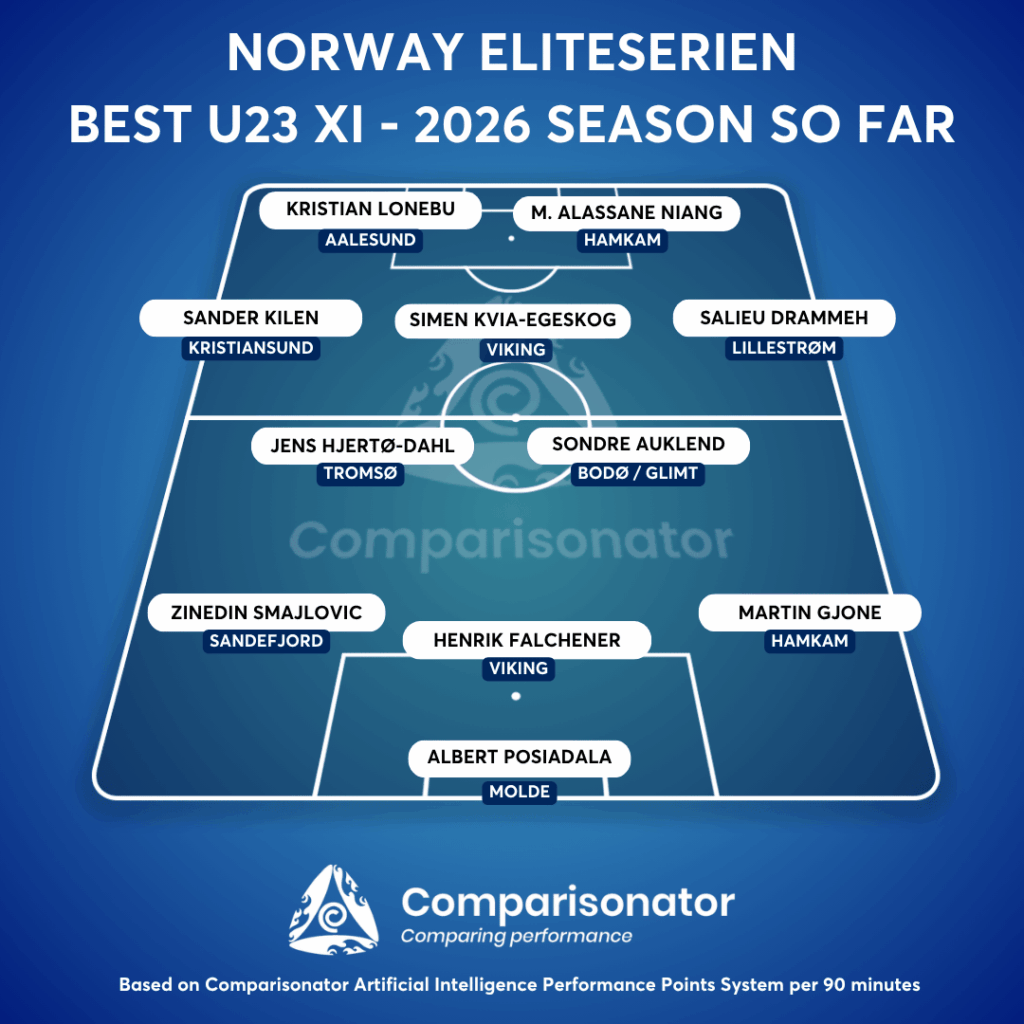

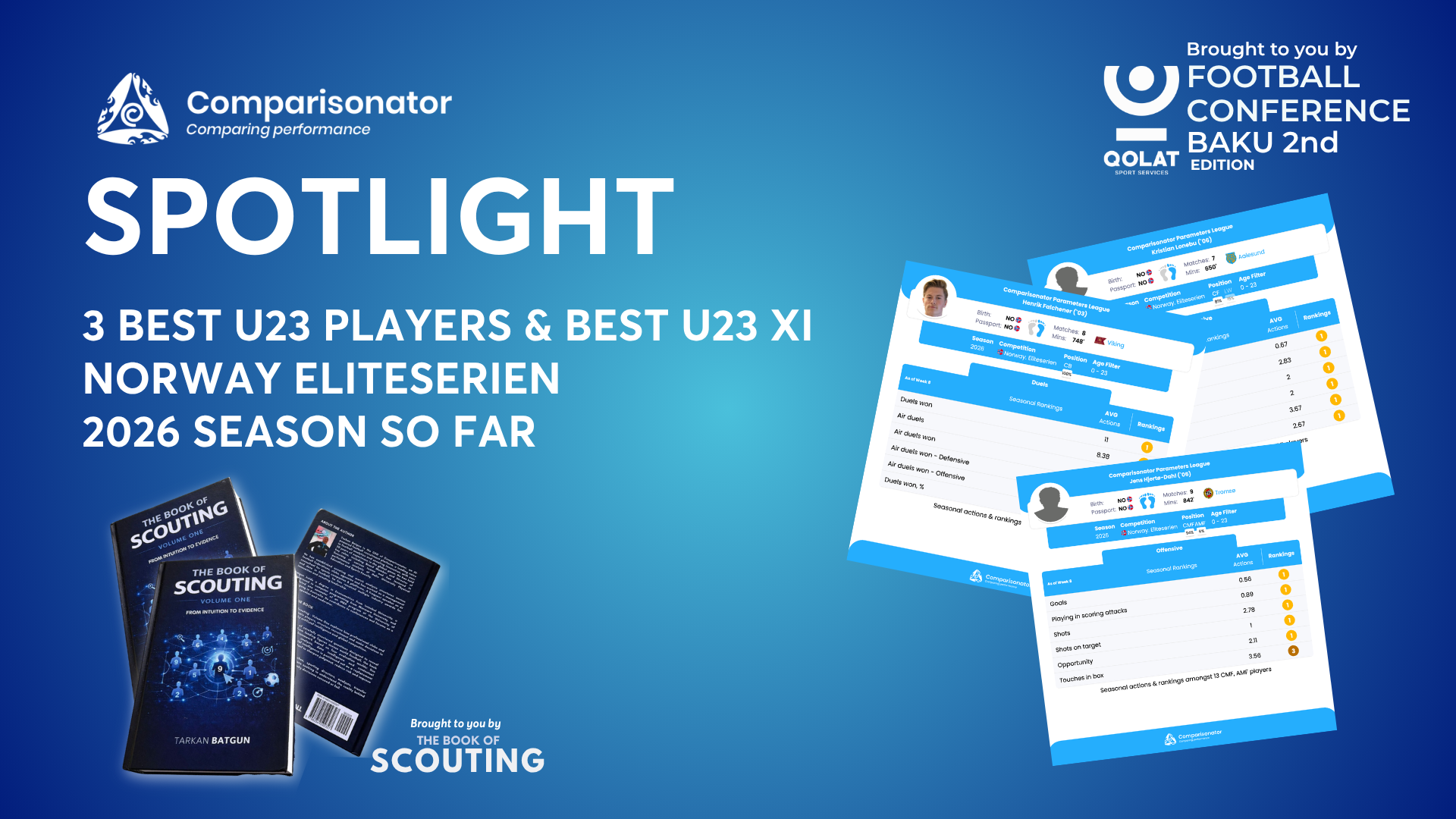
Norway Eliteserien has always been a breeding ground for talent, and the 2026 season is no exception. With rising stars making their mark, we have identified the top three players who have been standout performers.
Powered by CompaAI, the cutting-edge AI tool from Comparisonator, this analysis turns complex football data into clear, actionable insights. With its latest advancements, CompaAI transforms squad analysis, delivering an instant, comprehensive view of team performance. In seconds, it highlights standout players, identifies emerging young talents, and pinpoints key areas for improvement.
More than just analysis, CompaAI provides strategic guidance to optimize transfer strategies. By accurately detecting top potential signings, it enables clubs to reinforce key positions and scout future stars with precision. With CompaAI, raw data becomes powerful, data-driven intelligence, giving teams a competitive edge in the transfer market.
3 Best U23 Players in Norway Eliteserien
Henrik Falchener (‘03) (CB) – Viking
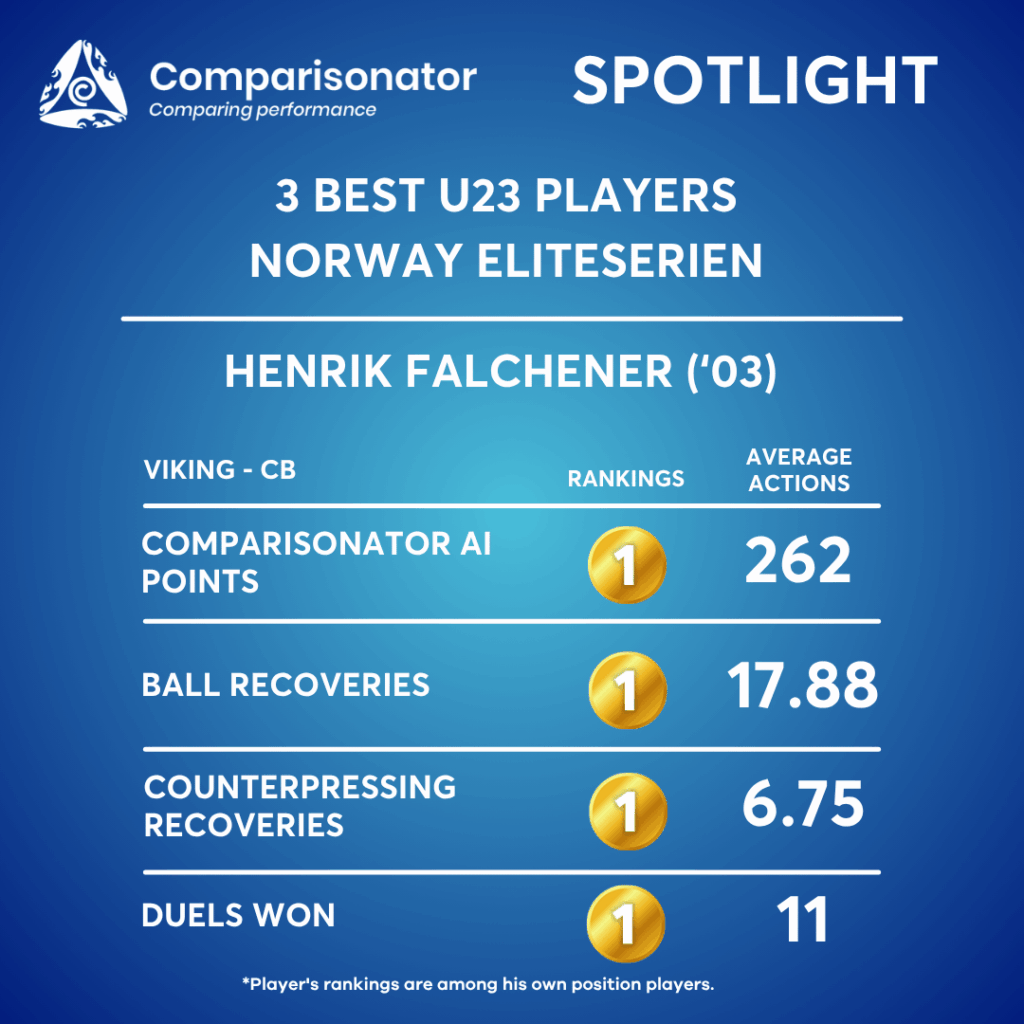
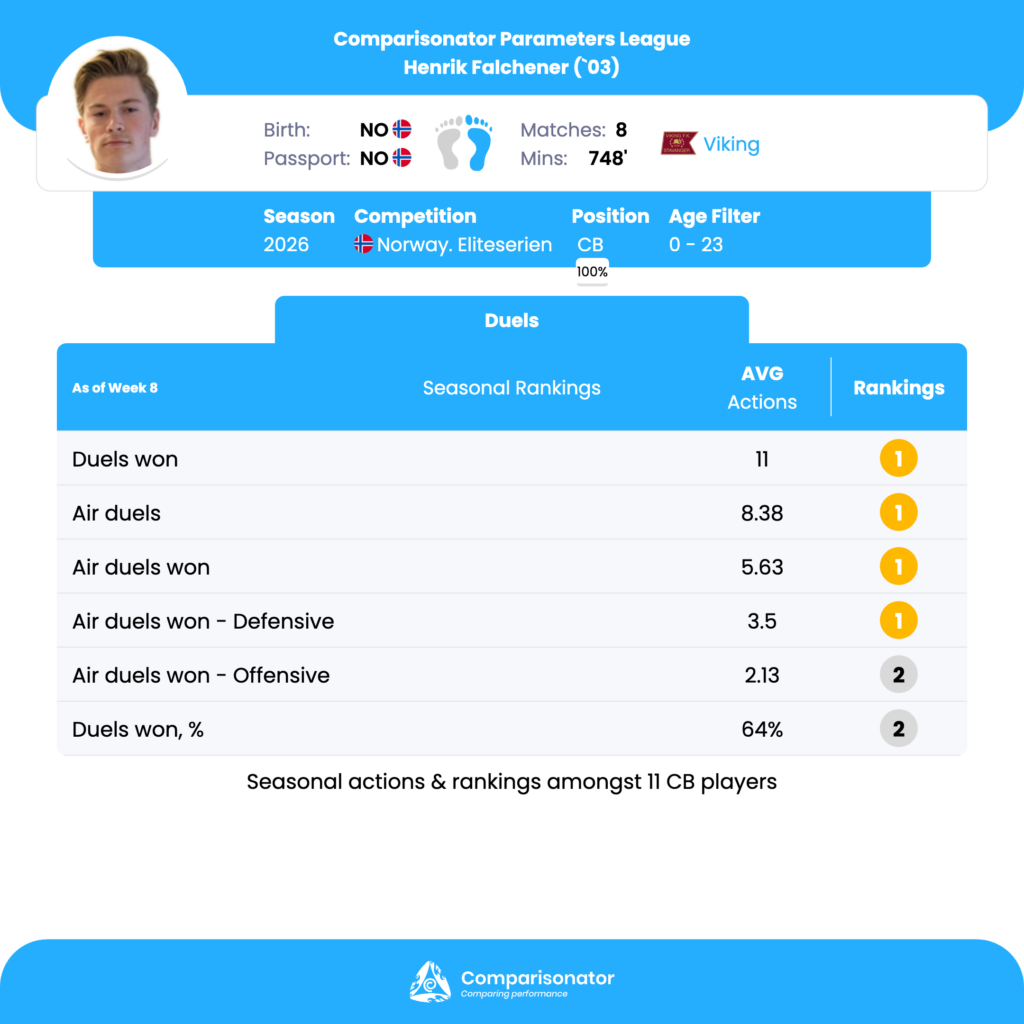
Henrik Falchener’s CompaAI Defensive report:
Falchener’s strongest area is his ability to win and recover the ball at a very high volume. He ranks 1st out of 11 CBs for ball recoveries with 17.88 per match, ahead of Zinedin Smajlović on 15.88. He also leads for ball recoveries in own half with 15.88 per match, again ahead of Smajlović on 13.13. This points to a defender who is highly active in protecting his own defensive territory, reacting quickly to loose balls and second phases, and helping his team regain possession deep. His counterpressing output is also elite. Falchener ranks 1st out of 11 for counterpressing recoveries with 6.75 per match, compared with Aleksander Hammer Kjelsen on 6.00. This indicates strong engagement immediately after possession loss, good anticipation, and a readiness to restore defensive structure quickly. For tactical use, this profile fits a side that wants its center-backs involved in aggressive defensive transitions and compact pressing behavior. Falchener also shows excellent overall defensive involvement and efficiency. He ranks 1st out of 11 for successful defensive actions with 42.00 per match, ahead of Smajlović on 40.88, and 1st out of 11 for successful defensive actions, % with 88.89%, just above Håkon Røsten on 87.92%. In addition, he is 2nd out of 11 for defensive actions with 47.25 per match, narrowly behind Smajlović on 47.38. This suggests a defender who is consistently involved, usually successful in execution, and capable of sustaining a strong defensive workload without losing efficiency.
Falchener’s best ranking parameters are clearly in ball recovery, counterpressing recovery, and defensive action volume/efficiency, where he is either 1st or near the top of the group. His profile suggests a highly active, recovery-oriented center-back who is especially strong in his own half and in transitional defending. The main limitations appear in higher pressing recoveries, blocked shots, opponent-box recoveries, and dribble duels, which can point to a defender better used in a deeper, structured defensive role rather than as a frequent high-line disruptor.
Jens Hjertø Dahl (‘05) (CMF) – Tromsø
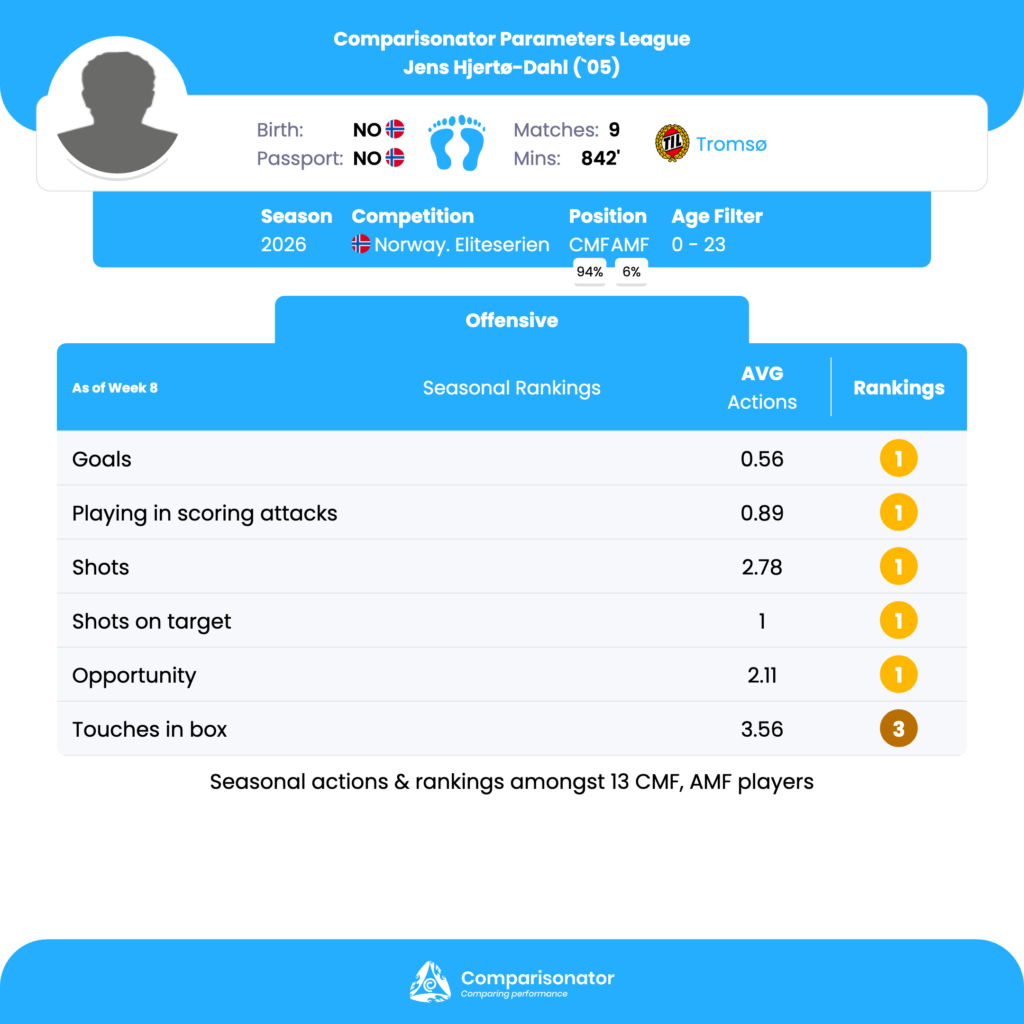
Jens Hjertø-Dahl’s CompaAI Offensive report:
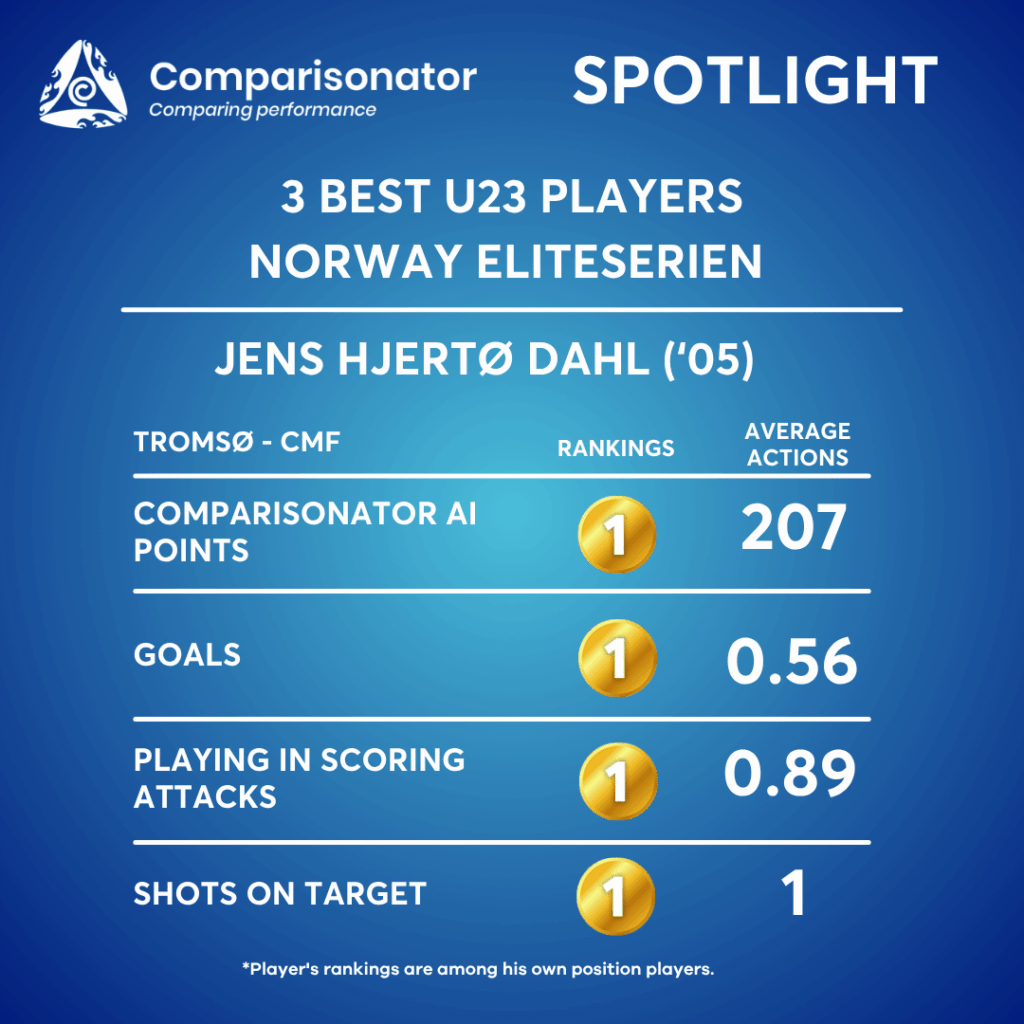
Jens Hjertø-Dahl’s biggest offensive strength is his direct goal threat. He ranks 1st out of 13 among U23 CMFs/AMFs with 0.56 goals per match, leading the group ahead of Victor Emanuel Halvorsen (0.33). He also ranks 1st in shots per match with 2.78, clearly ahead of Mads Bomholt (1.83). This combination shows a midfielder who can regularly enter finishing positions and take responsibility for ending attacks himself. Tactically, this makes him valuable as an advanced central midfielder arriving into the box, or as a more attacking interior who can act almost like a second striker in settled possession. He is also first in playing in scoring attacks with 0.89 per match, again 1st out of 13, slightly ahead of Victor Emanuel Halvorsen (0.83), and first in opportunity with 2.11 per match, ahead of Adrian Kurd Rønning (1.67). This points to a player consistently involved in the final phase of attacks and frequently connected to dangerous situations. Together with his goal and shot volume, it suggests strong off-ball timing, good occupation of advanced zones, and an ability to stay involved when the team is around the penalty area. Another clear strength is his box presence. He ranks 3rd out of 13 in touches in box with 3.56 per match, behind Sondre Auklend (7) and Oskar Øhlenschlæger (4). He is also 3rd in offensive actions with 28 per match, behind Sondre Auklend (35) and Oskar Øhlenschlæger (30.33). These numbers show he is regularly arriving in dangerous areas and sustaining attacking activity. For a central midfielder, that level of box occupation can be tactically useful when the team needs late runs into the area and extra penetration from midfield.
Jens Hjertø-Dahl’s strongest seasonal indicators are his goals, shots, playing in scoring attacks, opportunities, and box presence, where he ranks near the top of his position group. This creates the profile of a highly advanced central midfielder with a real scoring instinct and strong penetration into dangerous areas. His main limitations are in assists, xA, shot assists, and dribbling volume/success, which suggest he is more of a direct attacking midfielder than a creative orchestrator. Tactically, he can be used as an advanced CMF or attack-minded AMF, especially in systems that value late runs into the box, second-wave attacking, and midfield goal threat.
Kristian Lonebu (‘06) (CF) – Aalesund
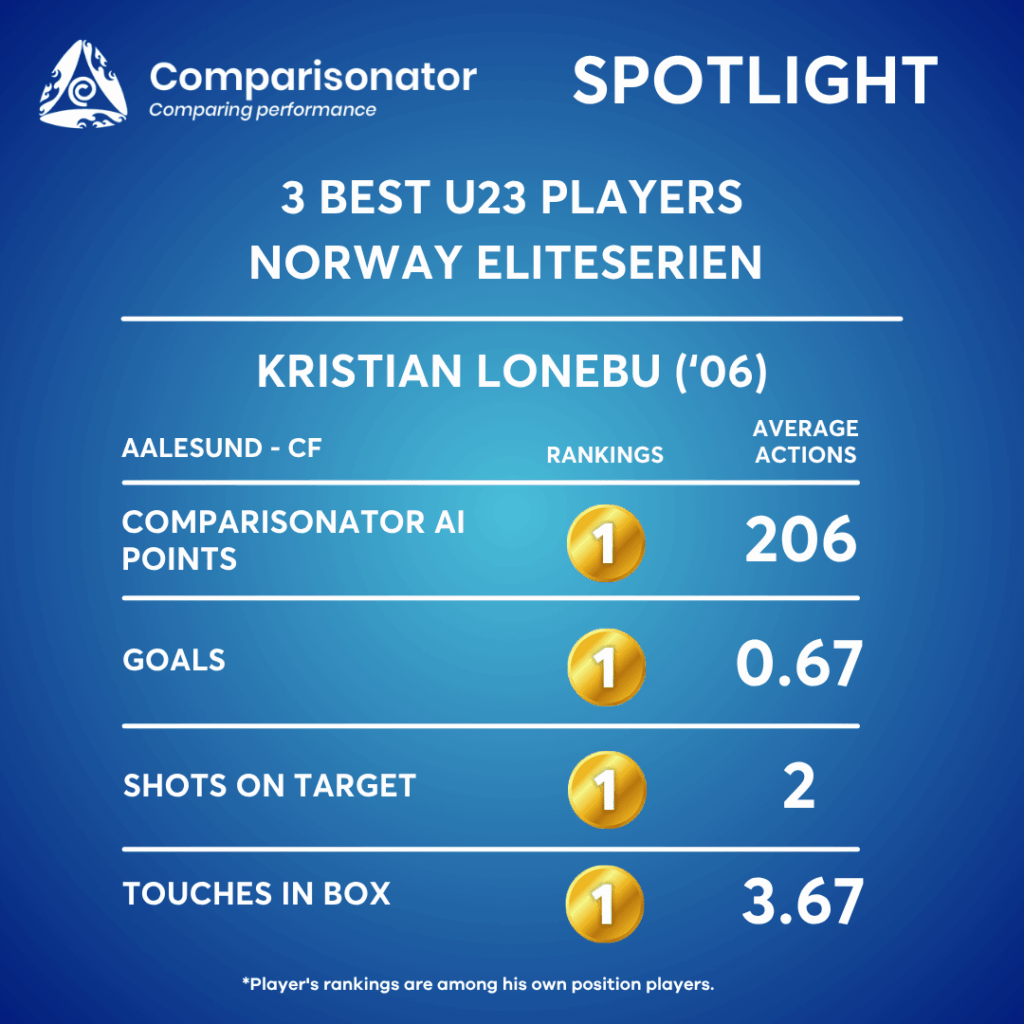
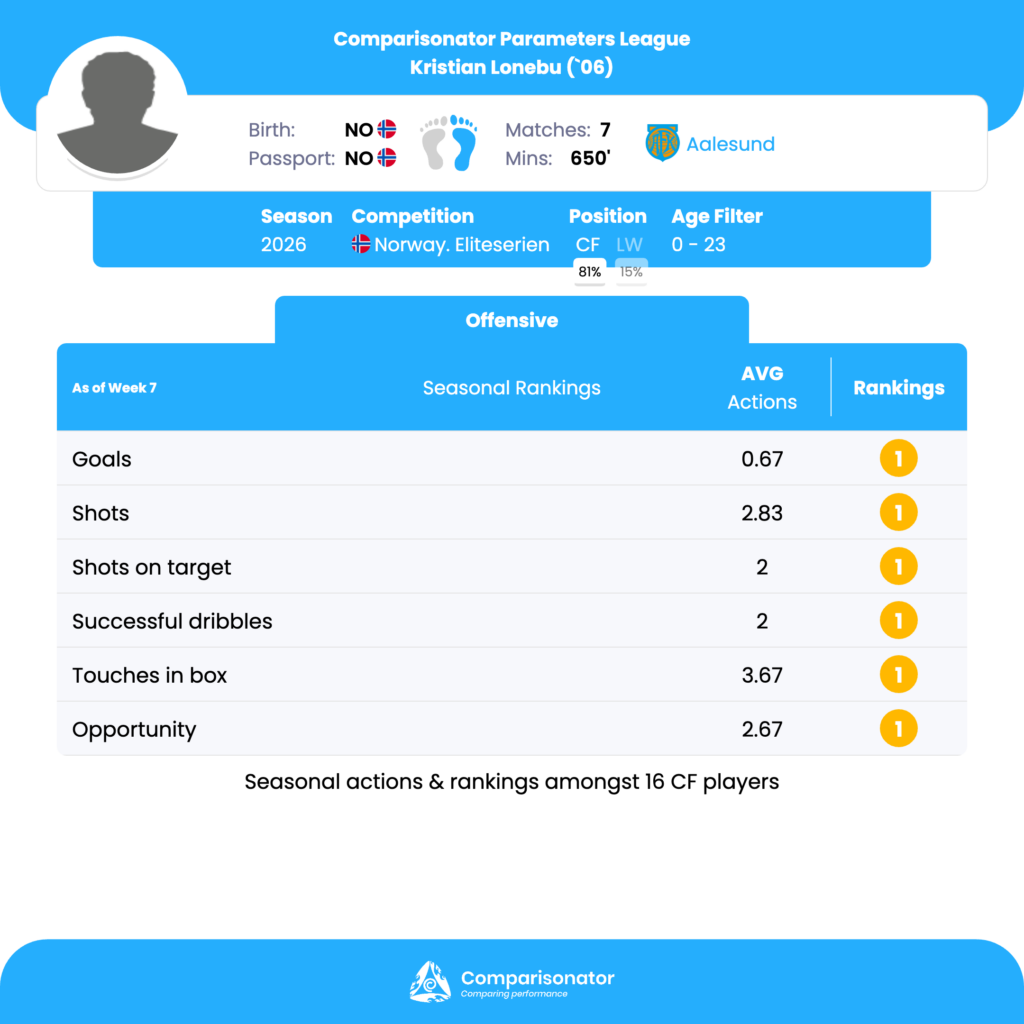
Kristian Lonebu’s CompaAI Offensive report:
Kristian Lonebu’s most notable trait is his direct goal threat. He ranks 1st out of 16 CFs for Goals average per match (0.67), level with Mame Alassane Niang (0.67). He also ranks 1st for Shots average per match (2.83), ahead of Niang (2.17), and 1st for Shots on target average per match (2.0), ahead of Leander Alvheim (1.2). This combination shows a forward who is consistently involved in finishing actions and can generate repeated attempts inside the attacking phase. Tactical value: he can be used as a primary box presence or as the main end point of attacks, especially in teams that create frequent entries into the final third. His dribbling output is also elite for the age and position group. Lonebu ranks 1st for Dribbles average per match (3.17), 1st for Successful dribbles average per match (2.0), 1st for Dribbling in the final third (2.67), and 1st for Successful dribbling in the final third (1.83). He is also 1st for Successful dribbles, % (63.16) among the listed comparisons, though that efficiency is slightly below the elite numbers seen in the best performers in other related categories. This points to a striker who can win his own advantage through 1v1 actions and carry the ball into dangerous zones. Lonebu also scores well in box presence and offensive involvement. He ranks 1st for Touches in box (3.67), tied with Simen Kvia-Egeskog, and 1st for Opportunity average per match (2.67) ahead of Mame Alassane Niang (1.83). He is 1st for Successful offensive actions average per match (16.5) and 2nd for Offensive actions average per match (27.5) behind Oskar Øhlenschlæger (29.25). These numbers suggest a forward who is regularly active around the penalty area and contributes across multiple offensive sequences, not only in final finishing. Tactical value: he fits systems that keep the striker involved in combination play, second-ball actions, and repeated box occupation.
Kristian Lonebu’s best seasonal ranking parameters are clearly tied to finishing volume, dribbling, and penalty-box activity. He is top-ranked in Goals, Shots, Shots on target, Dribbles, Successful dribbles, dribbling in the final third, Successful dribbling in the final third, Touches in box, Opportunity, and Successful offensive actions among U23 CFs in the dataset. That profile points to a forward with strong direct attacking impact, strong 1v1 ability, and regular presence in dangerous zones. The main limitation is his weaker creative output for teammates, with low rankings in Expected assists, Shot assists, and Shot on target assists. From a tactical perspective, he can be used best as a goal-focused central forward in teams that attack with speed, value dribbling into the box, and create chances for the striker rather than through the striker.