

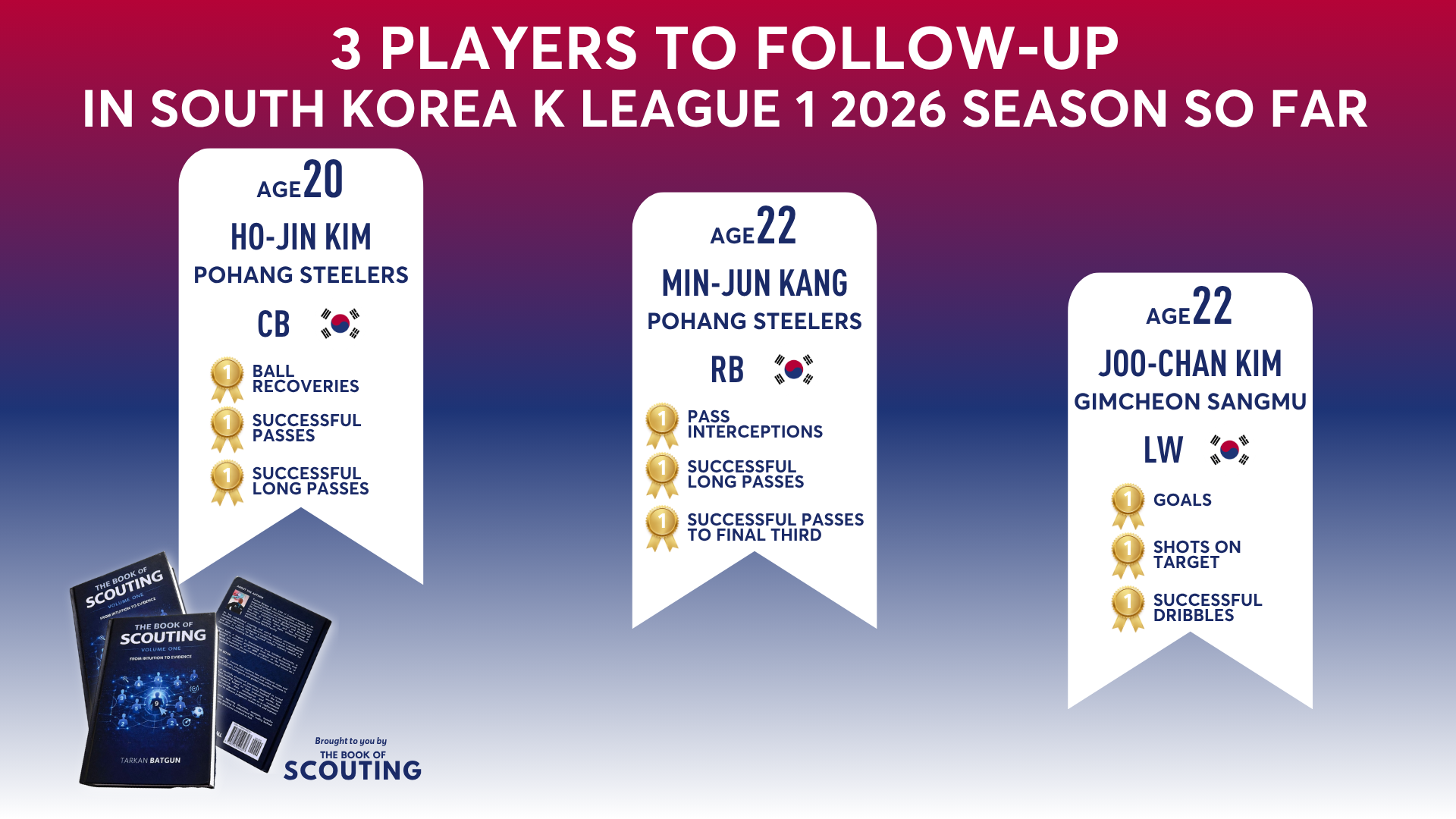
As the 2026 South Korea K League 1 season progresses, several young talents are making their mark. Here are three standout U23 players who have been turning heads with their performances. Ho-jin Kim from Pohang Steelers, Min-jun Kang from Pohang Steelers and Joo-chan Kim from Gimcheon Sangmu are analyzed based on data from Comparisonator platform. Their impressive statistics highlight their influence on the pitch and their potential for future success.

Powered by CompaAI, an advanced AI tool by Comparisonator, this analysis transforms complex football data into clear, actionable insights. With its latest feature, CompaAI redefines squad analysis, providing an instant, in-depth view of team performance. In just seconds, it highlights standout players, identifies emerging young talents, and detects areas that need reinforcement.

More than just analysis, CompaAI delivers strategic recommendations to enhance transfer strategies. By pinpointing top potential signings, it enables clubs to strengthen key positions and scout future stars effectively. With CompaAI, raw data becomes precise, data-driven transfer insights—giving teams a crucial advantage in the market.

Ho-jin Kims CompaAI Parameters League Passing report:

Ho-jin Kim’s strongest seasonal output is in passing volume and distribution, where he ranks 1st out of 9 CBs in several key metrics. He leads the group in Passes per match (63.25), ahead of Kyung-sub Park (55.73), and also tops Successful passes per match (57.13) ahead of Hyeon-seo Han (49.33). This shows a defender who is heavily involved in ball circulation and can carry a large passing load without losing efficiency. Tactically, this profile suits a build-up oriented side that uses the centre-back as a primary outlet in first phase possession. His long-range distribution is another major strength. Kim ranks 1st in Long passes (6.13) and Successful long passes (3.63) per match, both above Kyung-sub Park (5.45 and 2.36 respectively). He also ranks 1st in Passes to final third (6.75) and Successful passes to the final third (4.88), narrowly ahead of Kyung-sub Park (6.55 and 4.82). This combination suggests a centre-back who can progress play directly and repeatedly, not just recycle possession. From a tactical point of view, he can be used to break lines early and connect defensive build-up with midfield occupation. Kim also ranks 1st in Offensive passes (61) and Successful offensive passes (55.38) per match, plus 1st in Forward passes (23.88) and Successful forward passes (20.25). In addition, he leads in Passes into the penalty box / accurate (1) and Successful progressive passes (5.75). These numbers indicate a defender with a clearly progressive mindset, able to move the ball into dangerous or advanced areas with consistency. For a coach, this can be valuable in teams that want their centre-backs to initiate territorial gain and support attacks through vertical passing.

Ho-jin Kim’s best ranking parameters are clearly tied to passing volume, forward progression, and line-breaking distribution. He finishes 1st in several major categories: Passes, Successful passes, Long passes, Successful long passes, Passes to final third, Successful passes to final third, Offensive passes, Successful offensive passes, Forward passes, Successful forward passes, Passes into the penalty box / accurate, Successful progressive passes, Received pass, Passes in the opposition half, Successful passes in the opposition half, and Passes into the middle third. This profile paints him as an advanced ball-playing centre-back with strong influence in build-up and progression. The main concerns are his lower relative rankings in some accuracy-based metrics in the opposition half and lateral/back-pass efficiency, which may point to less consistency when the team is under pressure or when the passing task is more controlled rather than progressive.

Min-jun Kangs CompaAI Parameters League Defensive report:

Min-jun Kang’s standout defensive strength is his ability to intercept passes and break up opposition circulation, where he ranks 1st out of 6 with 3 pass interceptions per match and also 1st out of 6 with 3.63 interceptions per match. He is ahead of the nearest competitor, Seok-hyeon Choi, who posts 2.73 pass interceptions and 4.18 interceptions respectively. This indicates a right-back who reads the game early and can step into passing lanes with consistency. Tactically, that can support a side defending in a medium block, where proactive lane protection and timing in stepping out are valuable. He also leads the group in duels and direct defensive containment, ranking 1st out of 6 with 1.5 dribbles against won per match and 1st out of 6 with 3.13 clearances per match. In addition, he tops the set with 20.5 successful defensive actions per match, again 1st out of 6, while Seok-hyeon Choi is close behind on 19.82. This combination points to a defender who is active in 1v1 situations, can survive under pressure, and contributes strongly when the team is forced to defend its box. From a tactical standpoint, he can be useful in a back four where the full-back may face isolated wide duels and repeated defensive recoveries. His overall defensive output also looks strong in volume and consistency, with 24.63 defensive actions per match ranking 2nd out of 6, and 83.25% successful defensive actions also ranking 2nd out of 6. He trails only Seok-hyeon Choi in total defensive actions (25.36) and Seung-gu Choi in success rate (85.71%). This suggests a defender who is not only active, but also fairly efficient when engaging in defensive tasks. That profile can fit systems that ask the right-back to defend frequently without becoming overly exposed.

Min-jun Kang’s best seasonal indicators are his pass interceptions, interceptions, dribbles against won, clearances, and successful defensive actions, where he consistently ranks at or near the top among U23 RBs. The overall picture is of a reliable, proactive defensive right-back who is especially effective in reading play, winning isolated defensive duels, and clearing danger. His weaker areas are mainly in high recovery and counterpressing actions, where he ranks lower than the top performers. Tactically, he can be used as a defensive-leaning full-back in a back four, especially against direct wide threats, and can be valuable in matches where the team needs stability, duel security, and structured box defending rather than aggressive high pressing from the right side.


Joo-chan Kim
s CompaAI Parameters League Offensive report:

Kim’s strongest seasonal outputs are built around end product and shot volume. He ranks 1st out of 8 LW players under 23 in Goals average per match (0.22), ahead of Jun-ha Kim (0.08), and also 1st in Expected goals (xG) average per match (0.21) versus Jun-ha Kim (0.10). He is also 1st in Shots average per match (1.56), 1st in Shots on target average per match (0.56), and 1st in Shot assists average per match (0.89). This combination points to a winger who is consistently involved in finishing sequences, can generate his own attempts, and also creates shot opportunities for teammates. Tactically, this profile can be valuable in a direct attacking structure where the left winger is expected to arrive in scoring areas, take responsibility for shooting, and connect final-third combinations. Kim is also among the top ball-progressors in the sample. He ranks 1st in Dribbles average per match (3.44), ahead of Yong-jun Hong (2.57), 1st in Successful dribbles average per match (1.78) versus Yong-hak Kim (1.43), and 1st in Progressive runs average per match (1.56) versus Hyeok-joo An (1.43). He also leads Ball carrying average per match (0.33). These numbers suggest a winger who can repeatedly isolate defenders, advance play through carrying, and create penetration without relying only on passing. In tactical terms, he fits well in teams that want the wide forward to break lines by dribbling, attack space in transition, and force defensive collapses from the flank. Kim’s activity near the opponent’s goal is another clear strength. He ranks 1st in Touches in box average per match (2.22) ahead of Seo-woong Hwang (2.00), and 1st in Opportunity average per match (1.00) versus Seo-woong Hwang (0.75). He also tops Offensive actions average per match (23.11) and Successful offensive actions average per match (13.00). This shows strong repeated involvement in attacking phases and steady entry into dangerous areas. The tactical meaning is straightforward: he can be used as an outlet who repeatedly attacks the penalty area, supports finishing moves, and sustains pressure in the final third.


Joo-chan Kim’s best seasonal ranking parameters are Goals, xG, Shots, Shot assists, Dribbles, Successful dribbles, Progressive runs, Touches in box, Opportunity, Offensive actions, and Successful offensive actions, where he consistently ranks near the top of his age-position group. The profile points to a dynamic left winger who attacks space aggressively, carries the ball well, and regularly enters dangerous areas. The main limitations are in assist output, dribbling success rate, and shot efficiency consistency, which suggest a player better suited to direct, high-tempo wide attacking usage than to being the primary final passer.

Tarkan Batgün

Tarkan Batgun is scouting & match analysis specialist with more than 20 years in football field, worked as a scouting director & head of performance analysis inside clubs, lectured in federations, currently working as the CEO of Comparisonator platform.

Leave a Reply


Close Menu