
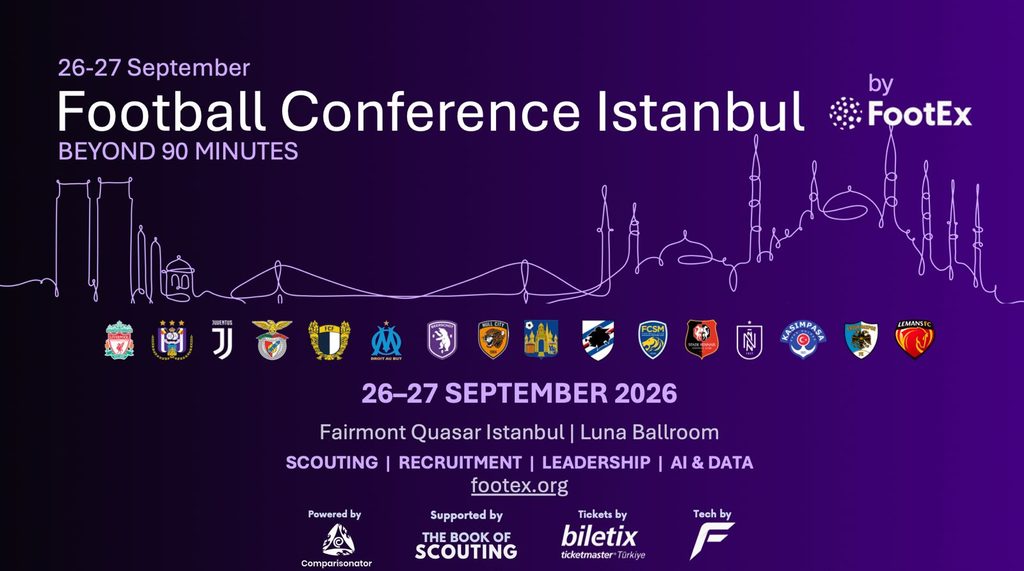
Meet the People Behind Modern Football at Football Conference Istanbul by FootEx, 26–27 September 2026
Powered by Comparisonator & Supported by The Book of Scouting as an Event Partner, Football Conference Istanbul by FootEx will bring together leading professionals from across international football at Fairmont Quasar Istanbul for two days of discussions on scouting, recruitment, transfers, sporting management, data and artificial intelligence.
The conference will welcome club Presidents, Sporting Directors, Chief Scouts, recruitment specialists and football executives as keynote speakers, sharing their experience from some of the world’s leading football organisations.
Comparisonator readers are invited to join us in Istanbul and meet the professionals shaping how modern football identifies players, makes transfer decisions and builds for the future.
BEYOND 90 MINUTES: Insights from Across World Football
As part of Comparisonator’s support for Football Conference Istanbul by FootEx, we will be publishing a series of data-driven articles exploring the subjects at the heart of the conference, from scouting and recruitment to emerging talent, transfer markets, player development, data and artificial intelligence.
Through these analyses, we aim to extend the conversation Beyond 90 Minutes, using Comparisonator’s data and technology to highlight players, leagues and trends from across world football.
In this edition, we turn our attention to South Korea and the emerging U23 talent of the K League 1.
As the South Korean K League 1 2026 season progresses, a fresh generation of young talent is beginning to leave its mark across the competition. Whether they are commanding defenders or dynamic forwards, these athletes are showcasing their value through remarkable performances and strong data-driven contributions. By examining advanced performance metrics, we can analyze their on-pitch impact, core strengths, and future potential. This provides a purely data-backed perspective on why you should keep an eye on these rising stars. Let’s explore the numbers to see exactly what makes them stand out in the K League 1.
Driven by CompaAI—the next-generation AI solution developed by Comparisonator—this evaluation turns complex football data into straightforward, actionable insights. Thanks to its cutting-edge features, CompaAI completely revolutionizes squad analysis, providing an immediate and in-depth assessment of a team’s overall performance. Within mere seconds, the platform can pinpoint standout players, discover rising young talents, and highlight key areas for squad enhancement.
Going beyond traditional analysis, CompaAI delivers the strategic intelligence needed to refine club transfer strategies. By accurately detecting high-potential signings, it empowers teams to strengthen key positions and effectively scout future stars. Ultimately, CompaAI transforms raw data into highly valuable, data-driven insights, giving clubs a decisive advantage in the highly competitive transfer market.
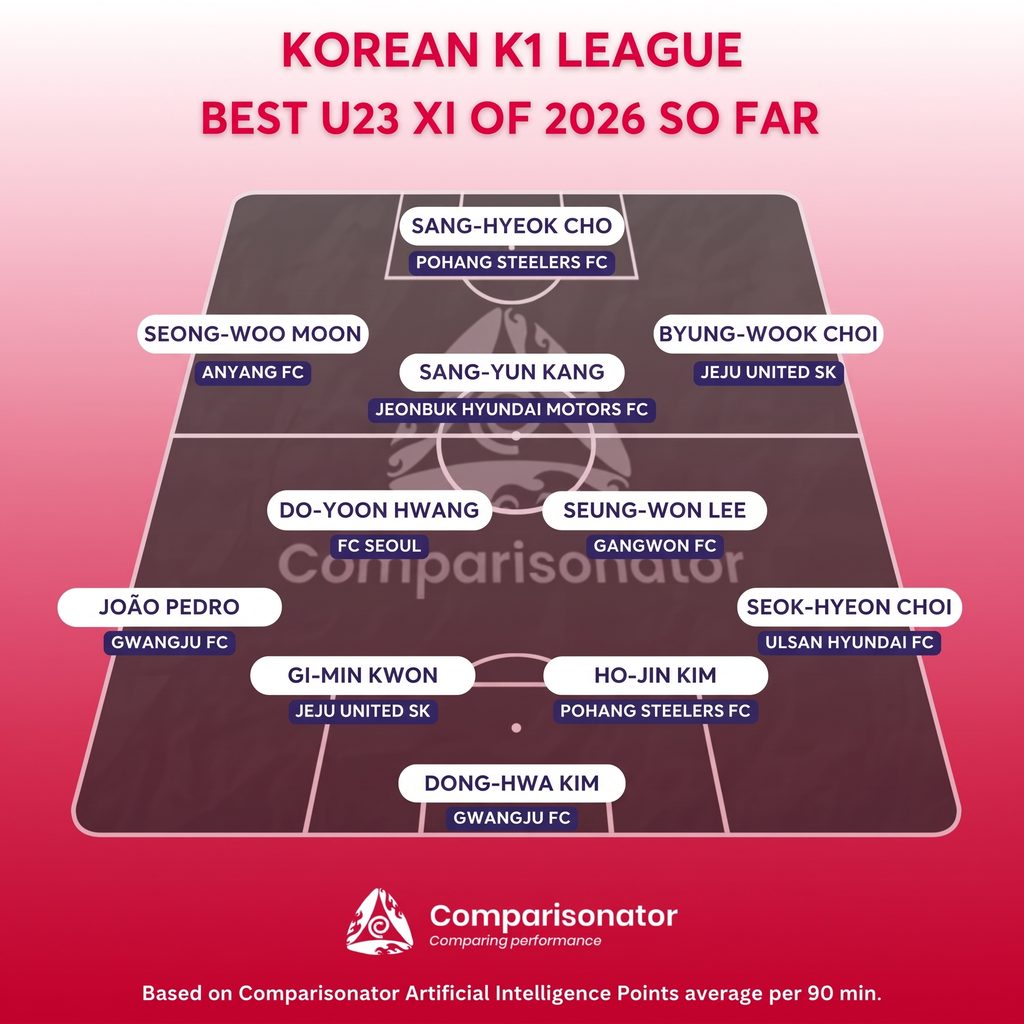
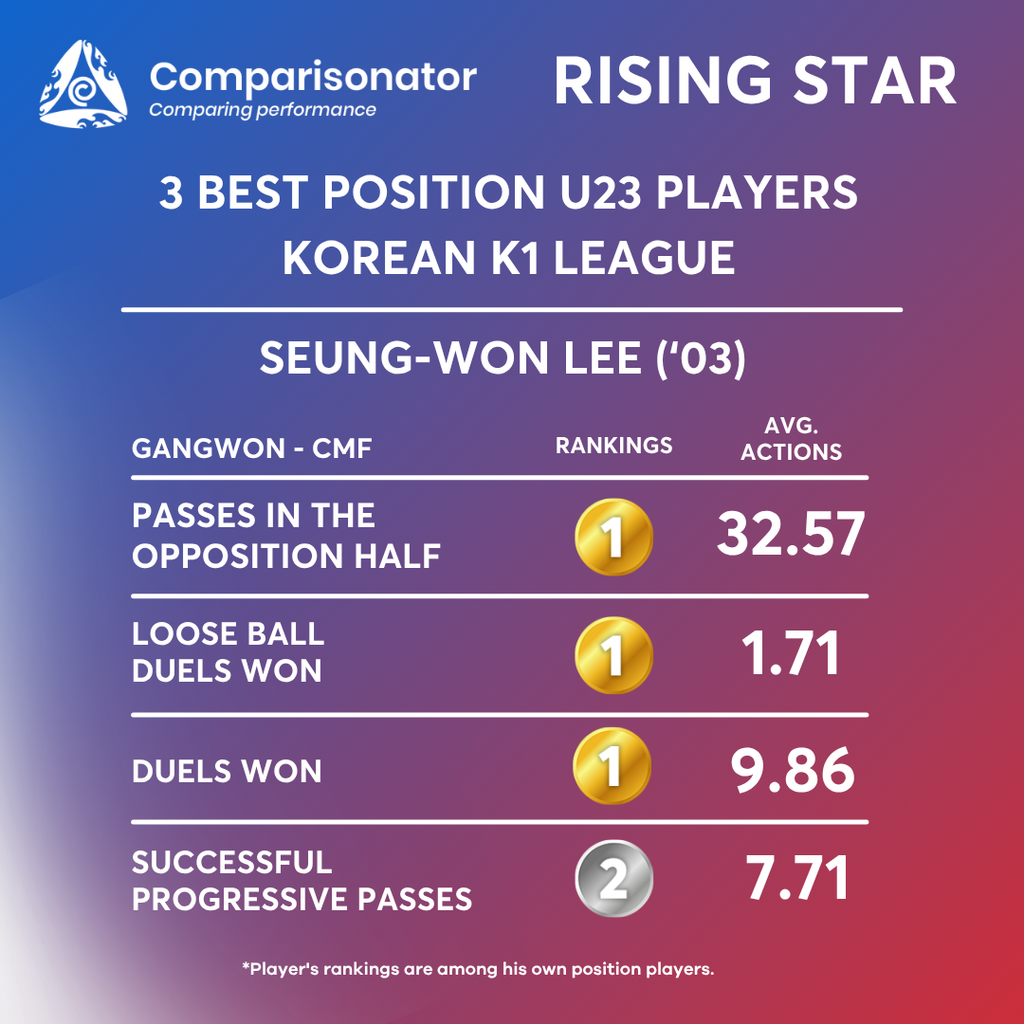
“Rising Star” 3 Best U23 Players Korean K1 League 2026 so Far
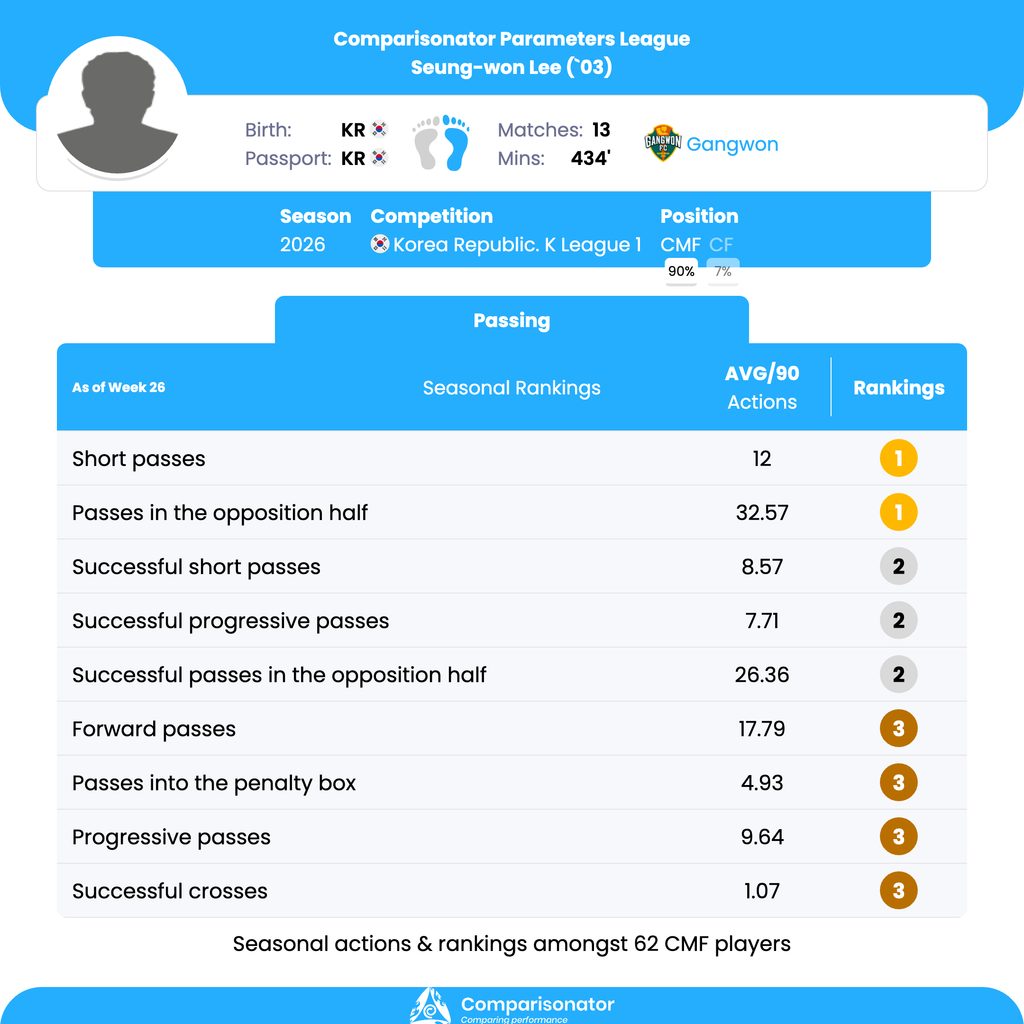
Seung-Won Lee (’03) (CMF) – Gangwon
Lee’s CompaAI Parameters League Duels report:
Lee’s most significant strength is his elite duel-winning volume and efficiency. He ranks 1st out of 62 CMF players with 9.86 duels won per 90, ahead of the next best performer, Min-hyuk Lee (9.74). This is reinforced by his 1st place rank in duels won percentage at 68.66%, above Iker Undabarrena (62.07%). Furthermore, he leads the position in ground duels won percentage at 77.5%, beating out Milosz Trojak (68.89%). This highlights a midfielder who consistently comes out on top in direct contests, combining high volume with an exceptional conversion rate. Tactically, he is highly valuable as an aggressive central midfielder in competitive duels, especially in zones where second balls and close-contact disputes shape possession.
His duel-winning ability is backed by very strong loose-ball competitiveness. Lee ranks 1st out of 62 in loose ball duels per 90 with 3.43, well ahead of Min-kyu Song (2.49). He also sits 1st in loose ball duels won per 90 with 1.71, above Ka-ram Han (1.37). This combination proves he possesses strong reaction speed, anticipation, and the ability to secure possession in chaotic phases. Tactically, this makes him an ideal fit for teams that press, play direct, or generate many transitional and second-ball situations.
He also demonstrates high-level defensive ground duel effectiveness, recording 74.07% in defensive ground duels won percentage, ranking 1st just ahead of Matheus Oliveira (73.08%). When combined with his 4th place rank in defensive ground duels won per 90 with 4.29, trailing leaders like Min-hyuk Lee (6.84) and Jin-yong Lee (5.16), it shows he is highly efficient in defensive ground contests even if his raw volume is not the highest. Ultimately, this indicates a central midfielder well-suited to protecting central lanes, winning contact duels after opponent progression, and stabilizing midfield transitions.
Seueng-Won Lee (’03) (CMF) – Gangwon
Gi-Min Kwon (’05) (CB) – Jeju SK
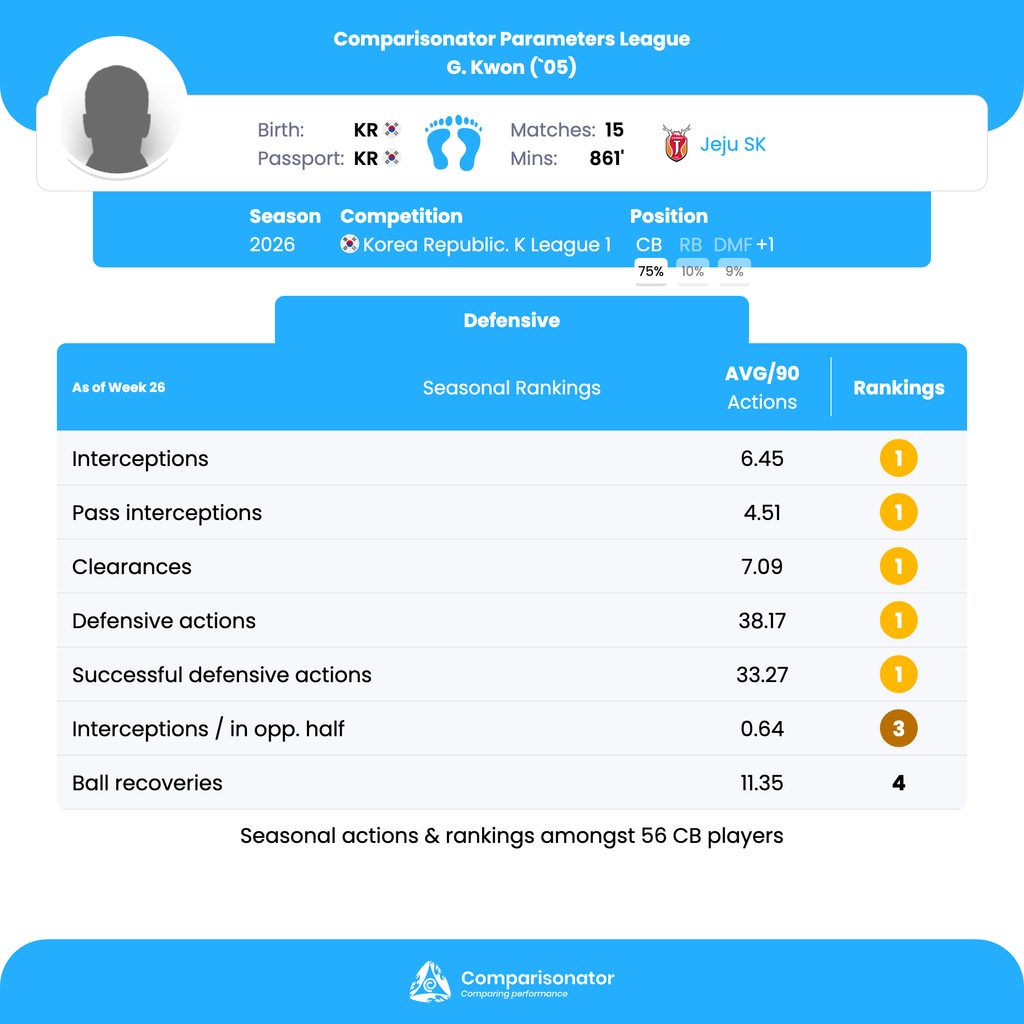
Kwon’s CompaAI Parameters League Defensive report:
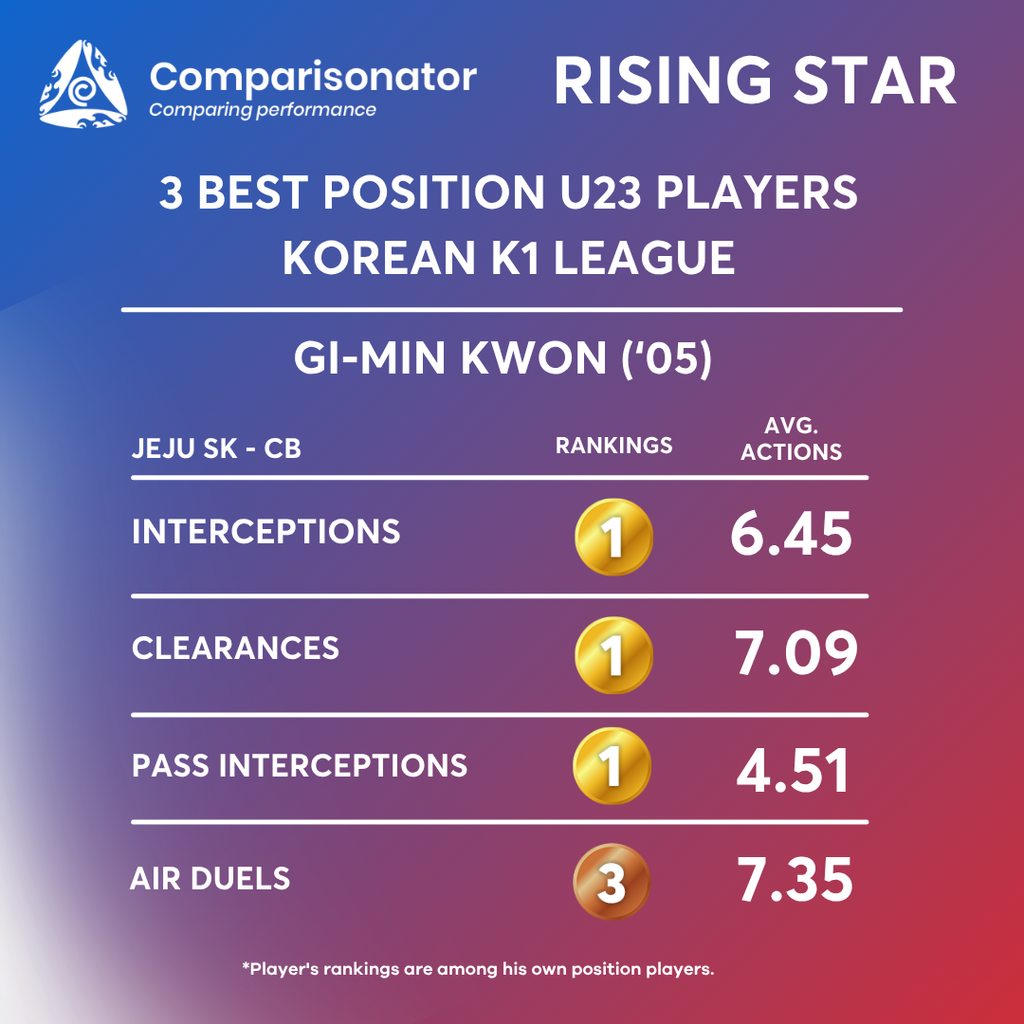
Kwon’s most significant strength is his elite overall defensive activity and output. He ranks 1st out of 56 CB players with 38.17 defensive actions per 90, leading the position in both volume and productivity. This is reinforced by his 1st place rank in successful defensive actions per 90 with 33.27. Furthermore, he is the leader in clearances per 90 with 7.09 and pass interceptions per 90 with 4.51, beating out Sung-wook Hong in both metrics. This highlights a defender who is heavily involved in stopping attacks early, clearing danger efficiently, and consistently reading the game well. Tactically, he is highly valuable as a central defender who can be trusted in a high-volume defensive structure, especially when the team is facing sustained pressure.
His high-volume output is backed by elite anticipation and interception work. Kwon ranks 2nd out of 56 in interceptions per 90 with 6.45, just behind Sung-wook Hong (6.47). He also sits 3rd in interceptions in the opponent half per 90 with 0.64, 4th in ball recoveries per 90 with 11.35, and 4th in ball recovery in his own half per 90 with 9.28. This proves he possesses strong defensive reading, useful positioning, and a quick response after turnovers. When combined with his 6th place rank in counterpressing recoveries per 90 (4.9), it shows he covers multiple defensive phases. Tactically, this makes him an ideal fit for systems that value proactive defending, second-ball control, and immediate regaining of possession after pressure.
He also demonstrates strong resistance in duels and containment, recording 75% in dribbles against won, ranking 3rd. He sits 7th in successful defensive actions percentage with 87.16%. This highlights that when attackers try to engage him, he is often successful in limiting progression and finishing defensive actions effectively. Along with posting 0 own goals per 90, this aligns with a clean and controlled defensive profile. Ultimately, this indicates a centre-back well-suited to direct defensive matchups where the team wants a player who can stay composed under pressure and reduce risk in isolation situations.
Gi-Min Kwon (’05) (CB) – Jeju SK
Dong-Hwa Kim (’03) (GK) – Gwangju
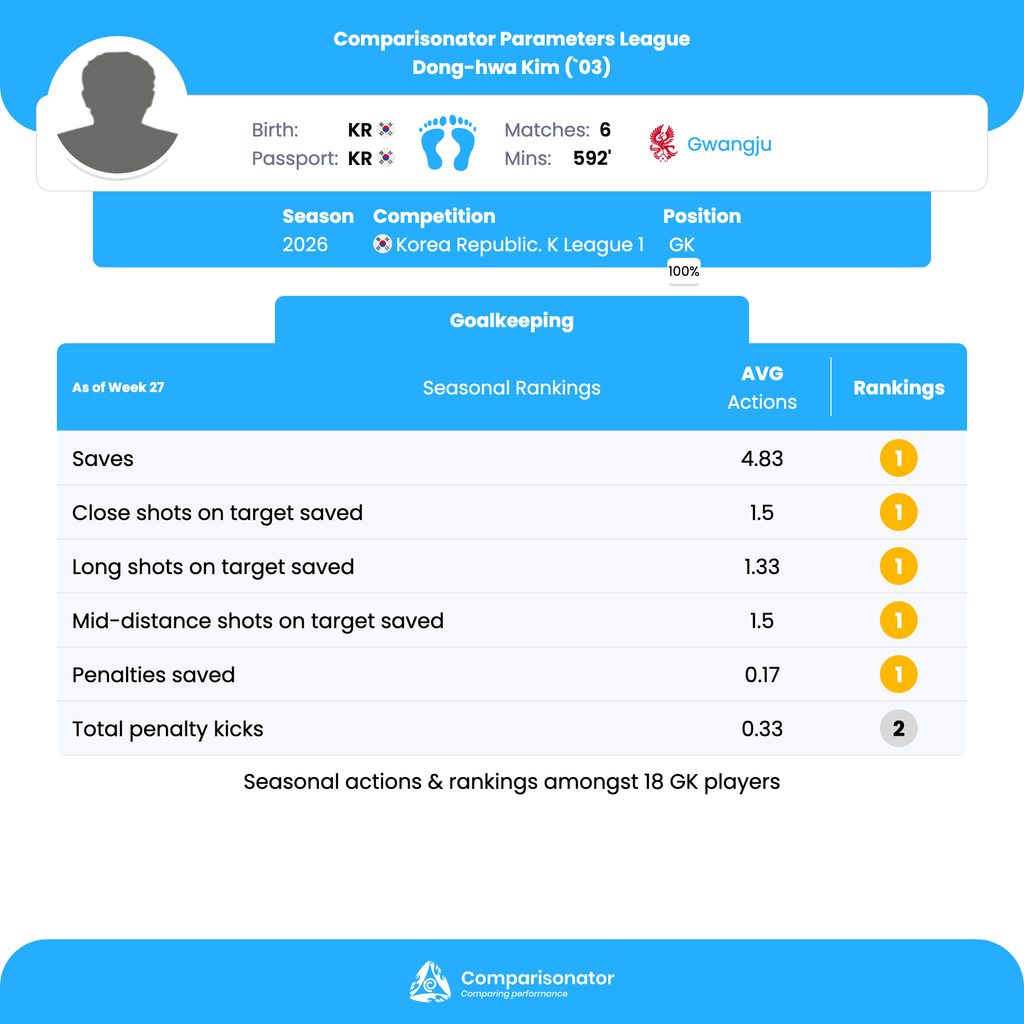
Lee’s CompaAI Parameters League Goalkeeping report:
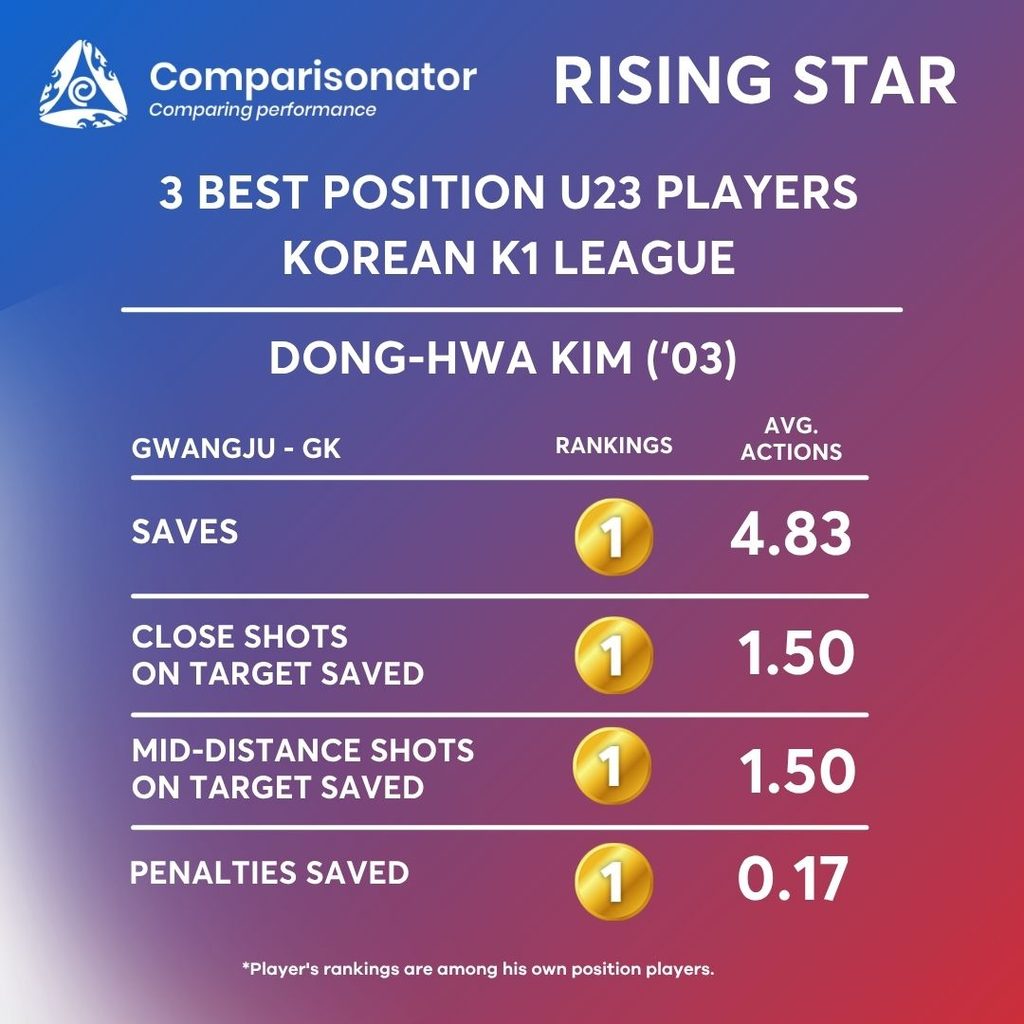
Dong-hwa Kim’s most significant strength is his elite shot-stopping volume. He ranks 1st out of 18 GK players with 4.83 saves per match, well ahead of the next best performer, Jeong-hoon Kim (3.42). This is reinforced by his 1st place rank in close shots on target saved per match with 1.5, again above Sung-min Hong (1.33). Furthermore, he leads the position in long shots on target saved per match with 1.33, beating out Hyeon-yeob Kim (0.92). This highlights a goalkeeper who is heavily involved in direct save actions and can handle a high shot volume, especially from both close and long range. Tactically, he is highly valuable for a team that expects its keeper to face frequent attempts and relies on reflex saves and range management.
His raw save volume is backed by strong effectiveness against specific, high-leverage shot types. Kim ranks 1st out of 18 in saved shots xG per match with 0.96, ahead of Tae-heui Lee (0.78). He also sits 1st out of 18 in penalties saved per match at 0.17, ahead of Jong-beom Baek (0.08). This proves he is not only busy but is generating high-value save contributions, especially in situations where shot quality or shot distance varies. Tactically, this makes him an ideal profile in matches where the opponent produces from distance or where penalty situations may carry added value.
He also demonstrates elite shot-stopping efficiency, recording a perfect 100% in long shots on target saved percentage, ranking 1st alongside Da-sol Kim. This highlights a clear and reliable defensive profile when dealing with attempts from outside the penalty area. When combined with his dominance in both close and long-range volume, it shows he produces high-end security despite facing a heavy workload. Ultimately, this indicates a goalkeeper who can be trusted as a formidable last line of defense in systems that concede frequent or varied shooting opportunities.
Dong-Hwa Kim (’03) (GK) – Gwangju
BUY TICKETS:
ENGLISH TICKET LINK: https://www.biletix.com/etkinlik/5FEX1/TURKIYE/en/footex-summit-26-eylul-26-09-2026-istanbul
TURKISH TICKET LINK: https://www.biletix.com/etkinlik/5FEX1/TURKIYE/tr/footex-summit-26-eylul-26-09-2026-istanbul
And as the final Best U23 XI of Japan J1 100 Year Vision League 2026 so Far: