
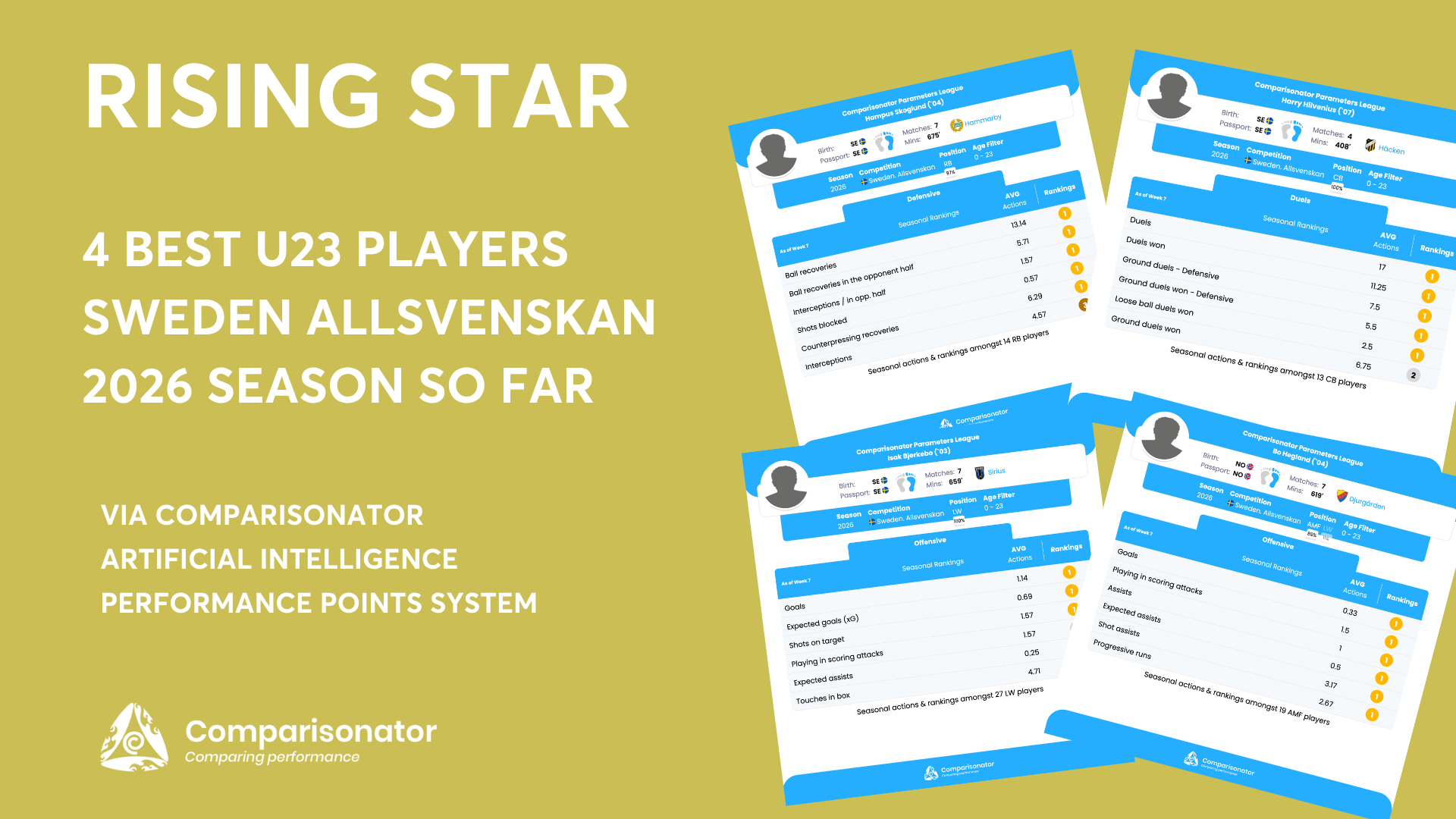
As the Sweden Allsvenskan 2026 season unfolds, a new wave of young talents is making a name for themselves across the league. From commanding defenders to dynamic forwards, these players are proving their worth with standout performances and impressive data-driven contributions. Using advanced performance metrics, we break down their impact, strengths, and potential, giving a data-driven perspective on why these rising stars are ones to watch. Let’s dive into the numbers and uncover what makes them stand out in Sweden Allsvenskan.

Powered by CompaAI, the next-generation AI solution from Comparisonator, this analysis simplifies complex football data into clear, actionable insights. With its cutting-edge features, CompaAI revolutionizes squad analysis, delivering an instant, in-depth assessment of team performance. In just seconds, it pinpoints standout players, uncovers rising young talents, and identifies key areas for enhancement.

Beyond traditional analysis, CompaAI offers strategic intelligence to refine transfer strategies. By detecting high-potential signings, it empowers clubs to strengthen key positions and scout future stars with accuracy. With CompaAI, raw data transforms into valuable, data-driven insights, providing teams with a decisive advantage in the transfer market.

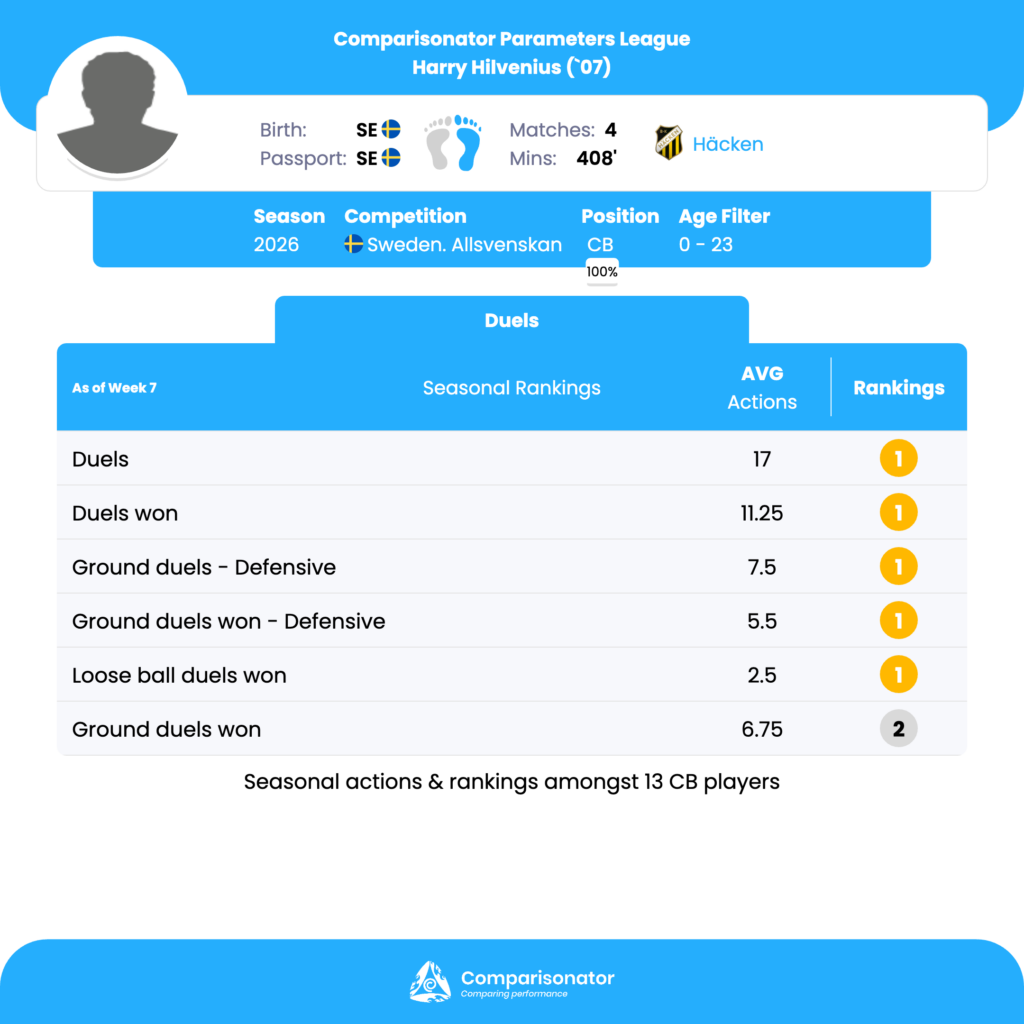
Harry Hilvenius‘s CompaAI Parameters League Duels report:

Hilvenius ranks 1st out of 13 CBs under 23 for several of the most important duel metrics: 17 duels per match and 11.25 duels won per match. He also leads ground duels – defensive with 7.5 per match, and ground duels won – defensive with 5.5 per match. Compared with the nearest challengers, these are clear top-end numbers: Erko Tougjas is next in total duel volume at 15.6 duels per match, while Rockson Yeboah follows in duel wins with 9.86 duels won per match. This profile points to a defender who is heavily engaged in direct physical contests and is highly effective in the defensive phase. Tactically, that kind of output can support a team that defends through duels, protects the back line aggressively, and values a CB capable of stepping into contact early. Hilvenius is also 1st out of 13 for the volume and success of defensive ground duels, with 7.5 defensive ground duels per match and 5.5 defensive ground duels won per match. His numbers are marginally ahead of the next best CBs, with Erko Tougjas at 7.2 and 5.2 respectively. This suggests a defender who is especially active in low, direct defensive actions around his zone, likely showing good timing in challenges and repeated readiness to engage. From a tactical perspective, he can be useful in systems that leave the centre-backs exposed to direct runners, second balls, or frequent 1v1 defending. Beyond purely defensive ground duels, Hilvenius also ranks 2nd out of 13 in ground duels won per match with 6.75, only behind Rockson Yeboah at 7.43. He also sits 3rd out of 13 in ground duels per match with 9.75, behind Yeboah (10.43) and Erko Tougjas (10.2). This indicates that his duel impact is not limited to one phase; he is consistently active in ground confrontations across the pitch. That can be valuable for a CB in a more proactive defensive structure, where ground duels are frequent in both step-out situations and box defense.

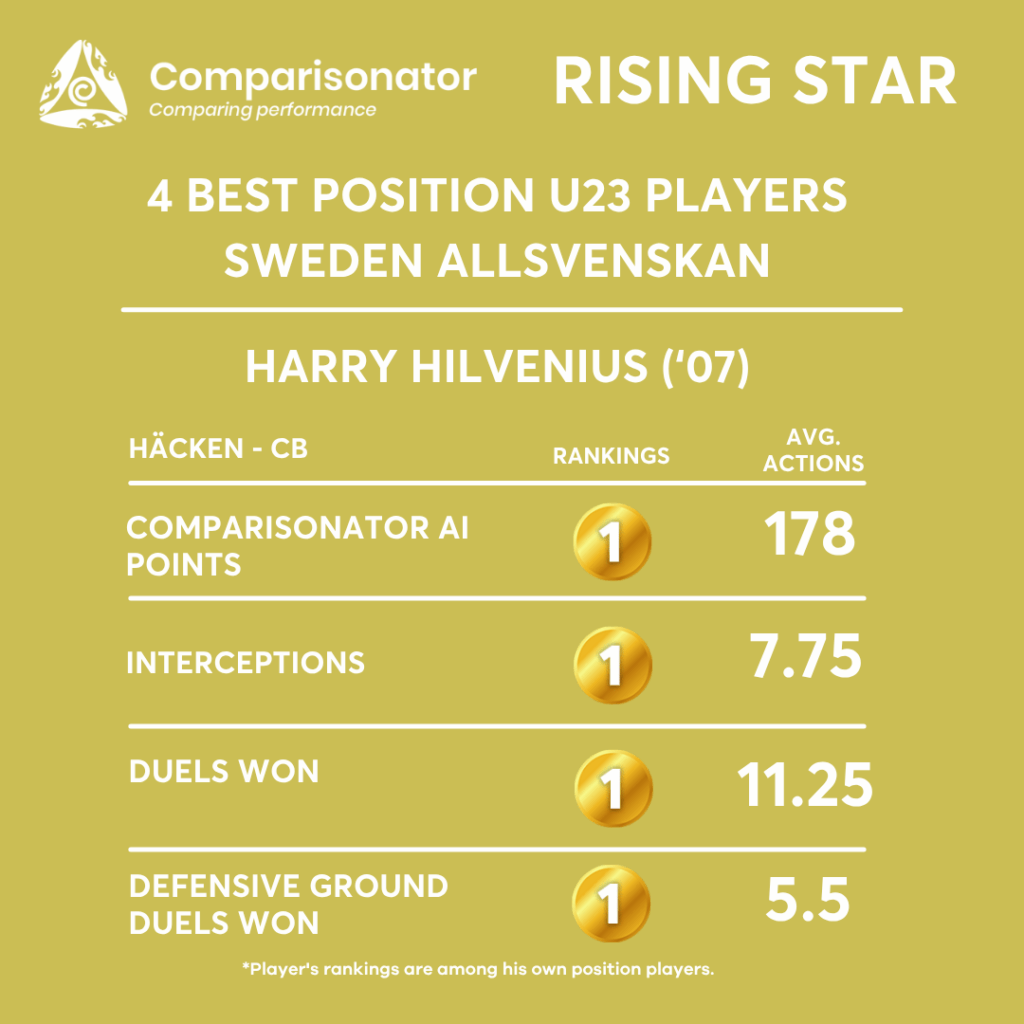
Hilvenius’ best ranking parameters are clearly concentrated in ground duels and defensive duel activity: he is 1st for duels per match, duels won per match, defensive ground duels per match, and defensive ground duels won per match, while also placing 2nd in ground duels won per match. This profile shows an 18-year-old CB who is already highly active, competitive, and effective in direct ground defending. His main limitation is the aerial side of defending, where his ranking and conversion rate are notably weaker than the top CBs in the group. Tactically, he can fit best in a structure that values aggressive ground defending, strong duel volume, and a partner or system that helps cover aerial load and set-piece responsibility.

Harry Hilvenius (‘07) (CB) – Häcken
Hampus Skoglund‘s CompaAI Parameters League Defensive report:

Hampus Skoglund’s strongest defensive trait is his ability to regain possession, where he ranks 1st out of 14 RBs with 13.14 ball recoveries per match. He also leads the group in ball recoveries in the opponent half with 5.71 per match, ahead of Victor Ekström on 4.33, and in interceptions in the opponent half with 1.57 per match, ahead of Ekström on 1.33. This profile points to a fullback who is active in advanced defensive zones, quick to step into pressure, and effective at winning the ball high up the pitch. Tactically, this can be valuable for a team looking to compress the field, press aggressively, and recover possession early to restart attacks quickly. His counterpressing output is also elite. Skoglund ranks 1st out of 14 with 6.29 counterpressing recoveries per match, compared with 5 for Victor Ekström. This indicates strong recognition in transition moments and a good ability to react immediately after possession loss. For a right back, that can be especially useful in a side that attacks with fullbacks high and needs immediate ball-winning support around the touchline and half-space. It also suggests he can contribute to maintaining territorial pressure after lost possession, rather than allowing opponents to escape the press. He also shows respectable duel and blocking output. Skoglund is 1st out of 14 in shots blocked with 0.57 per match, narrowly ahead of Erko Tougjas on 0.5. This suggests good timing in getting across shots and supporting the defensive line in box-protection situations. In addition, he ranks 4th in dribbles against won with 1.71 per match, which indicates he can handle 1v1 defensive situations reasonably well, even if that is not his standout area compared with his recovery and pressing numbers. This can be useful in matches where the right side is exposed to direct dribblers and he needs to delay or stop progression without immediate cover.

Hampus Skoglund’s best seasonal defensive rankings are built around ball recoveries, counterpressing recoveries, opponent-half regains, opponent-half interceptions, and shots blocked, with multiple 1st-place rankings and strong top-three placements across the main defensive indicators. This profile describes a proactive right back who can press aggressively, win the ball high, and support immediate transition control. His main limitations appear in more reactive and deeper defensive work, especially ball recovery in own half, pass interceptions, successful defensive actions %, and clearances, where he sits outside the top tier. Tactically, he may be most effective in a high-line, pressing structure, with freedom to step into midfield pressure and attack second balls, while being less ideal as a pure deep-block fullback asked to defend sustained box pressure.

Hampus Skoglund (‘04) (RB) – Hammarby

Bo Hegland‘s CompaAI Parameters League Offensive report:

His end-product involvement is also elite. He is 1st in goals per match (0.33), playing in scoring attacks (1.5), assists (1.0), expected assists (0.5), shot assists (3.17), and shot on target assists (1.17). He also leads the position in shots (3.17) and shots on target (1.5), with strong support from his 47.37% shots on target rate, where he ranks 2nd. Against the closest positional rivals, he stays ahead of Adrian Skogmar in goals, Victor Svensson in assists, Ludwig Malachowski Thorell in xA, and Róbert Frosti Thorkelsson in shot assists. This shows a player who is not only creating for others but also finishing actions himself at a high rate. In tactical terms, he can be a key final-third creator and secondary scorer, capable of functioning as a central attacking midfielder or inverted wide attacker with responsibility for both chance creation and shot generation. Bo Hegland’s strongest seasonal trait is his final-third involvement and ball progression from wide or central advanced areas. He ranks 1st out of 19 AMFs under 23 for dribbles (4.83), successful dribbles (2.33), dribbling in the final third (3.83), successful dribbling in the final third (1.67), progressive runs (2.67), touches in box (4.33), and offensive actions (41.5). Compared with the nearest challengers, he leads Róbert Frosti Thorkelsson in dribbles, final-third dribbling, touches in box, and offensive actions, while also staying ahead of Markus Karlsson in progressive runs. This profile indicates a player who consistently carries possession into dangerous areas, attacks defenders directly, and repeatedly gets into box-adjacent zones. Tactically, he can be used as a primary attacking connector between midfield and the penalty area, especially in systems that encourage 1v1s and vertical progression through the half-spaces.

Bo Hegland’s best-ranking parameters are his attacking volume and final-third influence: he leads the position in goals, assists, xA, shot assists, shots, dribbles, progressive runs, touches in box, and offensive actions. The overall profile points to a highly active AMF/LW who can drive attacks, create chances, and arrive in scoring zones with consistency. His main limitations sit in efficiency: finishing conversion and successful dribble rate are less dominant than his raw attacking volume. Tactically, he can be used as a high-involvement advanced creator in a system that gives him freedom to receive between the lines, attack the box, and combine with nearby runners, while surrounding him with support that covers for occasional inefficiency in dribbling and finishing.

Bo Hegland (‘04) (AMF) – Djurgården

Isak Bjerkebo‘s CompaAI Parameters League Offensive report:

Bjerkebo’s most dominant output is his direct goal threat. He ranks 1st out of 27 LW U23 players in Goals average per match (1.14), Expected goals (xG) average per match (0.69), Shots on target average per match (1.57), Penalties average per match (0.57), and Successful penalties average per match (0.57). These numbers place him clearly above the nearest competitors, such as C. Rosenqvist in goals (0.57) and Frederik Ihler in xG (0.37). This profile points to a winger who consistently gets into high-value scoring zones, finishes actions himself, and can also contribute from the spot. Tactically, he can be used as an aggressive wide attacker who cuts inside, attacks the box, and operates as a primary end-product winger rather than a pure creator. His second major strength is involvement in scoring sequences and offensive progression. He ranks 2nd in Playing in scoring attacks (1.57), Expected assists (0.25), and Shot on target assists (0.71). He is very close to the top in these categories, with Ludwig Malachowski Thorell leading scoring attacks at 1.67 and xA at 0.30. This suggests he is not only a finisher but also a strong participant in the final phase, helping to connect attacking moves and create shot outcomes for teammates. From a tactical angle, this makes him suitable for systems that rely on wide players entering the box, combining in the half-space, and linking quickly in transition. Bjerkebo also ranks highly in direct ball progression and dribble volume. He is 3rd in Touches in box (4.71) and Offensive actions (41.14), and 4th in Shots average per match (3.0), Dribbles (6.14), Dribbling in the final third (6.0), and Successful offensive actions (24.86). The leaders in these areas are notably ahead, but he remains well within the top cluster, which indicates a very active attacking presence. This shows a winger who repeatedly receives in dangerous areas, takes initiative, and keeps pressure on opposition defensive lines. He may fit well as a high-volume wide attacker in a proactive team, especially where wide overloads and repeated 1v1 situations are part of the plan.

Bjerkebo’s best ranking parameters are Goals, xG, Shots on target, Penalties, Successful penalties, and involvement in scoring attacks, all of which place him among the top players in his position group, with several categories ranked 1st. His profile is that of a high-volume, high-threat left winger who consistently reaches dangerous zones and finishes actions well. The main caution points are his low dribble success rate and more moderate ranks in assists, ball carrying, and opportunity creation, which suggest a player whose value is highest when used as an aggressive final-third weapon rather than a primary build-up creator. From a tactical perspective, he may be most effective in a system that gives him freedom to attack inside from the left, arrive in the box, and combine quickly around goal.

Isak Bjerkebo (‘03) (LW) – Sirius

Tarkan Batgün

Tarkan Batgun is scouting & match analysis specialist with more than 20 years in football field, worked as a scouting director & head of performance analysis inside clubs, lectured in federations, currently working as the CEO of Comparisonator platform.

Leave a Reply


Close Menu