

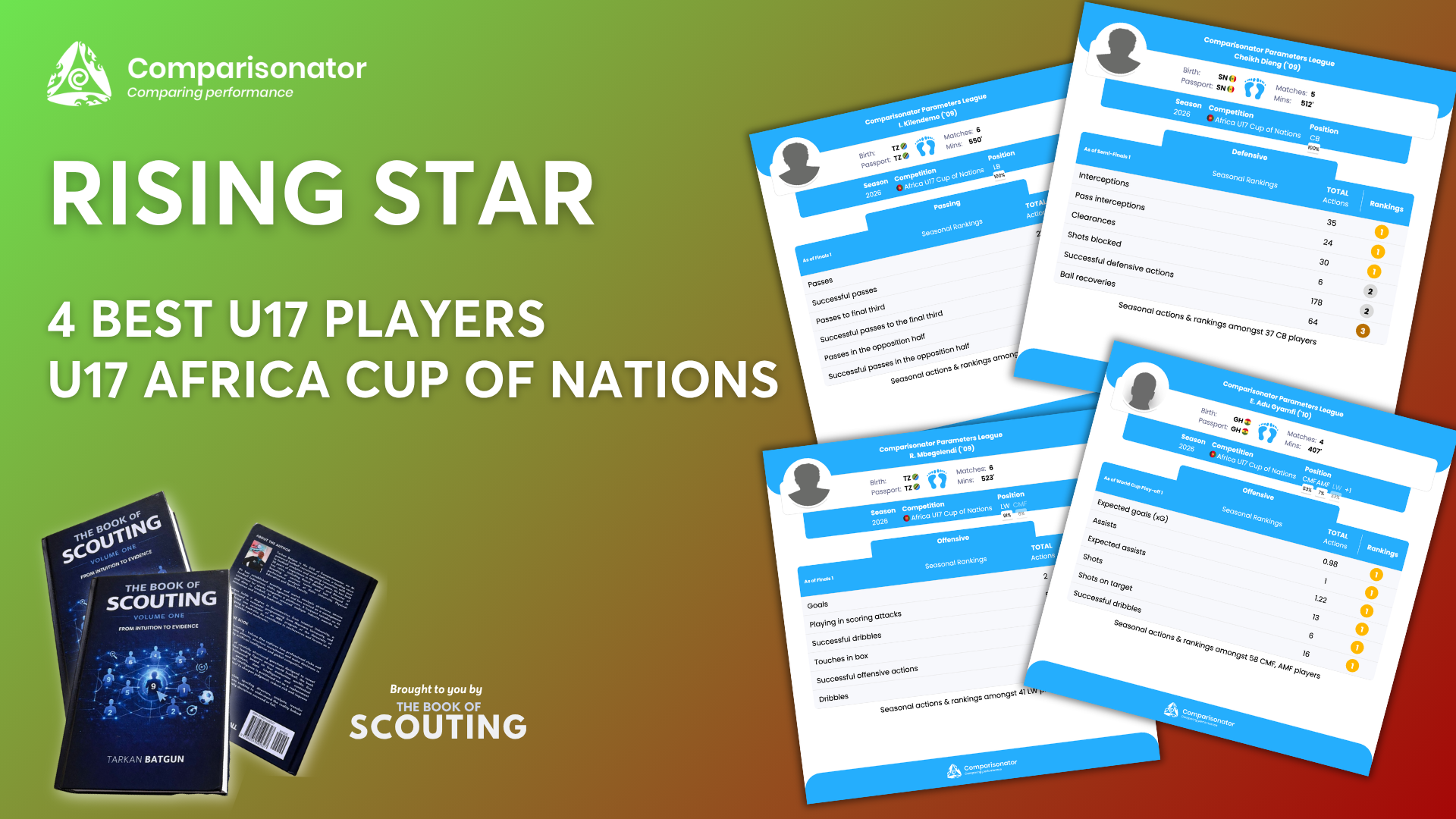
As the U17 Africa Cup of Nations 2026 season unfolds, a new wave of young talents is making a name for themselves across the league. From commanding defenders to dynamic forwards, these players are proving their worth with standout performances and impressive data-driven contributions. Using advanced performance metrics, we break down their impact, strengths, and potential, giving a data-driven perspective on why these rising stars are ones to watch. Let’s dive into the numbers and uncover what makes them stand out in U17 Africa Cup of Nations.

Powered by CompaAI, the next-generation AI solution from Comparisonator, this analysis simplifies complex football data into clear, actionable insights. With its cutting-edge features, CompaAI revolutionizes squad analysis, delivering an instant, in-depth assessment of team performance. In just seconds, it pinpoints standout players, uncovers rising young talents, and identifies key areas for enhancement.

Beyond traditional analysis, CompaAI offers strategic intelligence to refine transfer strategies. By detecting high-potential signings, it empowers clubs to strengthen key positions and scout future stars with accuracy. With CompaAI, raw data transforms into valuable, data-driven insights, providing teams with a decisive advantage in the transfer market.

Cheikh Dieng‘s CompaAI Parameters League Defensive report:

Cheikh Dieng’s standout trait is his ability to read and disrupt opposition play early. He ranks 1st out of 37 CBs in Interceptions total (35) and also 1st in Pass interceptions total (24), ahead of the next best player, A. Alaa Mohamed, who recorded 30 interceptions and 22 pass interceptions. This indicates very strong anticipation, good defensive timing, and a proactive profile in front of the back line. From a tactical perspective, he may fit well in teams that defend with an advanced line or face frequent buildup from the opposition, because he can break passing lanes and prevent attacks before they develop. His recovery work is another major strength. Dieng ranks 1st out of 37 in Clearances total (30), ahead of Cheickna Coulibaly on 27, showing strong penalty-box management and reliable last-line defending. He also sits 2nd in Shots blocked total (6), level with Lutho Makunga and just behind Adam Soudi on 8, which shows good commitment in direct defensive duels and willingness to protect the goal under pressure. Combined, these numbers point to a defender who can handle sustained pressure, contest shots, and clean up danger effectively in central defensive areas. Dieng also ranks among the better CBs in overall defensive volume. He is 2nd in Successful defensive actions total (178), behind only A. Alaa Mohamed with 202, and 3rd in both Ball recoveries total (64) and Ball recovery in own half total (58), behind A. Alaa Mohamed and Georges Esingala. He is also 3rd in Defensive actions total (207), again behind A. Alaa Mohamed (237) and Georges Esingala (211). This profile shows a defender who is consistently involved, recovers loose balls well, and contributes heavily to team defensive structure. For tactical use, this can support a side that expects its centre-backs to defend many actions without losing concentration.

Cheikh Dieng’s best ranking parameters are Interceptions total (1st, 35), Pass interceptions total (1st, 24), and Clearances total (1st, 30), supported by strong placement in Successful defensive actions total (2nd, 178) and Defensive actions total (3rd, 207). Overall, he profiles as a highly active central defender with excellent anticipation, strong box protection, and reliable recovery work. Tactical usage can lean toward a role where he defends deeper spaces, protects the box, and reads passing lanes early, while high counterpressing or very advanced pressing duties may fit him less naturally at this stage.

Cheikh Dieng (‘09) (CB) – Senegal

Idrisa Kilendemo‘s CompaAI Parameters League Passing report:

Kilendemo ranks 1st out of 36 in several key volume metrics: 287 total passes, 227 successful passes, 275 offensive passes, and 217 successful offensive passes. He also leads in 52 passes to the final third, 37 successful passes to the final third, 74 progressive passes, 55 successful progressive passes, 140 passes in the opposition half, and 109 successful passes in the opposition half. Compared with the closest challengers, he stays ahead of E. Yusuph in most of these categories, with the gap being most visible in total passing volume, final-third delivery, and opposition-half involvement. This profile points to a left-back who is heavily used in buildup, circulation, and territory progression. Tactically, he can be a strong outlet for teams that build from the back through the left side and value fullbacks who connect the defensive line with advanced areas consistently. Kilendemo’s 74 progressive passes place him 1st out of 36, and his 55 successful progressive passes place him 2nd out of 36, just behind E. Yusuph on the successful side. He also ranks 2nd out of 36 for 120 forward passes and 90 successful forward passes, again close to the top group. This shows that his passing is not limited to safe circulation; he can advance the ball into more dangerous zones and help the team move through lines. The tactical value here is clear: he can be used as a possession-progressing left-back in structured teams, especially when the coach wants the fullback to initiate attacks, break pressure with forward connection, and support territorial gain. Kilendemo ranks 2nd out of 36 in 17 crosses and 2nd out of 36 in 6 successful crosses. While the efficiency is not the best in the group, the raw crossing volume is still strong for a left-back. This suggests that he is willing to deliver from advanced wide areas and can be included in attacking patterns that create width and early service into the box. For tactical use, this makes him suitable for systems with wide overloads, overlapping runs, or a winger who comes inside and opens the flank for the fullback.

Kilendemo’s strongest seasonal passing indicators are his 1st-place rankings in total passes, successful passes, passes to the final third, successful passes to the final third, offensive passes, successful offensive passes, progressive passes, received passes, passes in the opposition half, and successful passes in the opposition half. His profile is that of a high-volume, progression-focused left-back who is heavily involved in buildup and territorial advancement. The main limitations are in final-third creation, smart passing, and some delivery efficiency, where his numbers are useful but not elite. Tactically, he can be deployed as a possession-oriented left-back in a team that values buildup support, forward progression, and width provision, rather than as a primary creator from wide areas.

Idrisa Kilendemo (‘09) (LB) – Tanzania

Eric Adu Gyamfi‘s CompaAI Parameters League Offensive report:

E. Adu Gyamfi’s standout offensive strength is his overall final-third volume and progression. He ranks 1st out of 58 CMF/AMF players in Expected goals (xG) total (0.98), Expected assists total (1.22), Shot on target assists total (4), Shots total (13), Shots on target total (6), Dribbles total (22), Successful dribbles total (16), Dribbling in the final third total (18), Successful dribbling in the final third total (12), Opportunity total (10), and Successful offensive actions total (104). He is also among the top in Offensive actions total, where he ranks 2nd out of 58 with 167, only behind Ahmed Safwat El Geziry’s 168. This profile points to a midfielder who is consistently involved in creating and finishing attacks, not just linking play. The combination of high xG, high xA, and strong dribble volume indicates a player who can both carry threat himself and create advantages for teammates in advanced zones. His dribbling output is particularly valuable tactically. With 22 dribbles, 16 successful dribbles, and 72.73% successful dribbles, he leads the position group in both volume and effectiveness. In the final third, he also leads with 18 dribbling actions and 12 successful final-third dribbles, which shows that his one-on-one game is not limited to safe areas of the pitch. Compared with the next best in the group, Ahmed Safwat El Geziry with 18 dribbles and 10 successful dribbles, Gyamfi has a clearer edge in both output and efficiency. This can be tactically important for a side that wants a midfielder who can break lines by ball carrying, attract pressure, and create overloads near the box. His final-product involvement is also strong. He ranks 1st in assists total with 1, sharing the top value with Aphelele Majola and Walid Nechab, while also ranking 1st in expected assists with 1.22, ahead of Ahmed Safwat El Geziry’s 0.81. He also posts 5 shot assists, ranking 4th out of 58, which supports the view that he is not only a ball carrier but also a consistent chance creator.

E. Adu Gyamfi’s best seasonal offensive rankings are his 1st-place finishes in xG, xA, shot-on-target assists, shots, shots on target, dribbles, successful dribbles, final-third dribbles, successful final-third dribbles, opportunities, and successful offensive actions, plus 2nd in offensive actions overall. This is a very strong offensive profile for a CMF/AMF-type player, built on volume, progression, and chance creation. The weaker areas are more about end-product efficiency than involvement, with his goal return and shooting conversion sitting below the very top tier.

Eric Adu Gyamfi (‘10) (CMF) – Ghana

Razaki Mbegelendi‘s CompaAI Parameters League Offensive report:

Mbegelendi scored 2 goals, ranking 1st out of 41 LW players, level with the best performers J. Narbi and Z. Saoudi on 2 goals each. He also recorded 5 playing in scoring attacks, again 1st out of 41, tied with Ilyes Grini and S. Hamis. These are the clearest indicators of his attacking value: he is not just involved in wide buildup, but regularly appears in the final phase where attacks become dangerous. Tactically, this can fit a side that wants the left winger to arrive in scoring zones rather than remain only a dribbler or provider. He produced 18 successful dribbles, ranking 2nd out of 41, tied with L. Abdul Wunzalgu, behind only I. Rabbaj on 24. He also registered 17 touches in the box, ranking 2nd out of 41, just behind Ismail El Aoud on 19. This combination shows a winger who can beat defenders and then carry that advantage into the box, which is tactically valuable against compact blocks. He can be used to isolate full-backs, attack the half-space, and create instability near goal. Mbegelendi recorded 135 successful offensive actions, ranking 2nd out of 41, behind I. Rabbaj on 153. He also had 12 successful dribbles in the final third, ranking 3rd out of 41, behind I. Rabbaj on 23 and L. Abdul Wunzalgu on 15. On top of that, he delivered 28 dribbles total, ranking 3rd out of 41. This profile suggests a player who is consistently active in advanced zones, not only making isolated actions. He can be trusted as a repeat attacker in systems that rely on wide progression and repeated 1v1 actions.

R. Mbegelendi’s strongest seasonal rankings are in goals, playing in scoring attacks, successful dribbles, touches in the box, and successful offensive actions, all of which place him near the top of the LW group. His profile points to a winger with strong direct impact, good box presence, and the ability to break lines through dribbling. The main areas for development are shot volume, finishing consistency, progressive carrying, and chance creation volume relative to the very best in the position.

Razaki Mbegelendi (‘09) (LW) – Tanzania

Tarkan Batgün

Tarkan Batgun is scouting & match analysis specialist with more than 20 years in football field, worked as a scouting director & head of performance analysis inside clubs, lectured in federations, currently working as the CEO of Comparisonator platform.

Leave a Reply


Close Menu