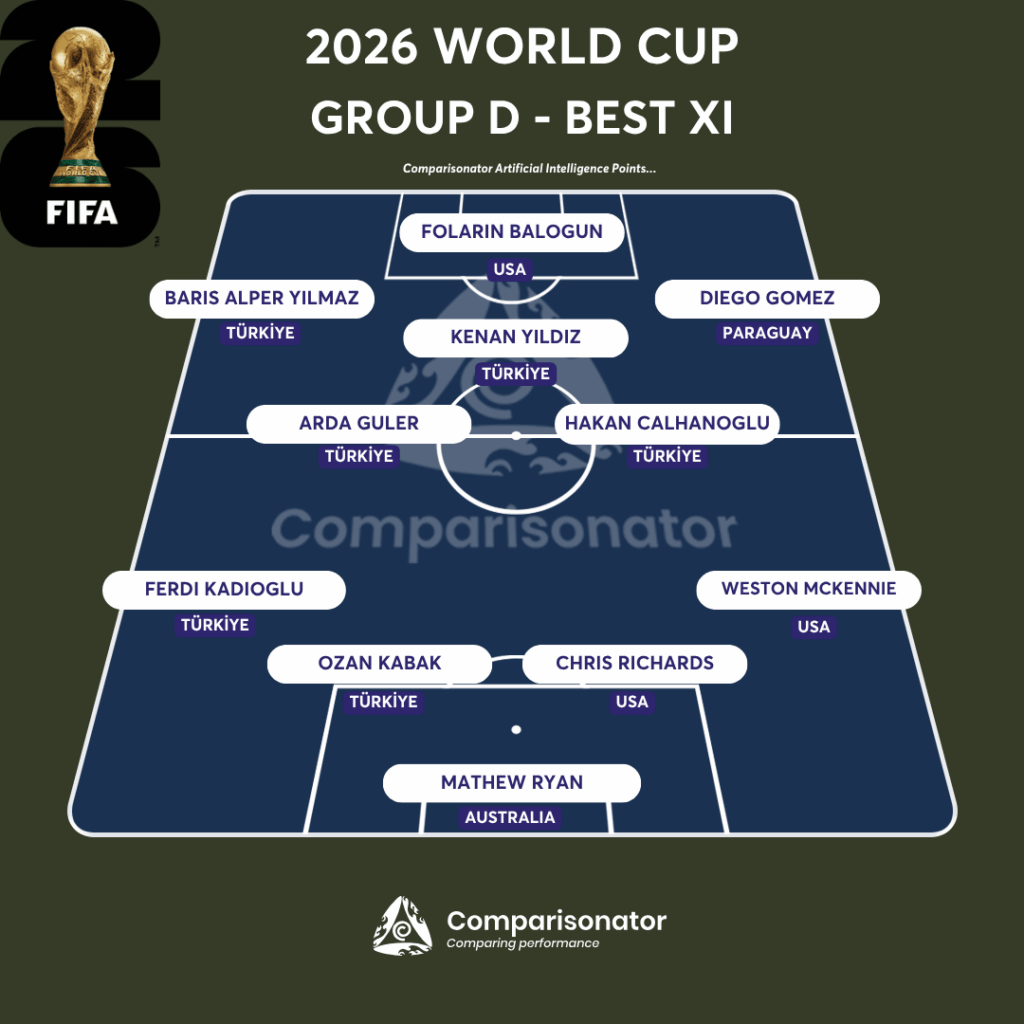

Brought to you by The Book of Scouting, our experts analysed “The 2026 World Cup-Group D” has always been a breeding ground for talent. With rising stars making their mark, we have identified the top four players who have been standout performers.
Powered by CompaAI, the cutting-edge AI tool from Comparisonator, this analysis turns complex football data into clear, actionable insights. With its latest advancements, CompaAI transforms squad analysis, delivering an instant, comprehensive view of team performance. In seconds, it highlights standout players, identifies emerging young talents, and pinpoints key areas for improvement.
More than just analysis, CompaAI provides strategic guidance to optimize transfer strategies. By accurately detecting top potential signings, it enables clubs to reinforce key positions and scout future stars with precision. With CompaAI, raw data becomes powerful, data-driven intelligence, giving teams a competitive edge in the transfer market.
4 Best Players in 2026 World Cup – Group D
Kenan Yıldız (‘05) (AMF) – Türkiye (Juventus Performance)
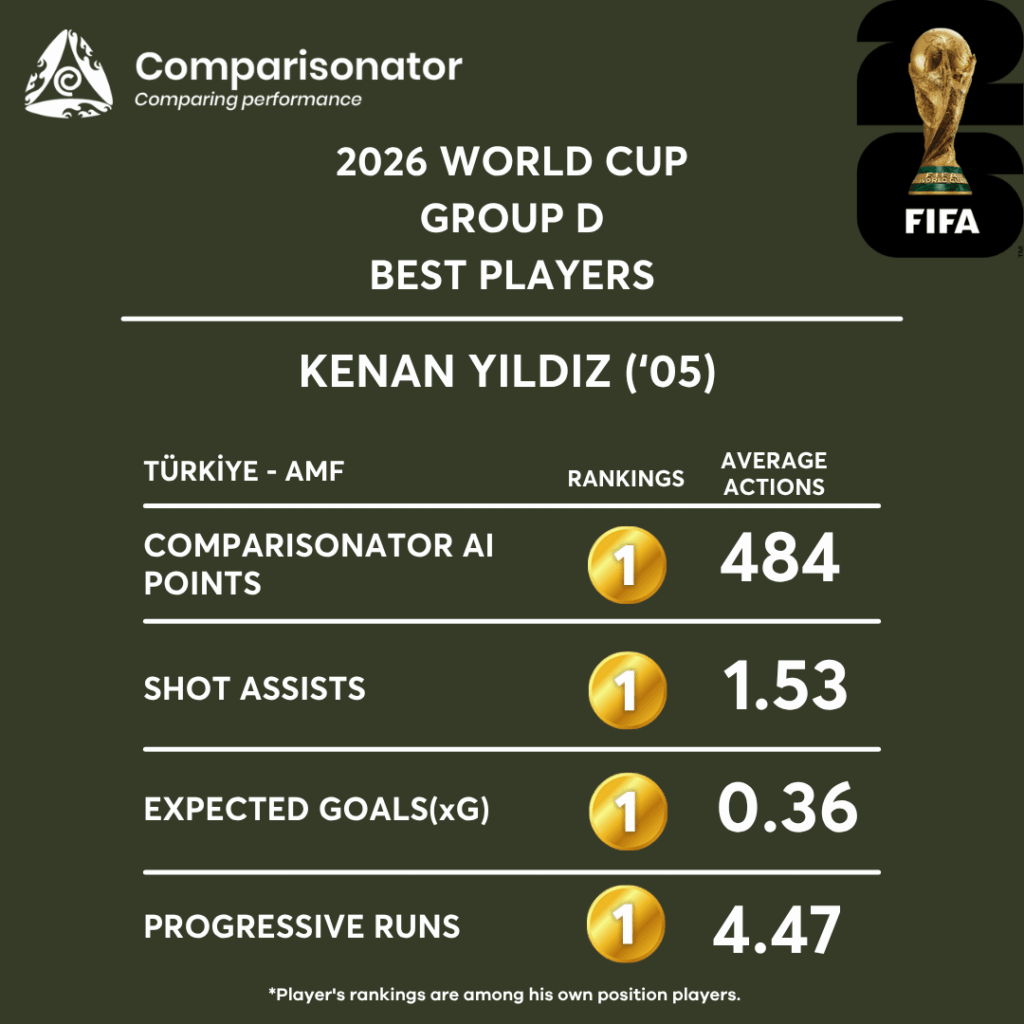

Kenan Yıldız’s CompaAI Offensive report:
Kenan Yıldız stands out first as one of the most dangerous direct attacking threats in the league from his position. He ranks 1st out of 11 for Expected goals (xG) with 0.36, ahead of Weston McKennie on 0.30. He also ranks 1st out of 11 for Shots on target with 1.41, ahead of Nico Paz on 1.27, and 2nd out of 11 for Shots with 2.94, just behind Nico Paz on 3.50. This profile points to a player who consistently gets into high-value shooting zones and is able to finish actions with regularity. His creative shooting support is also elite. Yıldız ranks 1st out of 11 for Shot assists with 1.53, ahead of Charles De Ketelaere on 1.43, and 2nd out of 11 for Opportunity with 1.88, just behind Nico Paz on 1.93. He adds 4th out of 11 in Shot on target assists with 0.59, behind Charles De Ketelaere on 1.14 and Weston McKennie on 0.69. This shows that he is not only finishing attacks himself, but also creating finishing chances for teammates through final action delivery. In practical terms, he can operate as a primary link between possession and final-third threat, especially in systems that rely on advanced combinations around the box. His 1v1 and progression output is the clearest dominance point in the dataset. He also ranks 1st out of 11 in Progressive runs with 4.47. This is a major attacking strength: he can receive under pressure, eliminate defenders, and move the team into dangerous territory by carrying the ball.
Kenan Yıldız’s best ranking parameters are clearly tied to dribbling volume and success, progressive runs, touches in the box, offensive actions, shot assists, xG, and shots on target. The profile points to a highly active attacking midfielder who can create separation, carry the ball into advanced zones, and generate both shots and shot assists at an elite level for his position. The most visible weaknesses are goal conversion efficiency, assist output, and final scoring impact relative to his chance volume.
Diego Gomez (‘03) (RW) – Paraguay (Brighton Performance)
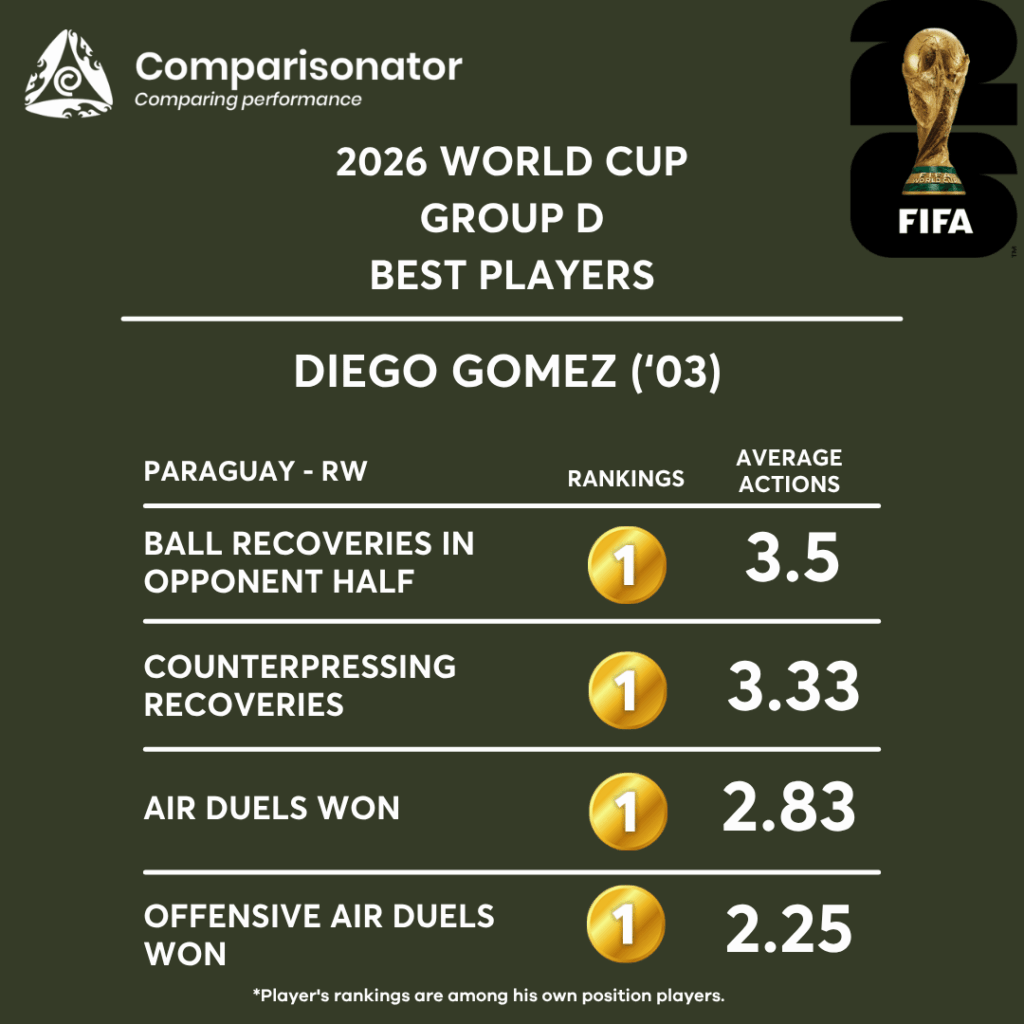
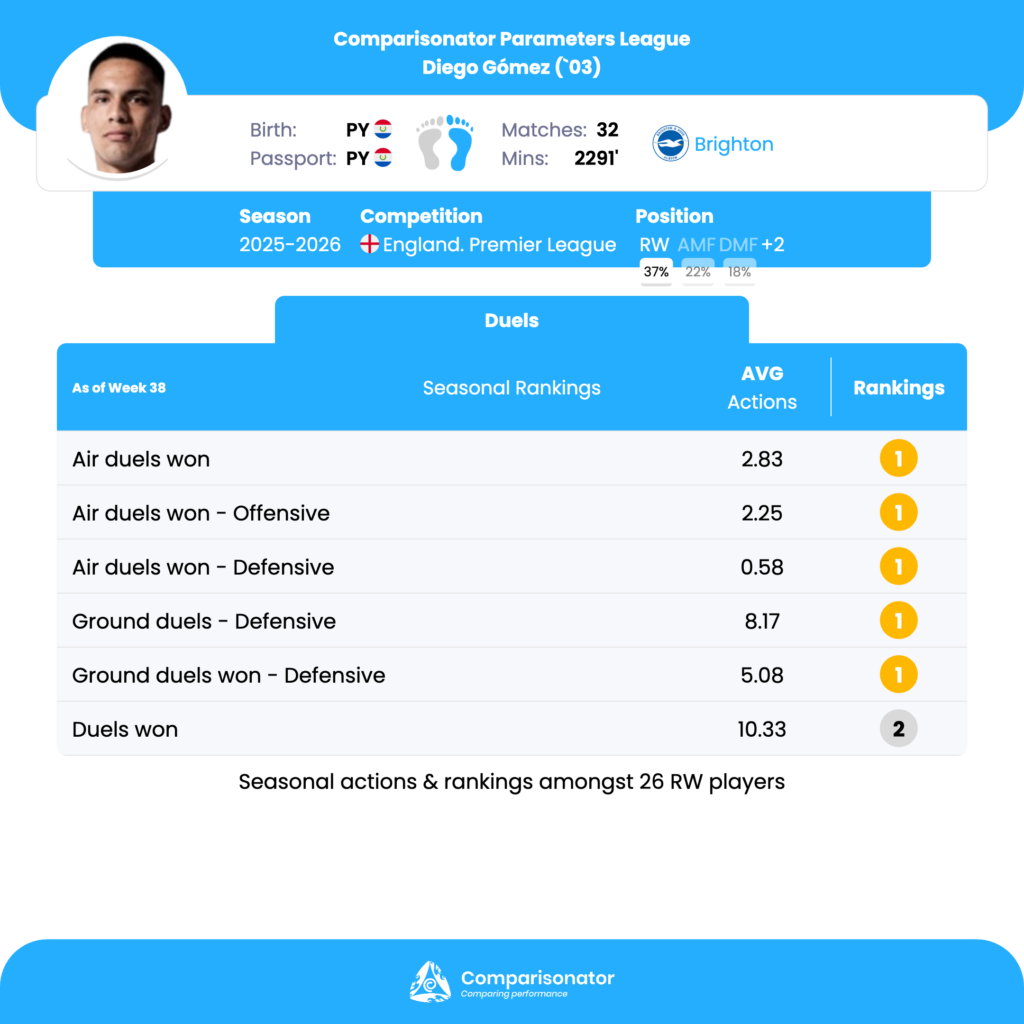
Diego Gomez’s CompaAI Duels report:
Diego Gómez ranks 1st out of 26 RW players in Air duels won average per match with 2.83, ahead of Rayan at 2.17. He is also 1st out of 26 in Air duels won – Offensive average per match with 2.25, ahead of Rayan at 2.08, and 1st out of 26 in Air duels won – Defensive average per match with 0.58, ahead of Antoine Semenyo at 0.36. This shows a winger who can win aerial battles in both phases, not just when attacking the ball. Tactically, that can be valuable in direct transitions, second-ball situations, and when Brighton need an outlet under pressure. It also gives him an advantage in wide duels against full-backs and in back-post situations. He ranks 1st out of 26 in Ground duels – Defensive average per match with 8.17, ahead of Iliman Ndiaye at 6.35, and 1st out of 26 in Ground duels won – Defensive average per match with 5.08, ahead of Ndiaye at 3.96. This is an elite defensive work-rate profile for a winger and indicates strong engagement when out of possession. He is capable of pressing, recovering, and contesting challenges in wide areas.
Diego Gómez’s best ranking parameters are clearly in aerial duels, defensive ground duels, and overall duel win rate, where he sits 1st in several categories and 2nd in others among RW players. His strongest signals point to a winger with strong physical engagement, reliable defensive contribution, and very good aerial competitiveness. The main weakness is his offensive ground-duel output, where he ranks near the bottom of the group, indicating less effectiveness in attacking 1v1 situations.
Weston McKennie (‘98) (RB) – USA (Juventus Performance)
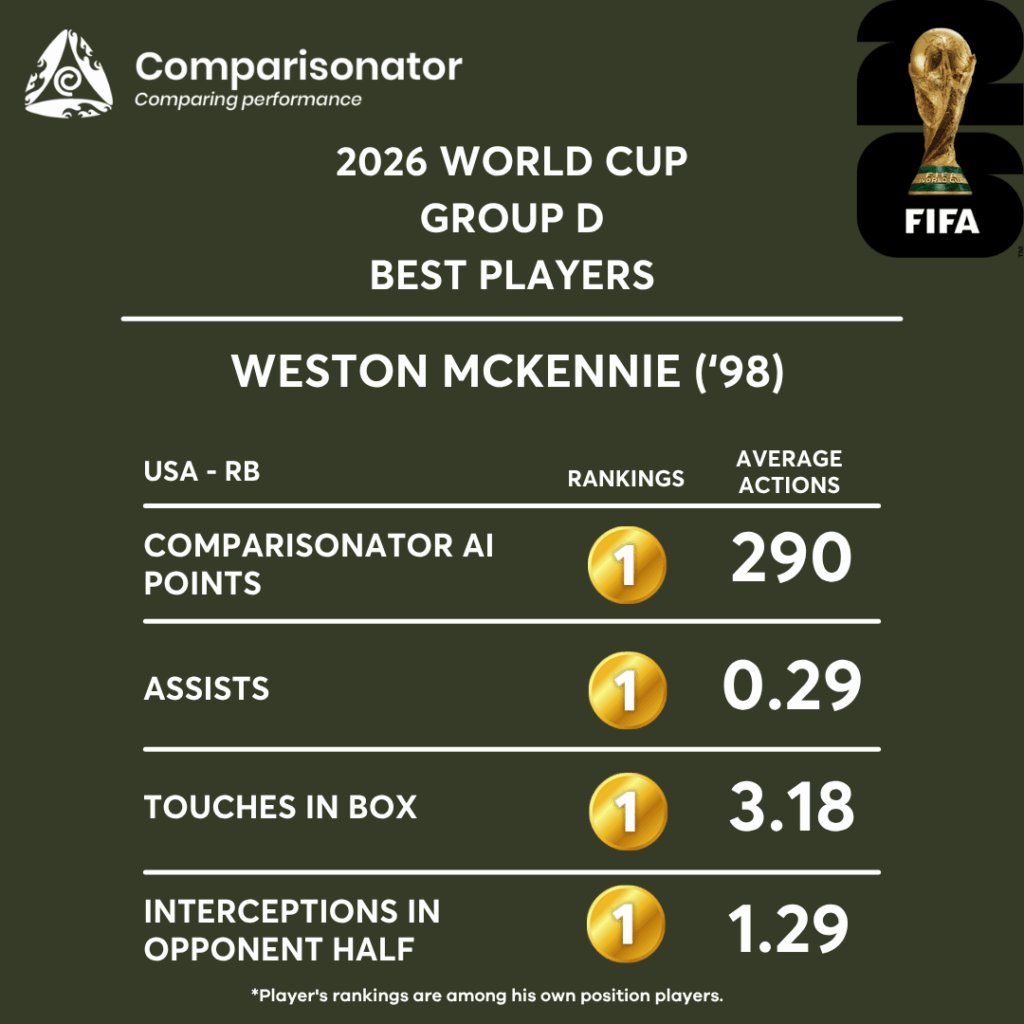

Weston McKennie’s CompaAI Offensive report:
He ranks 1st out of 38 RBs in Assists per match (0.29), ahead of Emil Holm at 0.24. He also ranks 4th in Expected assists per match (0.15), just behind Wesley at 0.23 and Raoul Bellanova at 0.16. This combination points to real productivity in the final pass rather than only territorial presence. His assist output is especially notable because it is not just volume-based; it aligns with meaningful attacking involvement. From a tactical perspective, he can be used as a fullback who overlaps, delivers the final ball, and connects with box entries from wide advanced zones. McKennie ranks 1st out of 38 RBs in Goals per match (0.18), Expected goals per match (0.21), and Playing in scoring attacks per match (0.82). He also ranks 1st out of 38 in Touches in box per match (3.18). Compared with the next best RBs, his gap is clear: Denzel Dumfries is second in goals at 0.15, in xG at 0.19, in scoring attacks at 0.75, and in box touches at 2.75. This indicates McKennie is consistently arriving in attacking finish zones at an elite level for the position.
McKennie’s best seasonal indicators are his 1st-place rankings in goals, xG, scoring attacks, assists, and box touches, which together present a highly productive attacking RB profile. His offensive value is strongest when he is allowed to move into advanced right-sided and central finishing zones, rather than being asked to consistently progress the ball through carries or repeated 1v1 dribbles.
Jordan Bos (‘02) (LB) – Australia (Feyenoord Performance)

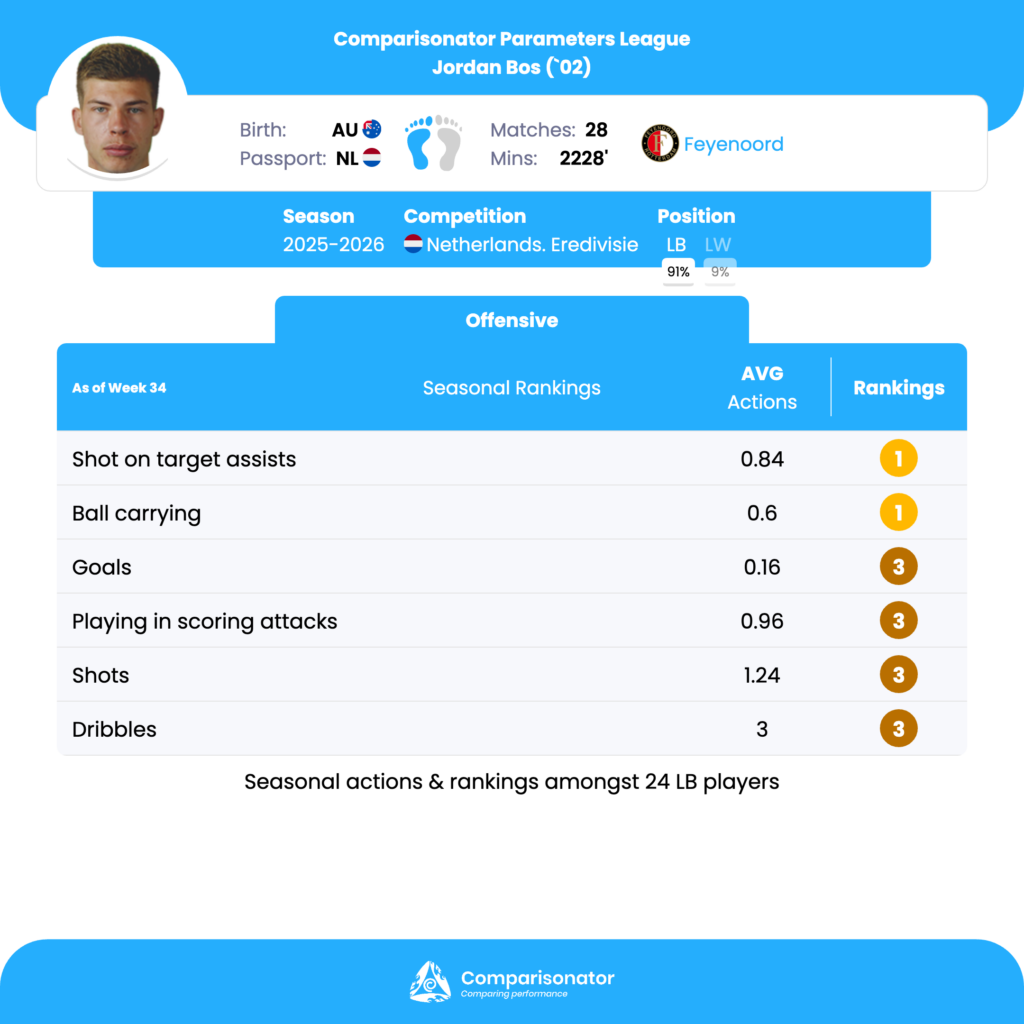
Jordan Bos’s CompaAI Offensive report:
Jordan Bos’ most notable attacking edge is his end product creation from wide areas. He ranks 1st out of 24 LB in Shot on target assists with 0.84 per match, ahead of Mats Rots on 0.68. He also ranks 1st in Ball carrying with 0.6 per match, level with Anass Salah-Eddine at the top value. This combination points to a fullback who can progress the ball aggressively and turn carries into direct shooting situations. His attacking volume is also strong across several progressive indicators. Bos ranks 3rd in Goals with 0.16, behind Başar Önal (0.25) and Jeff Hardeveld (0.19), and 3rd in Playing in scoring attacks with 0.96, behind Mauro Júnior (1.29) and Başar Önal (1.11). He sits 3rd in Shots with 1.24 and 3rd in Shots on target with 0.44, while also ranking 3rd in Dribbles with 3.0, behind Başar Önal (5.18) and Sergiño Dest (4.36). This shows a left-back who is not only involved in buildup but also consistently enters finishing zones and contributes to active attacking sequences.
Jordan Bos’ strongest seasonal offensive rankings are Shot on target assists, Ball carrying, and a cluster of high-volume attacking metrics including Goals, Playing in scoring attacks, Shots, Shots on target, Dribbles, and Progressive runs. The profile points to an aggressive, offense-oriented left-back who can progress play, enter advanced zones, and contribute directly to attacks. His main limitations are in direct creative output, expected goal/assist impact, and execution efficiency, where he ranks below the top attackers in the position.