

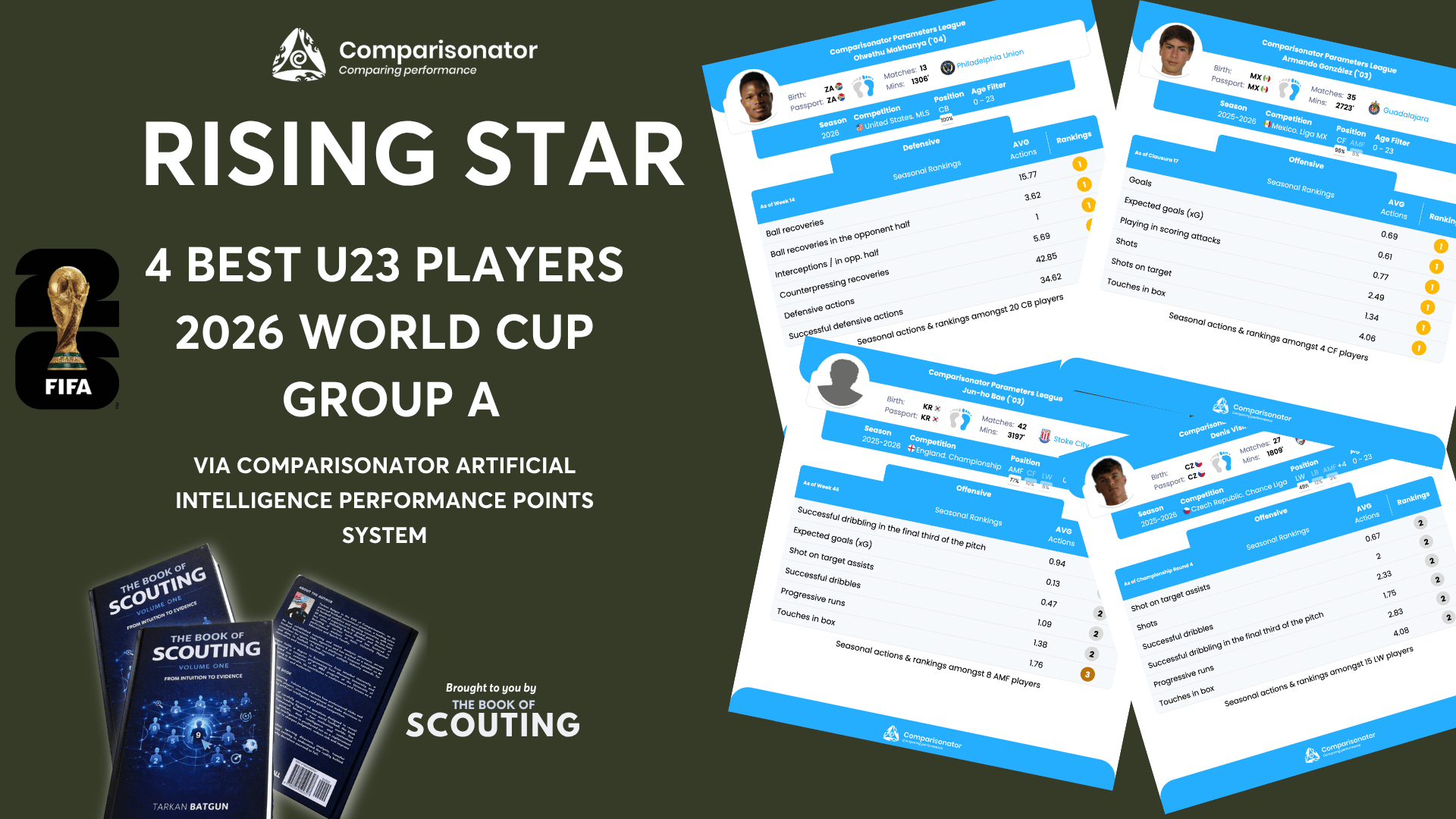
As the 2026 World Cup Group A, 2025/26 season unfolds a new wave of young talents is making a name for themselves across the league. From commanding defenders to dynamic forwards, these players are proving their worth with standout performances and impressive data-driven contributions. Using advanced performance metrics, we break down their impact, strengths, and potential, giving a data-driven perspective on why these rising stars are ones to watch. Let’s dive into the numbers and uncover what makes them stand out in 2026 World Cup Group A.

Powered by CompaAI, the next-generation AI solution from Comparisonator, this analysis simplifies complex football data into clear, actionable insights. With its cutting-edge features, CompaAI revolutionizes squad analysis, delivering an instant, in-depth assessment of team performance. In just seconds, it pinpoints standout players, uncovers rising young talents, and identifies key areas for enhancement.

Beyond traditional analysis, CompaAI offers strategic intelligence to refine transfer strategies. By detecting high-potential signings, it empowers clubs to strengthen key positions and scout future stars with accuracy. With CompaAI, raw data transforms into valuable, data-driven insights, providing teams with a decisive advantage in the transfer market.

Olwethu Makhanya‘s CompaAI Parameters League Defensive report:

Makhanya’s biggest defensive strength is his ball-winning volume and recovery activity, where he ranks 1st out of 20 CBs in several key indicators. He averages 15.77 ball recoveries per match, ahead of Efraín Morales at 12.3, and this is split into 12.15 recoveries in his own half and 3.62 in the opponent half, both ranking 1st in the group. That combination shows a defender who is highly active in both protecting his own box and stepping forward to regain possession higher up the pitch. Tactically, this can fit a side that wants a centre-back capable of supporting a high line, compressing space, and quickly restoring possession after loss. His counterpressing output is also elite. Makhanya averages 5.69 counterpressing recoveries per match, again 1st out of 20, just above Efraín Morales at 5.5. This points to strong reaction speed after possession changes and a profile well suited to aggressive team pressing structures. In practical terms, he can be valuable in moments immediately after turnover, where quick regains can prevent transitions from developing.

Makhanya’s best ranking parameters are his ball recoveries, recoveries in both halves, counterpressing recoveries, and overall defensive actions, where he consistently sits among the top performers in the age and position cohort. The profile suggests a high-activity, proactive centre-back who excels at regaining possession, pressing after turnover, and disrupting opponent buildup. His main relative limitations are clearances, shot blocks, and defensive success percentage, which indicate that his game is less centered on last-ditch box defending and more on anticipation and recovery.

Olwethu Makhanya (‘04) (CB) – South Africa (Philadelphia Union Performance)

Denis Visinsky‘s CompaAI Parameters League Offensive report:

Visinsky’s clearest strength is his ball progression and 1v1 attacking volume. He ranks 2nd/15 in Shots average per match (2), Dribbles (4.83), Successful dribbles (2.33), Dribbling in the final third (3.83), Successful dribbling in the final third (1.75), Progressive runs (2.83), and Ball carrying (0.58). In most of these areas, he is only behind Ebrima Singhateh, who leads the group with higher attacking output across the same profile. This shows a winger who can consistently take on opponents, advance the ball, and create penetration in advanced zones. Visinsky also performs strongly in chance-creation and shot generation support. He is 2nd/15 in Shot on target assists (0.67), behind Emmanuel Ayaosi at 0.75, and 3rd/15 in Shot assists (1.33) behind David Planka at 1.73 and Tom Sloncik at 1.46. He is also 3rd/15 in Expected goals (xG) (0.28) behind Ebrima Singhateh (0.35) and Prince Adu (0.32), which confirms that his presence is not limited to wide dribbling; he is also a genuine box-arrival threat.

Visinsky’s best ranking parameters are concentrated in dribbling volume, progressive carrying, box presence, offensive activity, and shot-related support, where he repeatedly places in the top 2-3 among U23 LW peers. He looks like a direct wide attacker who can advance play, attack the final third, and arrive in dangerous zones with regularity. The main concerns are dribbling efficiency, finishing output, and assist production, which sit below the top tier of the position.

Denis Visinsky (‘03) (LW) – Czechia (Viktoria Plzeň Performance)

Jun-ho Bae‘s CompaAI Parameters League Offensive report:

Jun-ho Bae’s clearest attacking strength is his dribbling impact in the final third. He ranks 1st out of 8 with 0.94 successful dribbling in the final third per match, ahead of Adrian Segečić on 0.73. He also leads the group in successful dribbles % at 67.27%, again finishing 1st out of 8, with Isaac Price next on 64.29%. This profile points to a player who can beat opponents efficiently in advanced zones, not just attempt dribbles. His broader ball progression also sits near the top of the group. Jun-ho Bae is 2nd out of 8 in successful dribbles per match with 1.09, just behind Divine Mukasa on 1.31, and 2nd out of 8 in progressive runs with 1.38, level with Divine Mukasa at 1.38. This indicates a strong capacity to carry the ball into more dangerous areas and advance play through individual movement. He also ranks 3rd out of 8 in dribbling in the final third per match with 1.32, behind Bobby Clark (1.91) and Adrian Segečić (1.53). Taken together, these numbers suggest he is a consistent attacking connector who can receive, carry, and attack space rather than remaining stationary.

Jun-ho Bae’s best ranking parameters are built around advanced dribbling efficiency, progressive carrying, and attacking involvement. His top outputs include 1st in successful dribbling in the final third, 1st in successful dribbles %, 2nd in successful dribbles, 2nd in progressive runs, and 2nd in shot on target assists. This points to an AMF who can move the ball through pressure and enter dangerous areas with control. The weaker side is his final production, where goals, assists, xA, and scoring-attacks involvement are all near the bottom of the group.

Jun-ho Bae (‘03) (AMF) – South Korea (Stoke City Performance)

Armando González‘s CompaAI Parameters League Offensive report:

Armando González is the clear standout finisher in this age and position group. He ranks 1st out of 4 in Goals (0.69), Expected Goals/xG (0.61), and Shots on target (1.34), while also leading in Shots (2.49) and Shots on target converted to goals (51.06%). Compared with the category leaders, his output is not just volume-based but also efficient: he generates the highest shot volume and converts a strong share of those shots into goals. This indicates a forward who can consistently get into scoring positions and turn those chances into end product. His off-ball attacking presence is also very strong. González ranks 1st in Playing in scoring attacks (0.77), Touches in box (4.06), and Opportunity (2.51), ahead of the next-best players by a clear margin. This points to a striker who is regularly involved in dangerous sequences and is a constant presence inside the box. His directness in attacking transitions is another positive. González ranks 1st in Progressive runs (0.66) and Dribbles (0.91), and he is also top in Dribbling in the final third (0.86) and Successful dribbling in the final third (0.40). These numbers show a striker who can carry the ball forward and break lines when needed, rather than being limited to static finishing.

Armando González’s strongest seasonal indicators are his Goals, xG, Shots, Shots on target, Playing in scoring attacks, Touches in box, Opportunity, and Successful offensive actions, all of which rank 1st out of 4 in his age-position group. This paints the picture of a high-end under-23 CF whose biggest value comes from box presence, shot generation, and finishing efficiency. His main limitations are in assists, expected assists, shot assists, and ball carrying, where he ranks near the bottom of the group, so his profile is far more about ending attacks than building them.

Armando González (‘03) (CF) – Mexico (Guadalajara Performance)

Tarkan Batgün

Tarkan Batgun is scouting & match analysis specialist with more than 20 years in football field, worked as a scouting director & head of performance analysis inside clubs, lectured in federations, currently working as the CEO of Comparisonator platform.

Leave a Reply


Close Menu