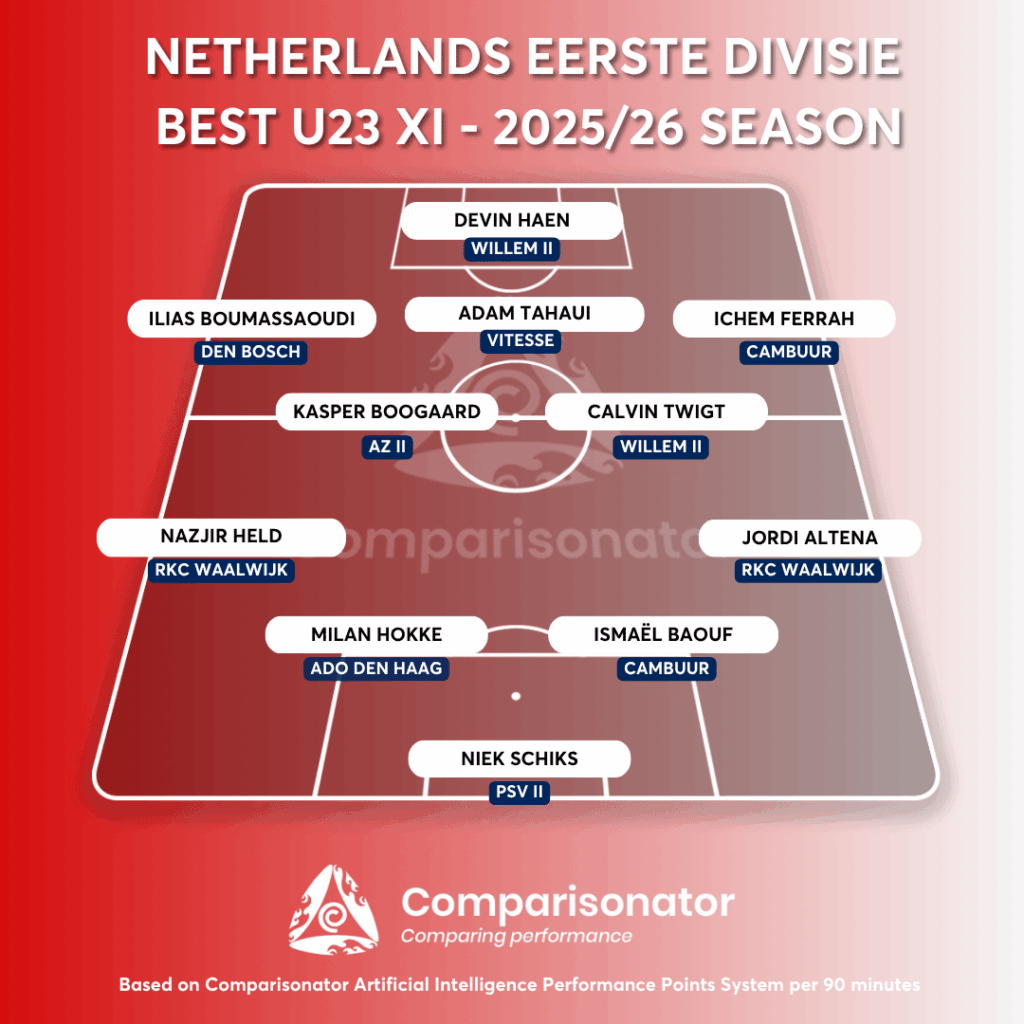

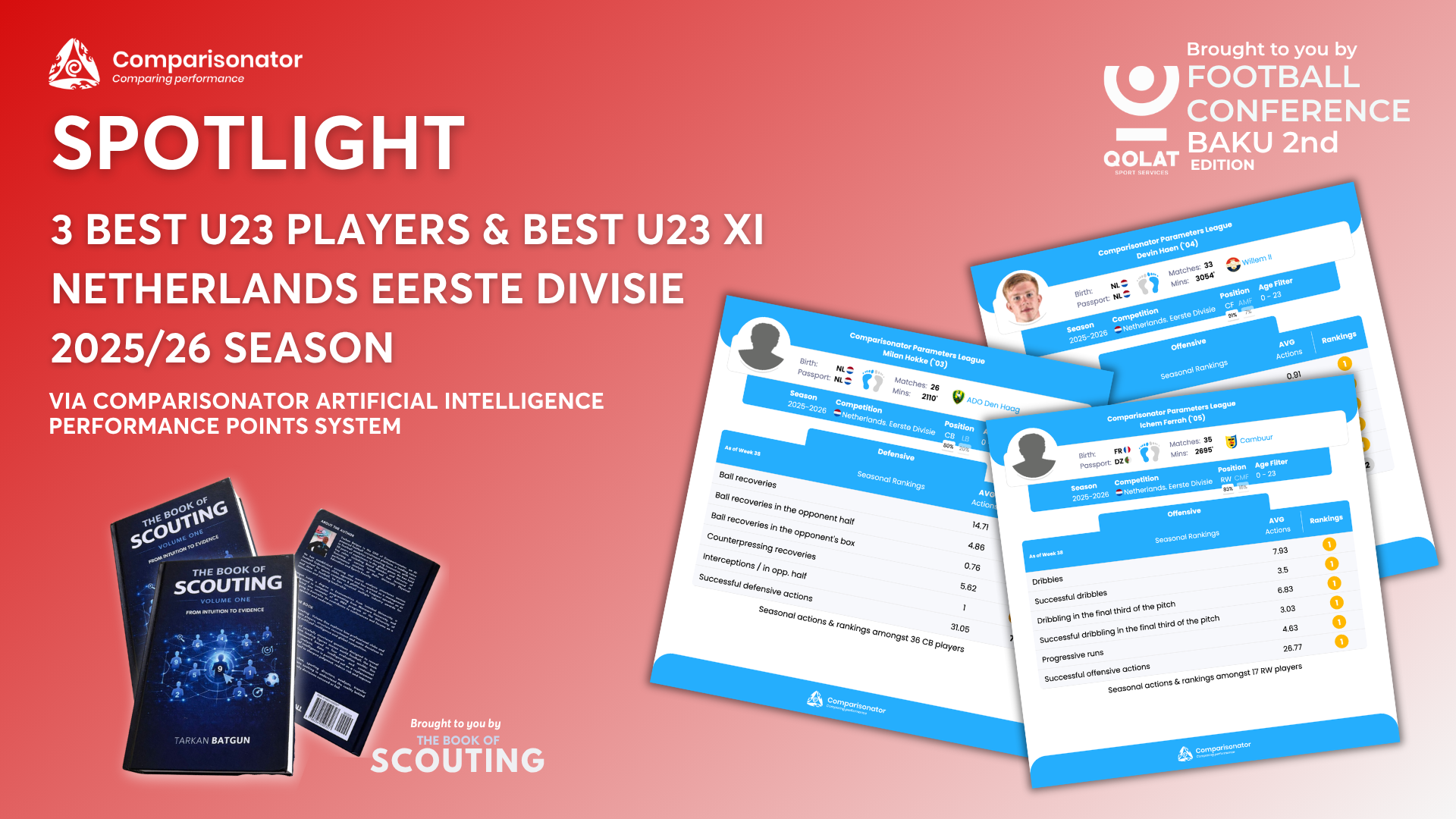
Netherlands Eerste Divisie has always been a breeding ground for talent, and the 2025/26 season is no exception. With rising stars making their mark, we have identified the top three players who have been standout performers.
Powered by CompaAI, the cutting-edge AI tool from Comparisonator, this analysis turns complex football data into clear, actionable insights. With its latest advancements, CompaAI transforms squad analysis, delivering an instant, comprehensive view of team performance. In seconds, it highlights standout players, identifies emerging young talents, and pinpoints key areas for improvement.
More than just analysis, CompaAI provides strategic guidance to optimize transfer strategies. By accurately detecting top potential signings, it enables clubs to reinforce key positions and scout future stars with precision. With CompaAI, raw data becomes powerful, data-driven intelligence, giving teams a competitive edge in the transfer market.
3 Best U23 Players in Netherlands Eerste Divisie
Milan Hokke (‘03) (CB) – ADO Den Haag
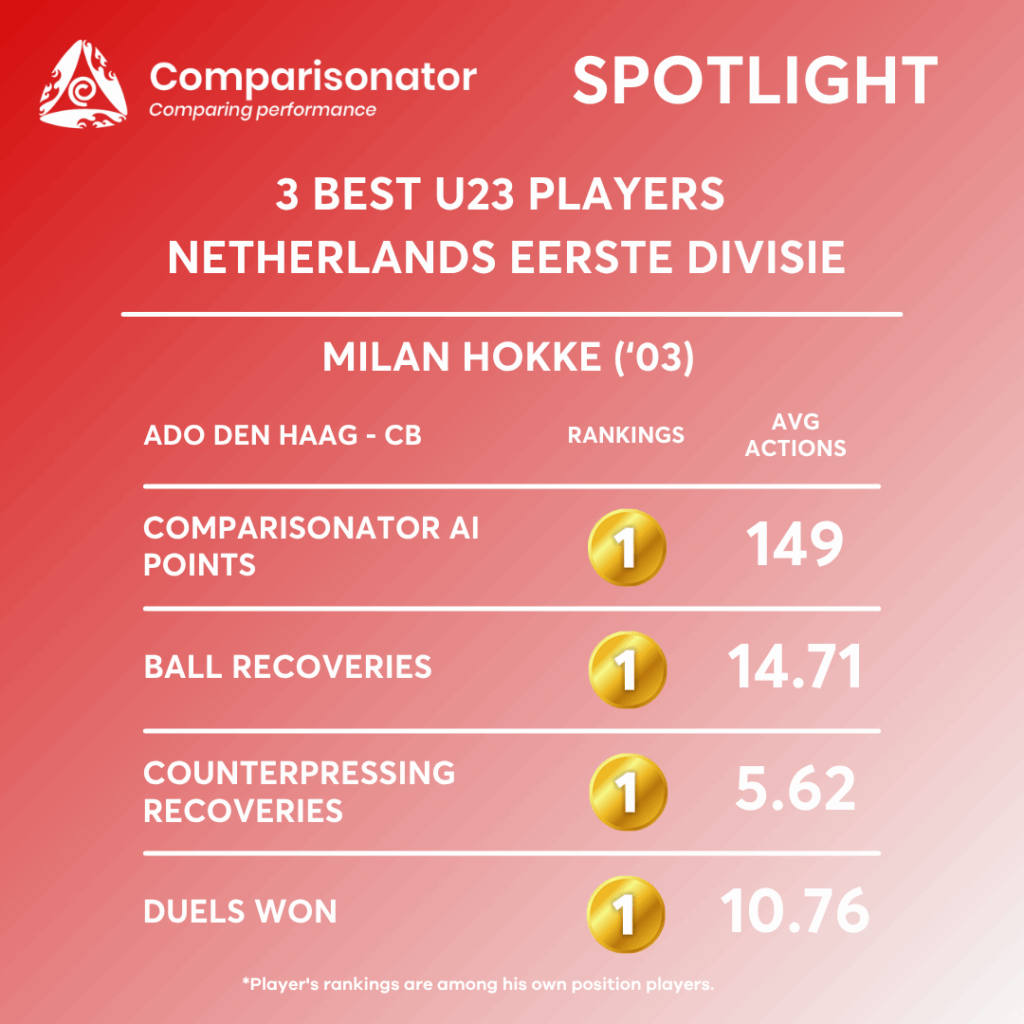
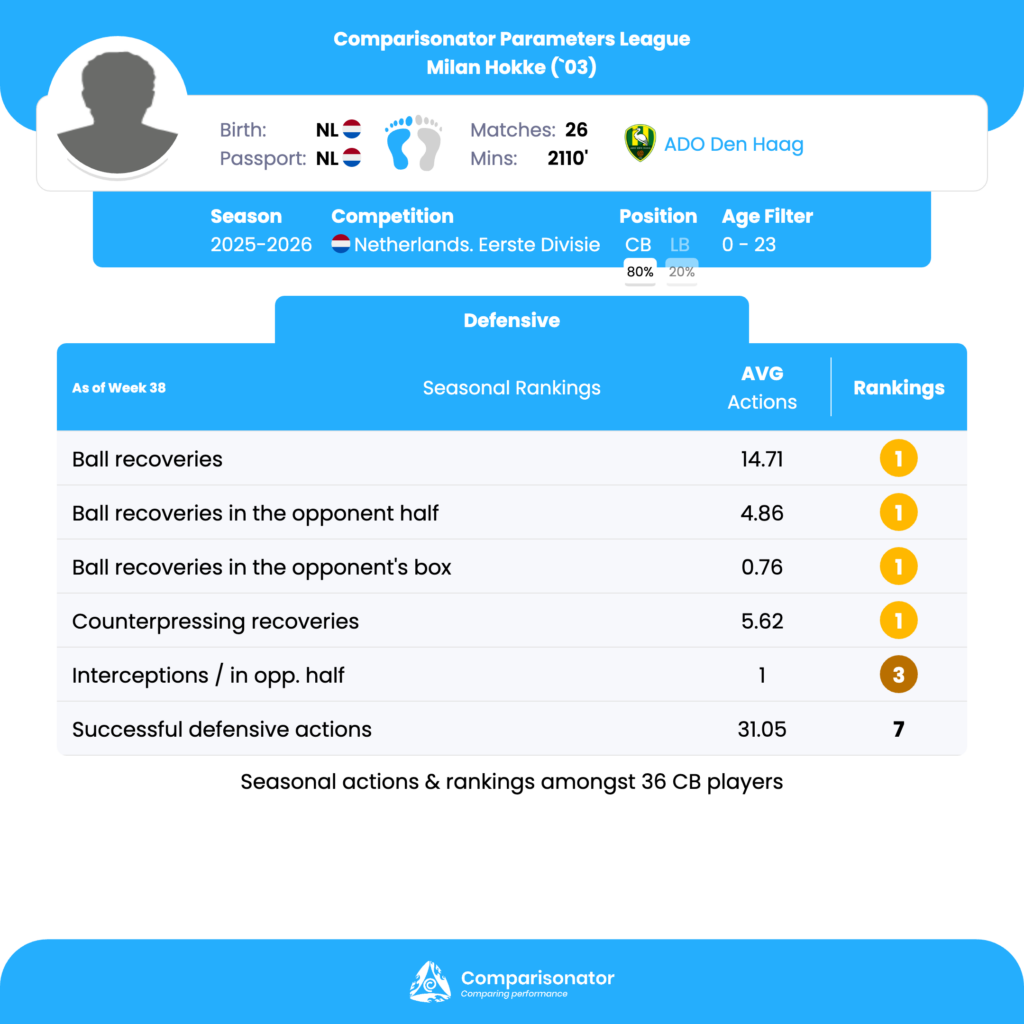
Milan Hokke’s CompaAI Defensive report:
Milan Hokke’s biggest seasonal strength is his ball-winning volume and advanced recovery activity. He ranks 1st out of 36 CBs under 23 with 14.71 ball recoveries per match, ahead of Ismaël Baouf (14.14). He is also 1st out of 36 for ball recoveries in the opponent half with 4.86, ahead of J. Plug (3.64), and 1st out of 36 for ball recoveries in the opponent’s box with 0.76, ahead of Nick Twisk (0.63). On top of that, he leads the group in counterpressing recoveries with 5.62 per match, ahead of Nick Twisk (5.13). This profile points to a centre-back who is highly active in stepping into pressure, recovering second balls, and helping his team win the ball high up the pitch. Tactically, that makes him valuable for an aggressive defensive line, pressing structures, and possession-based teams that want centre-backs to secure territory quickly after losing the ball. A second major strength is his ability to contribute in the opponent half through defensive actions rather than pure deep defending. He ranks 3rd out of 36 for interceptions in the opponent half with 1.00 per match, behind Finn Dicke (1.07) and F. Merién (1.04). This supports the idea that he reads higher-field defensive moments well and can anticipate passing lanes when his team is pressing. Combined with his top rankings in recoveries, this suggests a defender who is comfortable defending forward and participating in collective pressure rather than only protecting the box.
Hokke’s best seasonal rankings are clearly in ball recovery-based metrics, especially total ball recoveries, recoveries in the opponent half, recoveries in the opponent’s box, and counterpressing recoveries, where he ranks 1st out of 36 in all four categories. He also shows strong value in interceptions in the opponent half with a 3rd-place ranking. His main weaknesses are in interceptions, pass interceptions, clearances, and shots blocked, where he sits near the bottom of the group. Overall, he looks like a front-foot, aggressive recovery-oriented centre-back who may fit best in a proactive pressing system, with clear room to improve in deeper box protection and passive defensive reading.
Ichem Ferrah (‘05) (RW) – Cambuur
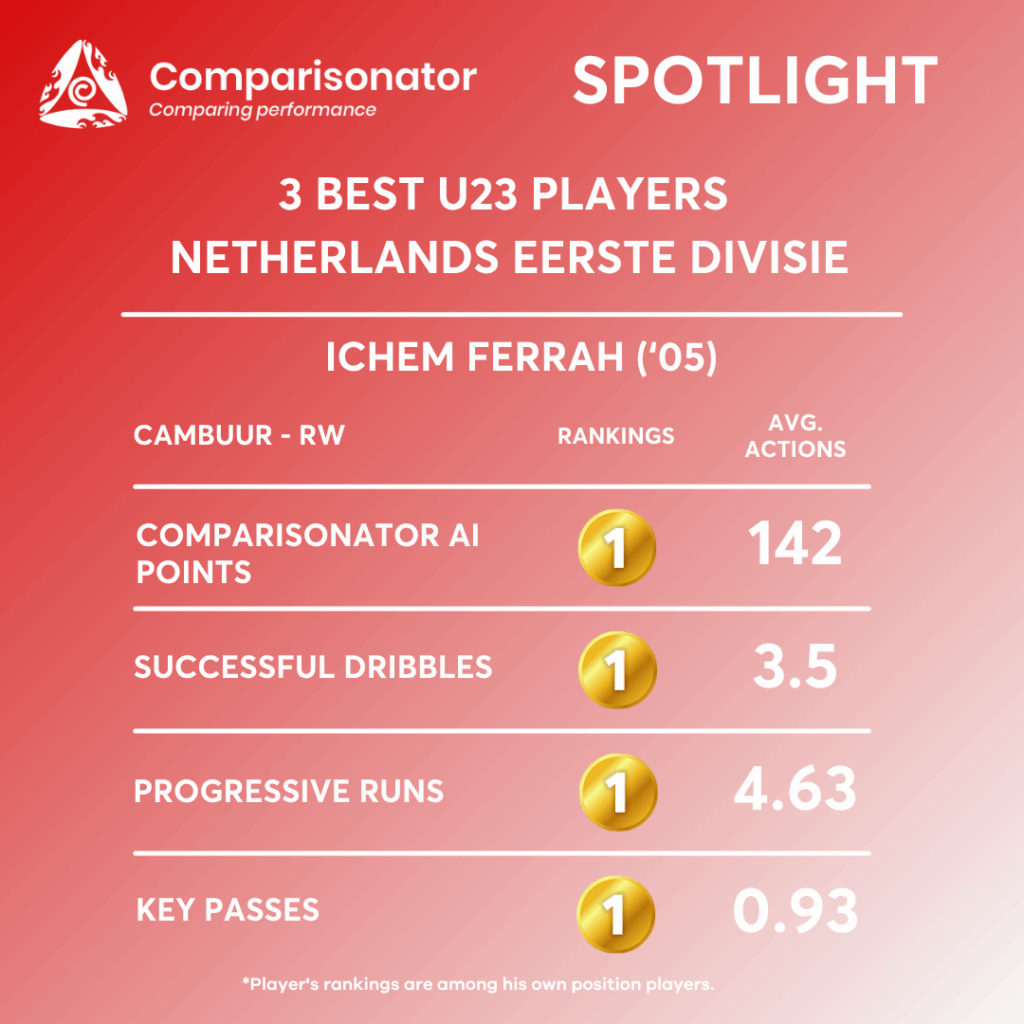
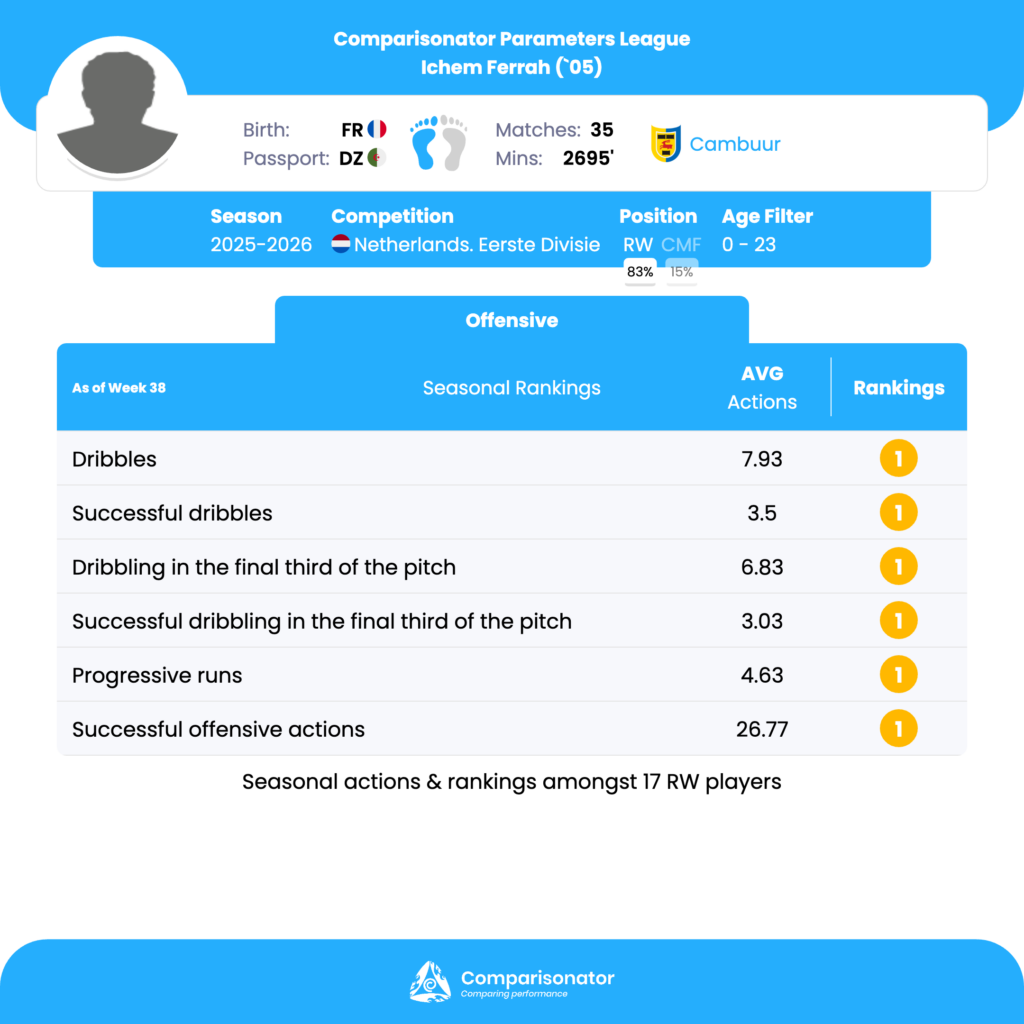
Ichem Ferrah’s CompaAI Offensive report:
Ferrah’s standout strength is his 1st-place output in ball progression and dribbling volume. He ranks 1st out of 17 in Dribbles (7.93), Successful dribbles (3.5), Dribbling in the final third (6.83), Successful dribbling in the final third (3.03), Progressive runs (4.63), Shot on target assists (0.93), Offensive actions (44.6), and Successful offensive actions (26.77). These numbers place him above the closest challengers, such as D. O’Niel, M. Bahaty, and Tay Abed. This suggests a winger with very strong 1v1 capacity, constant forward intent, and a high volume of productive attacking involvement. Tactically, he can be a major outlet on the flank in transition-heavy or isolation-based attacking structures, where repeated carrying and progressive actions can stretch the opponent’s defensive line. He also stands out as a reliable creator from wide areas. Ferrah is 2nd out of 17 in Shot assists (1.33), Opportunity (1.93), Penalties (0.03), and Successful penalties (0.03). He is very close to the leaders in each of these categories, especially in shot assists where he shares the top number with F. Kluit, and in opportunity creation where he is just behind Jasper Hartog. This shows that his dribbling is not just for show; it regularly leads to final actions and chances. Ferrah also performs well as an attacking finisher for a winger. He ranks 3rd out of 17 in Expected goals (0.32), Playing in scoring attacks (0.87), Expected assists (0.16), Shots (2.67), and Shots on target (1.03). While not the top number in these areas, he remains close to the leaders Tay Abed, Jasper Hartog, and F. Kluit. This indicates that he is not only a carrier but also a real end-product threat. He can be trusted to arrive in scoring zones and sustain pressure on the opponent’s back line.
Ferrah’s best ranking parameters are clearly tied to dribbling volume, progressive runs, final-third carrying, shot on target assists, and overall offensive activity, where he repeatedly places 1st in the league-wide under-23 RW sample. He combines high involvement with real attacking impact, especially as a ball carrier and wide creator. The main limitations are his dribbling success rate, which trails the best performers significantly, plus some middling efficiency in shooting and conversion.
Devin Haen (‘04) (CF) – Willem II
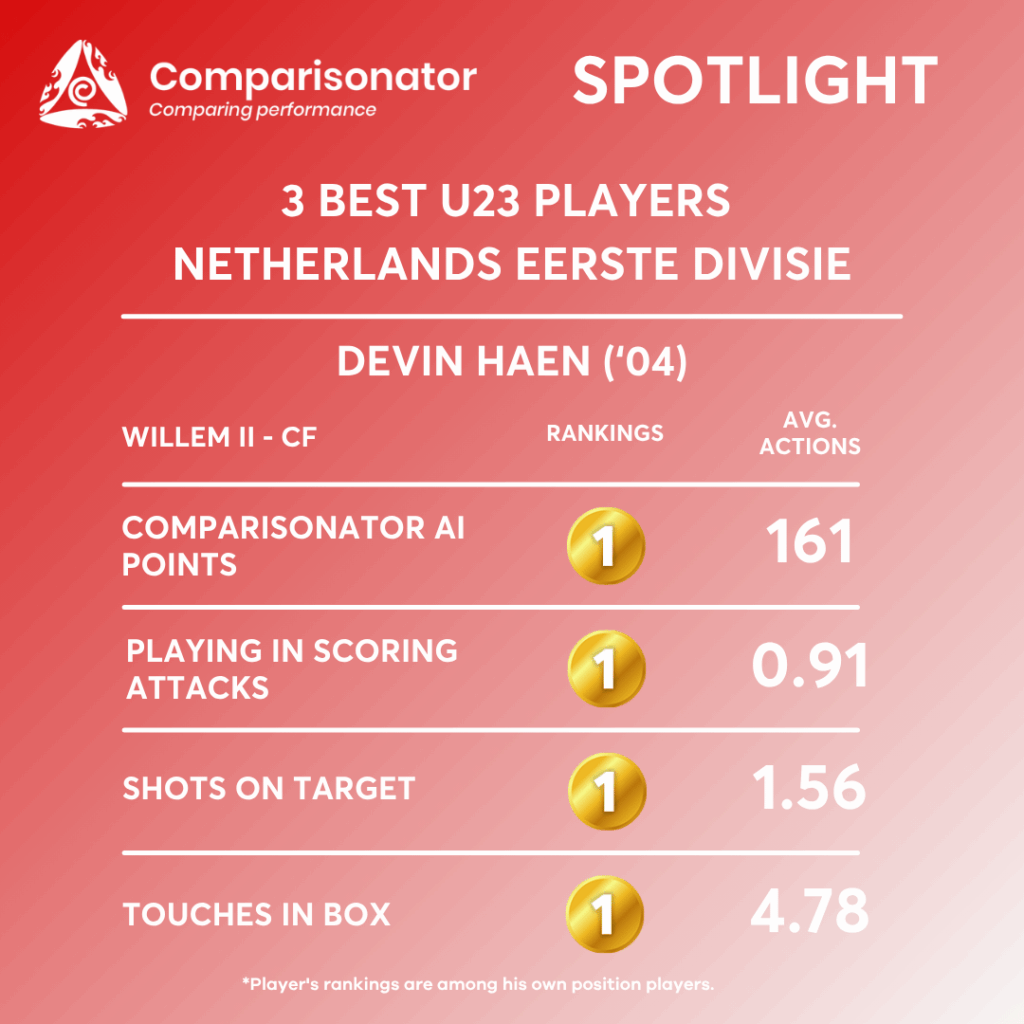
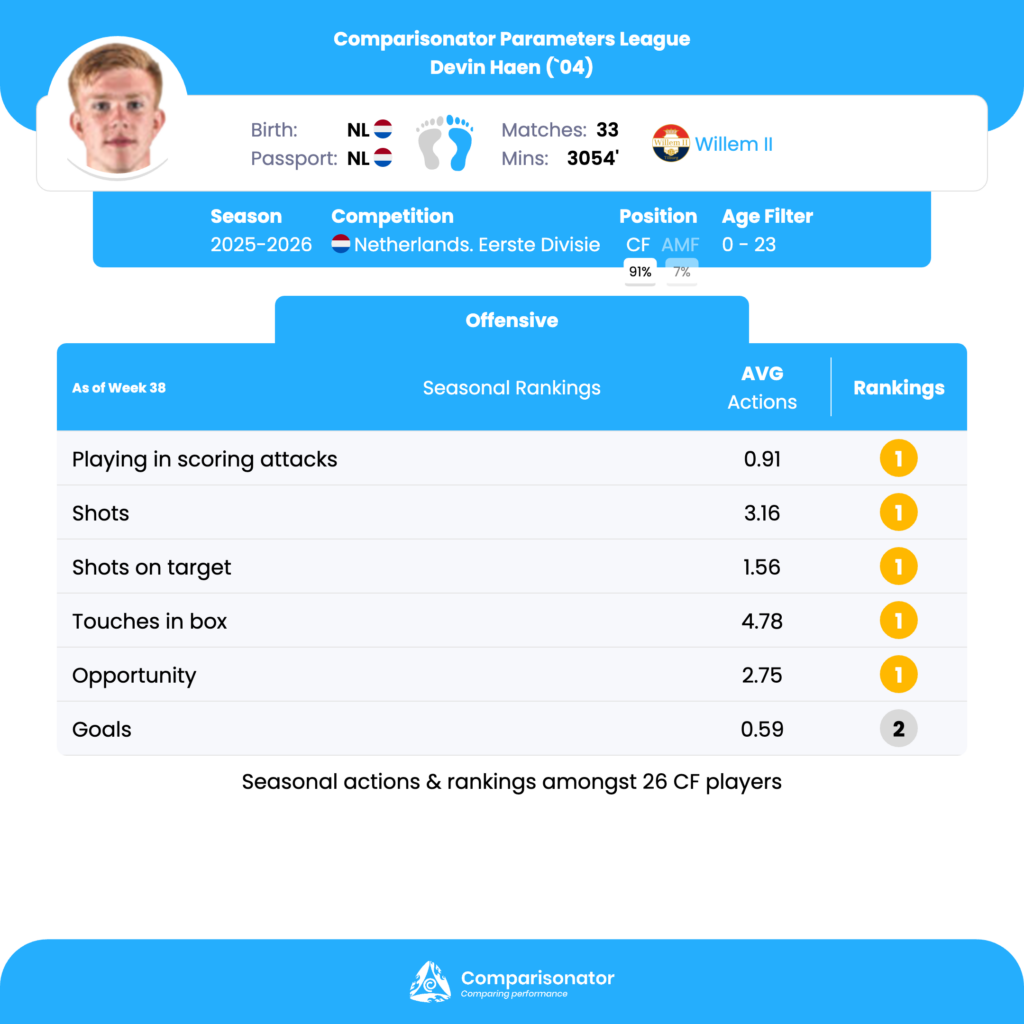
Davin Hoen’s CompaAI Offensive report:
Devin Haen’s most notable strength is his direct goal threat. He ranks 1st out of 26 for Playing in scoring attacks with 0.91 per match, just ahead of B. Boersma (0.89). He also ranks 1st out of 26 for Shots with 3.16 per match, ahead of Rafik El Arguioui (2.54), and 1st out of 26 for Shots on target with 1.56 per match, ahead of B. Boersma (1.42). This profile points to a striker who is consistently involved in attacking sequences and finishes them with volume. Tactical value: he can be used as the main reference forward in teams that generate repeated box entries and want a high-volume shooter who regularly forces goalkeeper actions. His box presence is also elite. Haen ranks 1st out of 26 for Touches in box with 4.78 per match, above B. Boersma (4.05), and 1st out of 26 for Opportunities with 2.75 per match, ahead of Jesper Uneken (2.38). He is also 2nd out of 26 for Goals at 0.59 per match, behind Robin van Duiven (0.64), and 2nd out of 26 for Expected goals (xG) at 0.56 per match, behind B. Boersma (0.65). This combination suggests strong penalty-box timing, reliable positioning, and a repeatable ability to arrive in dangerous zones. Haen also shows a solid all-around offensive involvement layer beyond pure finishing. He ranks 2nd out of 26 for Successful offensive actions, % with 62.25, behind Adam Tahaui (64.39), and 3rd out of 26 for Successful offensive actions with 16.75 per match, behind Adam Tahaui (18.29) and Rafik El Arguioui (17.15). He is 4th out of 26 for Shot on target assists at 0.41 per match and 4th out of 26 for Offensive actions at 26.91 per match. This indicates more than a pure box finisher; he can participate in the attacking phase with enough consistency to support combination play.
Devin Haen’s strongest seasonal indicators are his shots, shots on target, touches in box, scoring-attack involvement, opportunities, goals, and xG, all of which place him near the top of the under-23 CF group. The profile is that of a high-volume, box-oriented centre forward with strong positioning and reliable goal threat. His main limitations are in chance creation, assist output, and 1v1 progression, where he remains useful but not elite compared with the category leaders.