
As the Norway OBOS-ligaen 2026 season unfolds, a new wave of young talents is making a name for themselves across the league. From commanding defenders to dynamic forwards, these players are proving their worth with standout performances and impressive data-driven contributions. Using advanced performance metrics, we break down their impact, strengths, and potential, giving a data-driven perspective on why these rising stars are ones to watch. Let’s dive into the numbers and uncover what makes them stand out in Norway OBOS-ligaen.
Powered by CompaAI, the next-generation AI solution from Comparisonator, this analysis simplifies complex football data into clear, actionable insights. With its cutting-edge features, CompaAI revolutionizes squad analysis, delivering an instant, in-depth assessment of team performance. In just seconds, it pinpoints standout players, uncovers rising young talents, and identifies key areas for enhancement.
Beyond traditional analysis, CompaAI offers strategic intelligence to refine transfer strategies. By detecting high-potential signings, it empowers clubs to strengthen key positions and scout future stars with accuracy. With CompaAI, raw data transforms into valuable, data-driven insights, providing teams with a decisive advantage in the transfer market.
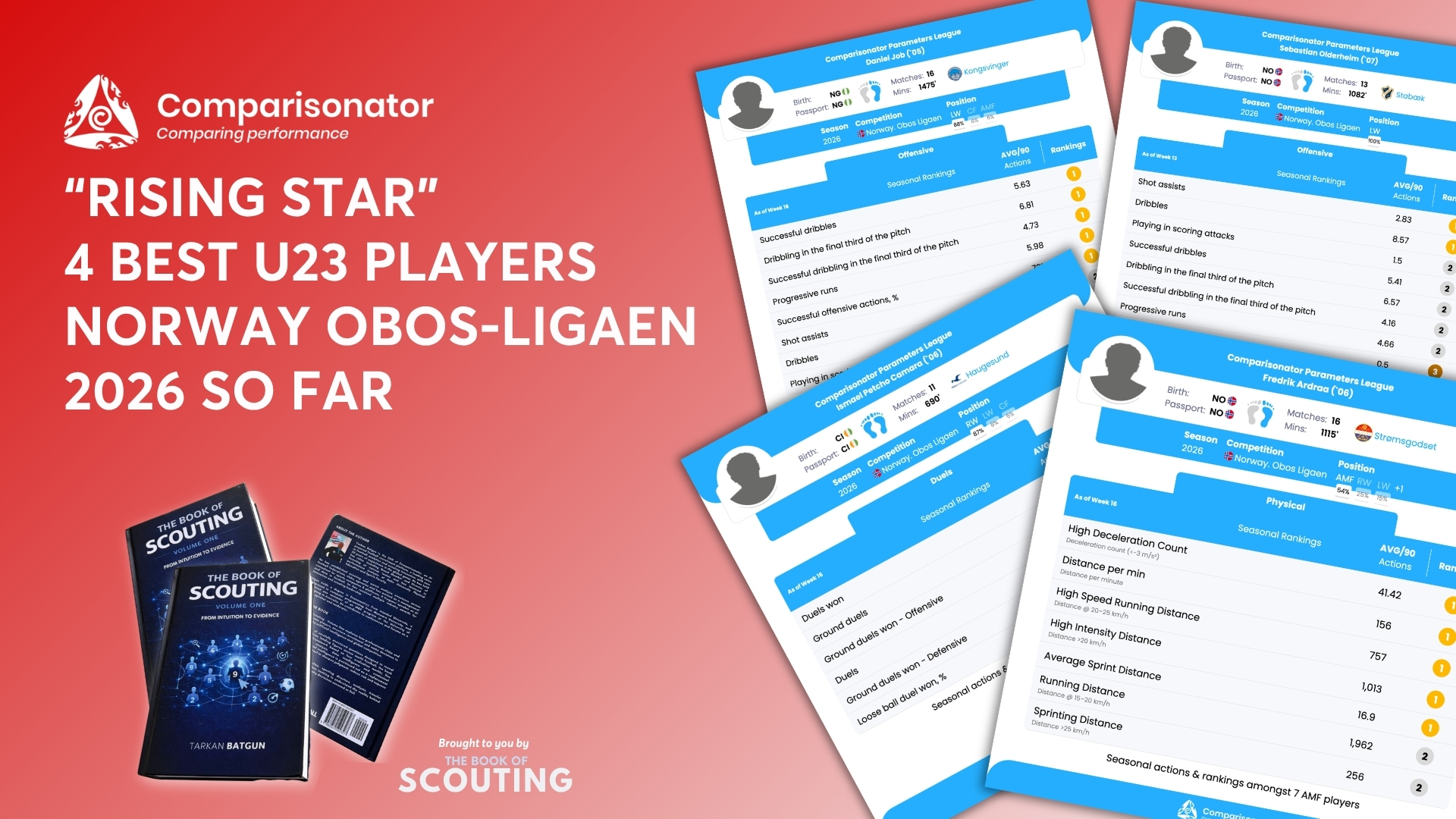
“Rising Star” 4 Best U23 Players Norway Obos-Ligaen 2026 so Far
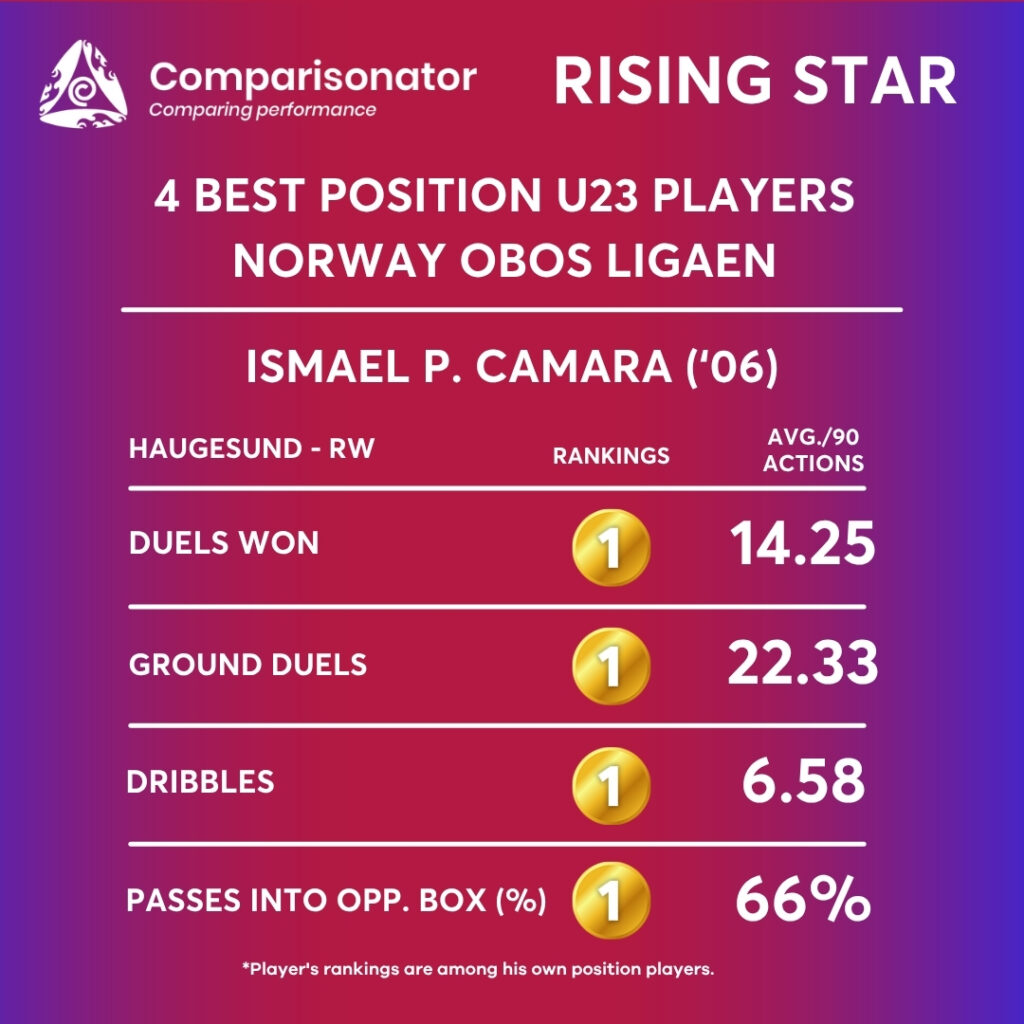
Ismael Petcho Camara (’06) (RW) – Haugesund
Ismael Petcho Camara‘s CompaAI Parameters League Offensive report:
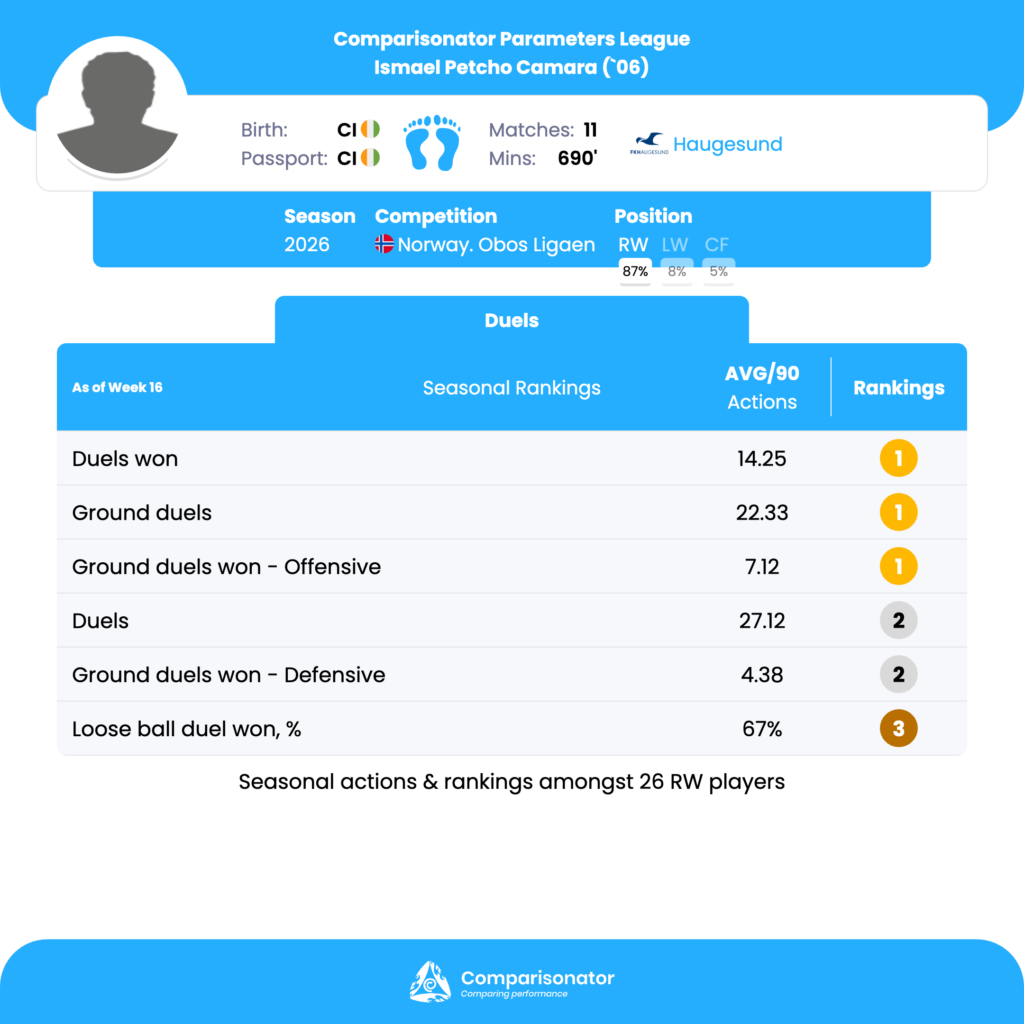
Ismael Petcho Camara’s strongest seasonal trait is his elite overall duel volume and success. He ranks 1st out of 26 RW players with 14.25 duels won per 90, ahead of Luka Fajfric at 11.87. He also ranks 1st in 22.33 ground duels per 90, compared with Isaac Monglo’s 17.12. This points to a winger who is highly involved in direct contact situations, consistently competing for the ball rather than avoiding physical engagement. Tactically, this can be valuable in a side that wants its wide players to secure second balls, contest full-backs aggressively, and create disruption in wide duels.
His offensive ground-duel profile is also exceptional. He ranks 1st in 16.3 ground duels – offensive per 90 and 1st in 7.12 ground duels won – offensive per 90, ahead of Franklin Nyenetue’s 11.9 and Marcus Mehnert’s 6.07 respectively. This is a major indicator of his ability to challenge defenders in advanced areas and carry attacking pressure through repeated 1v1 actions. The volume and success here suggest a winger who can sustain territorial pressure, force defensive actions, and create progression opportunities through direct dueling. For tactical usage, he can be effective as a wide outlet in transition-heavy attacks or in systems that encourage aggressive isolation against full-backs.
His defensive duel impact is also near the top of the position. He is 2nd in 4.38 ground duels won – defensive per 90, just behind Isaac Monglo’s 4.4, and 2nd in 72.73% ground duels won – defensive, level with the elite end of the role. He also ranks 3rd in 6.03 ground duels – defensive per 90. This shows he is not only active offensively but also reliable when helping his team recover possession. From a tactical perspective, this can support a more intense pressing or counter-pre- ssing structure on his flank, where he can close down opponents and compete effectively after turnovers.
He also posts strong results in loose-ball and aerial duel outcomes. He ranks 3rd in 66.67% loose ball duel won and 4th in 1.37 loose ball duels won per 90, while in the air he is 5th in both 1.1 air duels – defensive per 90 and 0.41 air duels won – defensive per 90. These numbers suggest a player who can contribute in chaotic phases, especially when the ball is loose and the game becomes physical. Even if he is not a dominant aerial winger, his willingness to contest these situations adds utility in direct play and defensive coverage.
Ismael Petcho Camara (’06) (RW) – Haugesund
Fredrik Ardraa (’06) (AMF) – Strømsgodset
Fredrik Ardraa‘s CompaAI Parameters League Physical report:
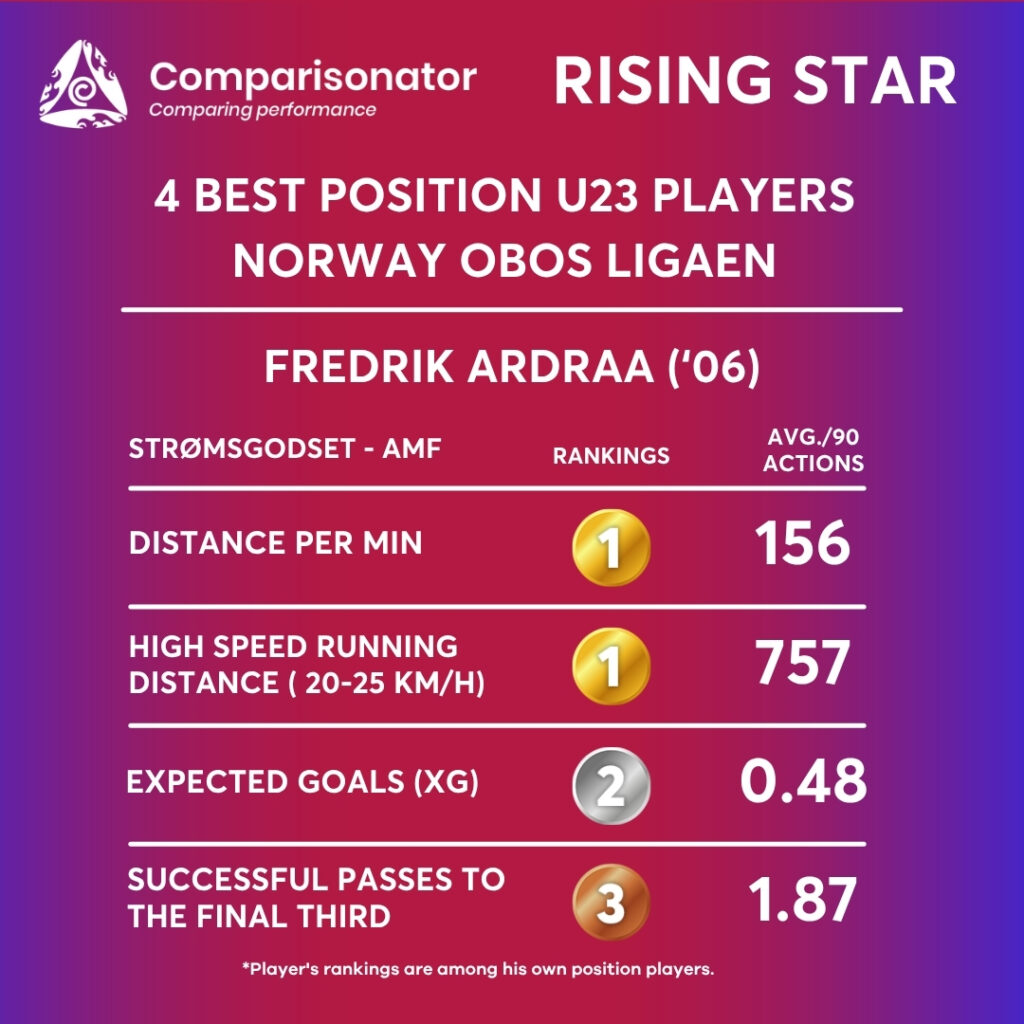
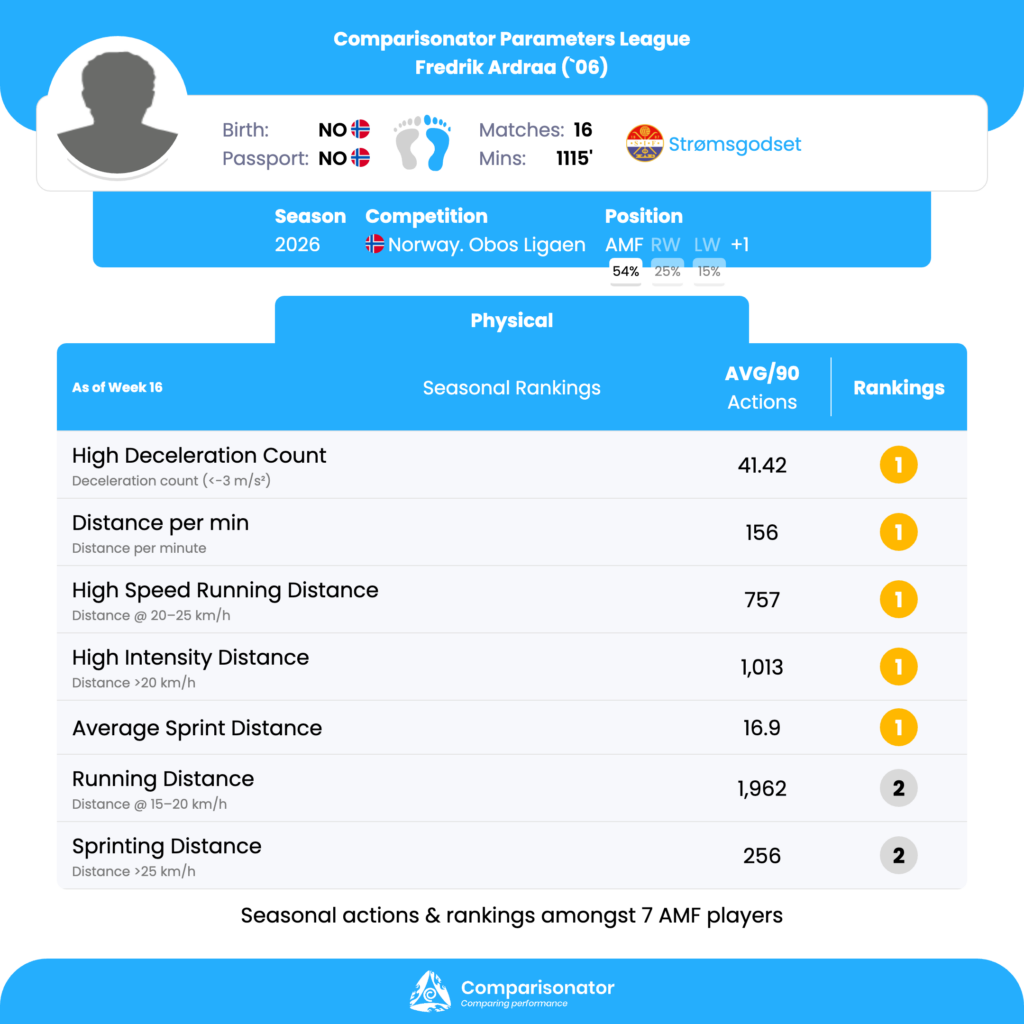
Fredrik Ardraa ranks 1st out of 7 AMFs in several major physical outputs, underlining a profile built on constant movement and strong engine capacity. He records 221.73 Medium Acceleration Count per 90, ahead of Kasper Skaanes (216.98), and 41.42 High Deceleration Count per 90, ahead of Villum Dalsgaard (39.92). He also leads the position in 156.36 Distance per min per 90, compared with Scott Vatne (134.1). These figures indicate a player who is extremely active between actions, capable of frequent changes of pace and direction, and able to sustain high involvement across the pitch. For tactical usage, this can be valuable in a pressing or transition-heavy system, where the AMF is expected to repeatedly adjust body orientation, support counters, and arrive quickly into space.
He is also the clear position leader in sustained high intensity movement. Ardraa produces 757.08 High Speed Running Distance per 90, ahead of Kasper Skaanes (625.04), and 1012.72 High Intensity Distance per 90, ahead of Isak Gabriel Skotheim (891.43). In addition, he ranks 1st in both 48.69 High Speed Run Count per 90 and 67.68 High Intensity Count per 90, ahead of Scott Vatne (40.76) and Scott Vatne (57.71) respectively. This combination suggests a midfielder who can repeatedly threaten space, support vertical attacks, and remain physically available for pressing and recovery work. In tactical terms, he can be used as an aggressive advanced midfielder who links midfield and attack through constant off ball activity, especially in teams that rely on fast circulation and counter pressing.
Ardraa’s repeated running profile is reinforced by his top ranking in 16.9 Average Sprint Distance per 90, slightly ahead of Isak Gabriel Skotheim (15.91). He also ranks 2nd in 11302.68 Total Distance per 90, just behind Lars Remmem (11371.69), and 2nd in 1962.32 Running Distance per 90, behind Lars Remmem (2046.01). These outputs show that his physical contribution is not limited to isolated bursts; he also sustains a strong overall workload throughout the match. That makes him suitable for roles demanding continuous circulation support, defensive tracking, and second line pressure.
Daniel Job (’05) (LW) – Kongsvinger
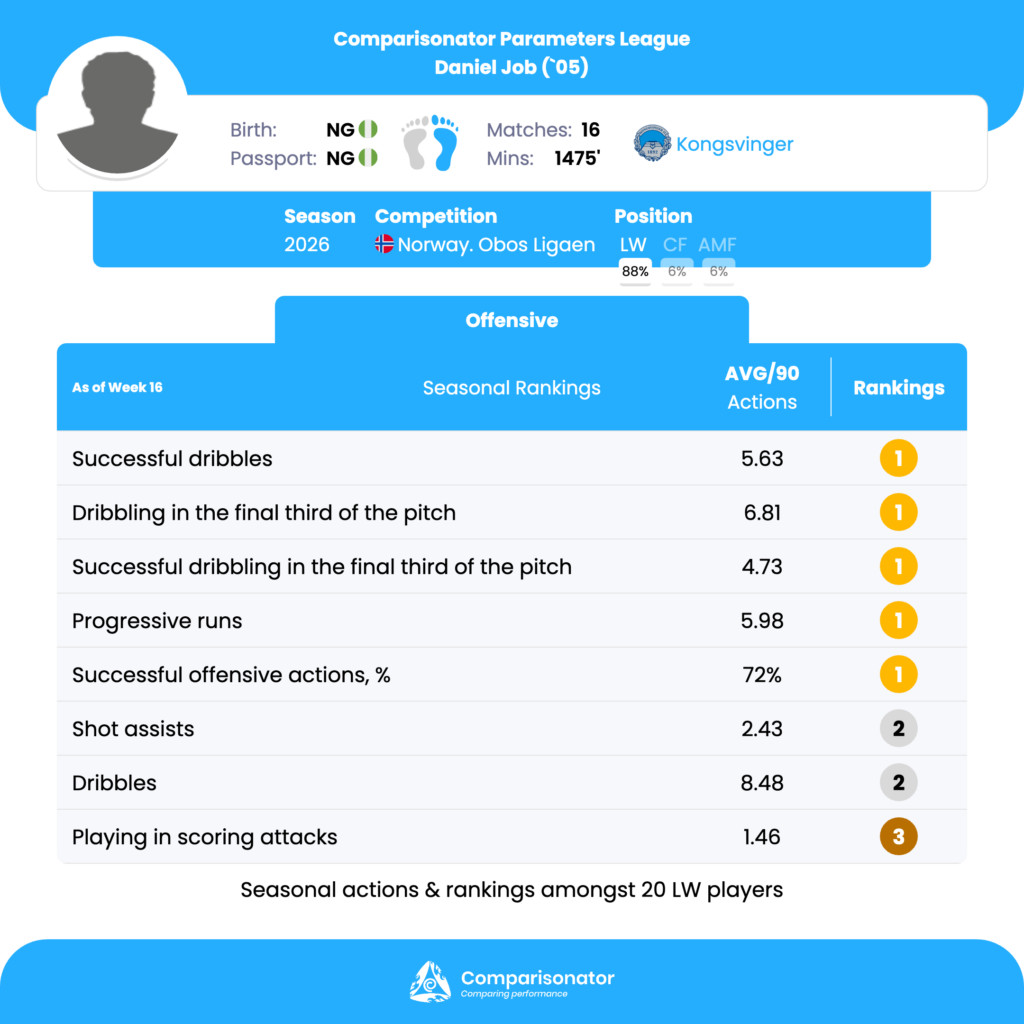
Daniel Job‘s CompaAI Parameters League Offensive report:
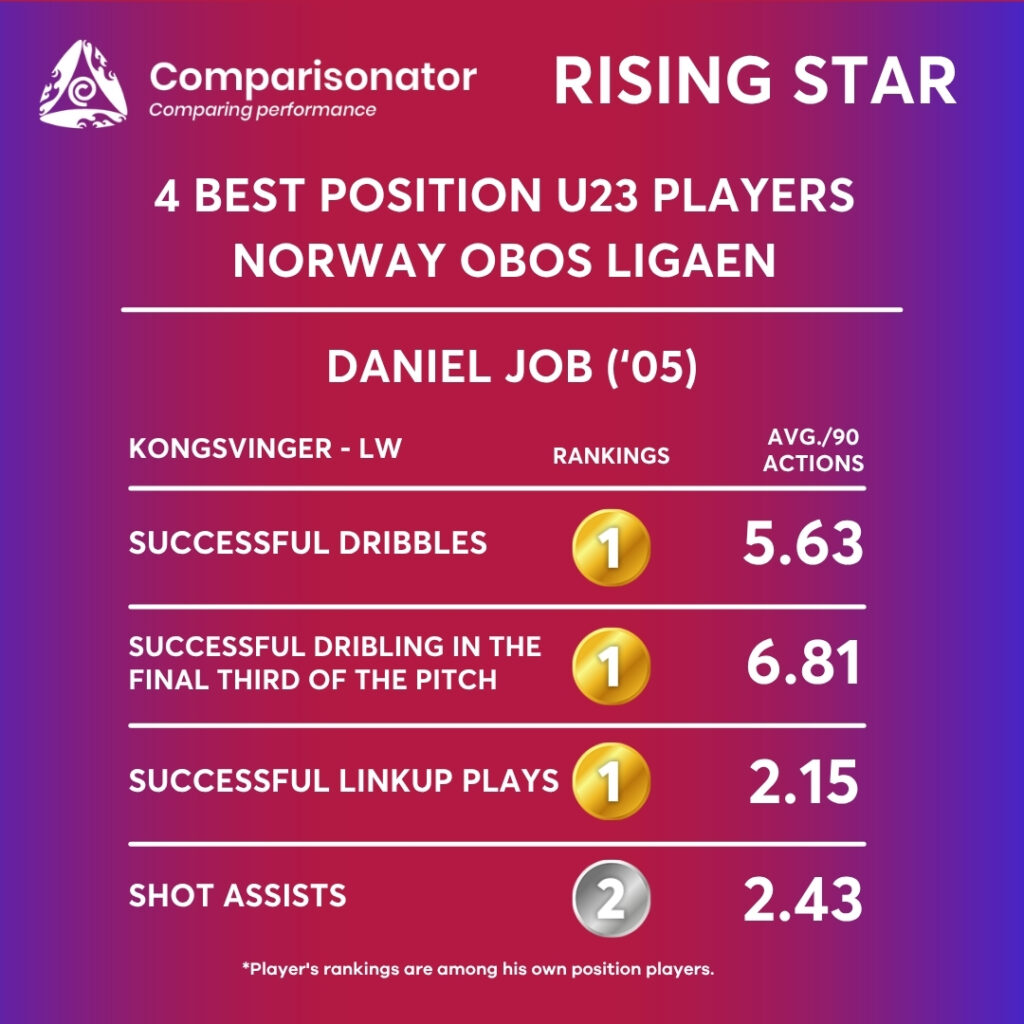
Daniel Job’s clearest strength is his ball-carrying and 1v1 progression. He ranks 1st out of 20 in Successful dribbles per 90 with 5.63, ahead of Sebastian Olderheim (5.41). He is also 1st in Dribbling in the final third of the pitch per 90 with 6.81, ahead of Olderheim (6.57), and 1st in Successful dribbling in the final third of the pitch per 90 with 4.73, ahead of Olderheim (4.16). In addition, he ranks 1st in Progressive runs per 90 with 5.98, ahead of Olderheim (4.66). This profile points to a winger who can repeatedly beat opponents, enter advanced areas, and carry the team forward through individual action. Tactically, he can be valuable in systems that rely on wide isolation, transition attacks, and direct progression into the final third.
His off-ball offensive involvement is also strong. Job ranks 1st in Successful offensive actions, % per 90 with 71.62, narrowly ahead of Isak Gabriel Skotheim (71.33). He also ranks 2nd in Dribbles per 90 with 8.48, just behind Olderheim (8.57), and 2nd in Successful dribbles, % per 90 with 66.39, behind the 100% top values posted by the most selective performers. This suggests a high-volume winger who is active in offensive sequences and consistently tries to create advantage through dribbling. From a tactical angle, he can be used as a main outlet on the left side to stretch the block, attack full-backs, and sustain attacking momentum.
Job also shows strong involvement in chance creation. He ranks 2nd in Expected assists per 90 with 0.38, behind Kasper Skaanes (0.52), and 2nd in Shot assists per 90 with 2.43, behind Sebastian Olderheim (2.83). He is 5th in Assists per 90 with 0.42, and 5th in Opportunity per 90 with 2.22. This mix indicates that his dribbling is not isolated from end product; it connects to passing actions that lead to shots. He can fit well as a winger who attacks from the left half-space, carries defenders, and then releases final passes or cutbacks.
His scoring production is solid rather than elite, but still useful. He ranks 6th in Expected goals per 90 with 0.46, 7th in Goals per 90 with 0.49, and 7th in Shots per 90 with 2.85. He also ranks 7th in Opportunity converted per 90 with 0.49. This shows that he reaches scoring zones regularly and contributes as a secondary scorer. He can be useful in teams where the winger is expected to finish attacks from the far post, attack inside from the left, or exploit space created by a central striker.
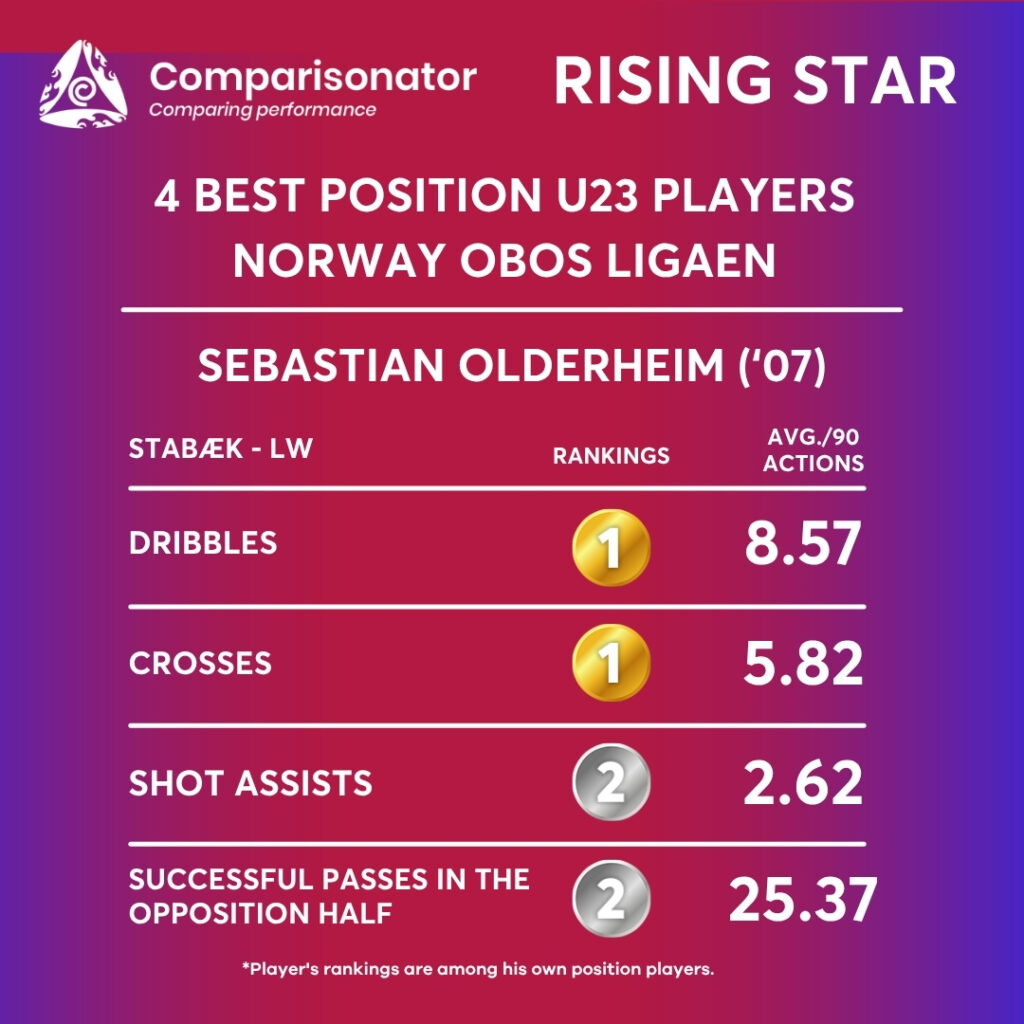
Sebastian Olderheim (’07) (LW) – Stabæk
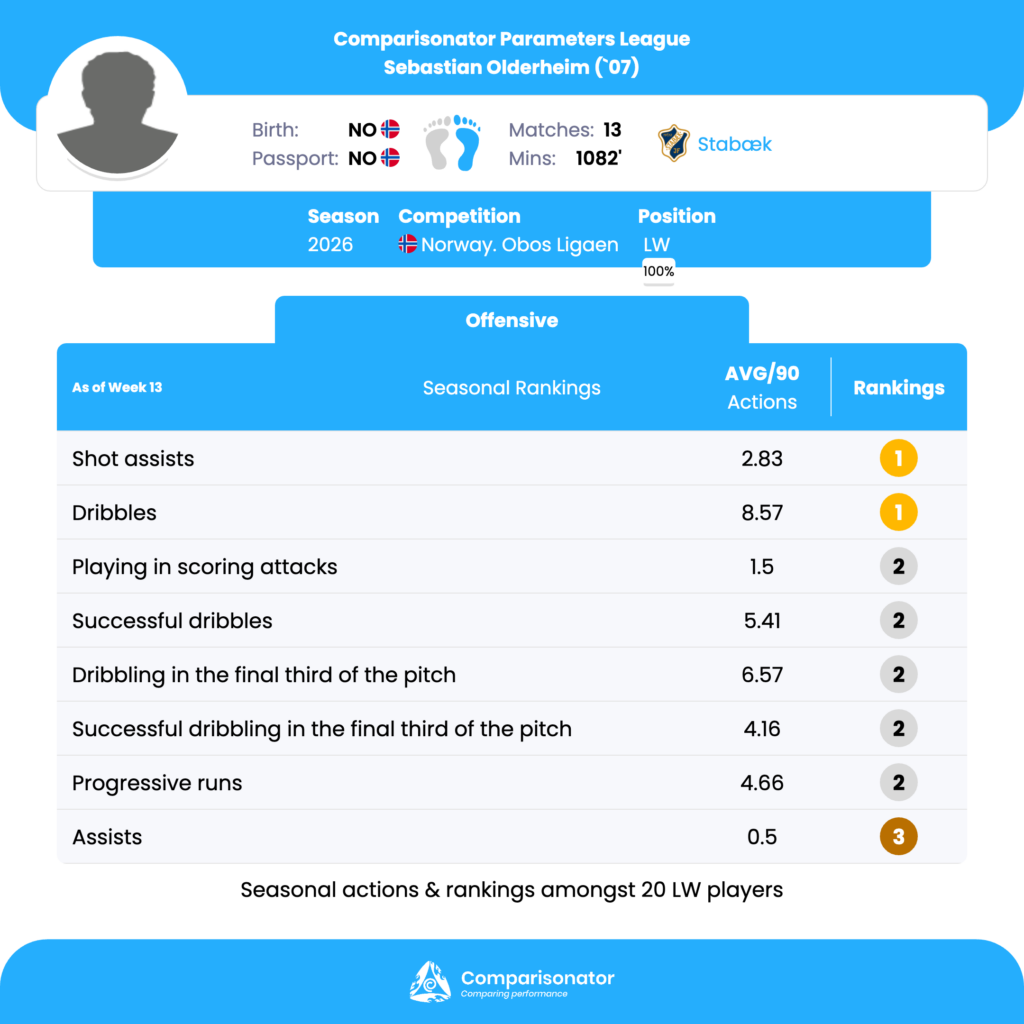
Sebastian Olderheim‘s CompaAI Parameters League Offensive report:
Olderheim’s clearest standout strength is his chance creation and final-third involvement. He ranks 1st out of 20 in Shot assists per 90 with 2.83, ahead of Daniel Job (2.43). He also ranks 1st out of 20 in Dribbles per 90 with 8.57, just above Job (8.48). This combination points to a winger who is heavily involved in advancing attacks, creating shots for teammates, and carrying the ball into dangerous zones. For a left winger, this profile can be highly valuable in a team that wants wide progression, penetration, and constant ball-carrying threat.
A second major strength is his ball progression and 1v1 output. He ranks 2nd out of 20 in Successful dribbles per 90 with 5.41, behind Daniel Job (5.63), and 2nd in Dribbling in the final third per 90 with 6.57, again behind Job (6.81). He is also 2nd in Successful dribbling in the final third per 90 with 4.16, trailing Job (4.73), and 2nd in Progressive runs per 90 with 4.66, behind Job (5.98). These numbers show that he is not only attempting dribbles often, but also completing them at a strong level and turning them into forward progress. Tactically, this makes him well suited to isolated wide duels, transition attacks, and situations where the team needs a direct outlet on the left side.
Olderheim also shows strong involvement in scoring sequences and attacking impact. He ranks 2nd out of 20 in Playing in scoring attacks per 90 with 1.5, behind Eirik Viland Andersen (1.69). In addition, he is 3rd in Assists per 90 with 0.5, behind Niklas Sandberg (0.63) and Kasper Skaanes (0.58), and 3rd in Expected assists per 90 with 0.36, behind Skaanes (0.52) and Daniel Job (0.38). This indicates that his contribution goes beyond individual carrying; he is regularly involved in the build-up to actual scoring actions and is already producing end product at a relevant level for his position. For tactical use, this supports deployment in systems where the winger is expected to create, combine, and provide the final pass rather than only stretch the pitch.