
As the Japan J1 100 Year Vision League 2026 season progresses, a fresh generation of young talent is beginning to leave its mark across the competition. Whether they are commanding defenders or dynamic forwards, these athletes are showcasing their value through remarkable performances and strong data-driven contributions. By examining advanced performance metrics, we can analyze their on-pitch impact, core strengths, and future potential. This provides a purely data-backed perspective on why you should keep an eye on these rising stars. Let’s explore the numbers to see exactly what makes them stand out in the Japan J1 100 Year Vision League.
Driven by CompaAI—the next-generation AI solution developed by Comparisonator—this evaluation turns complex football data into straightforward, actionable insights. Thanks to its cutting-edge features, CompaAI completely revolutionizes squad analysis, providing an immediate and in-depth assessment of a team’s overall performance. Within mere seconds, the platform can pinpoint standout players, discover rising young talents, and highlight key areas for squad enhancement.
Going beyond traditional analysis, CompaAI delivers the strategic intelligence needed to refine club transfer strategies. By accurately detecting high-potential signings, it empowers teams to strengthen key positions and effectively scout future stars. Ultimately, CompaAI transforms raw data into highly valuable, data-driven insights, giving clubs a decisive advantage in the highly competitive transfer market.
“Rising Star” 3 Best U23 Players Japan J1 100 Year Vision League 2026 so Far
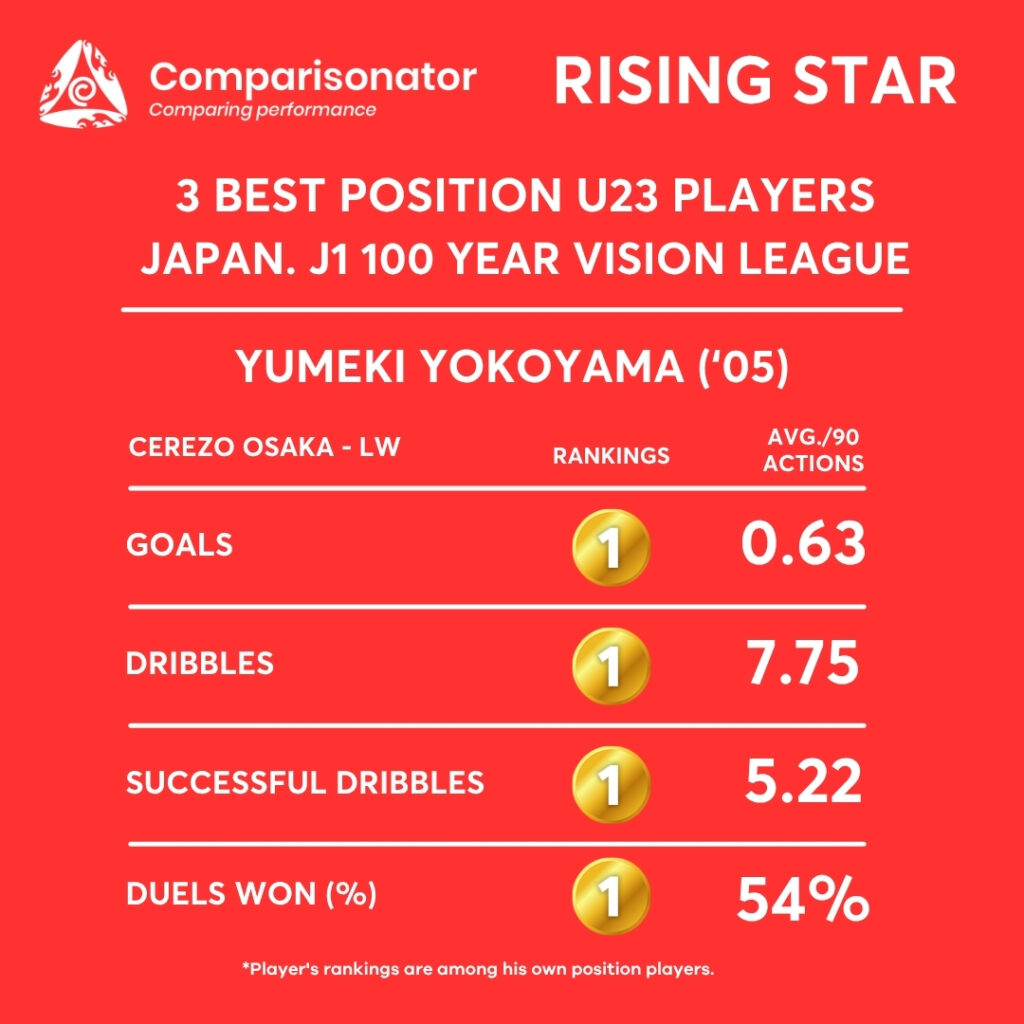
Yumeki Yokoyama (’05) (LW) – Cerezo Osaka
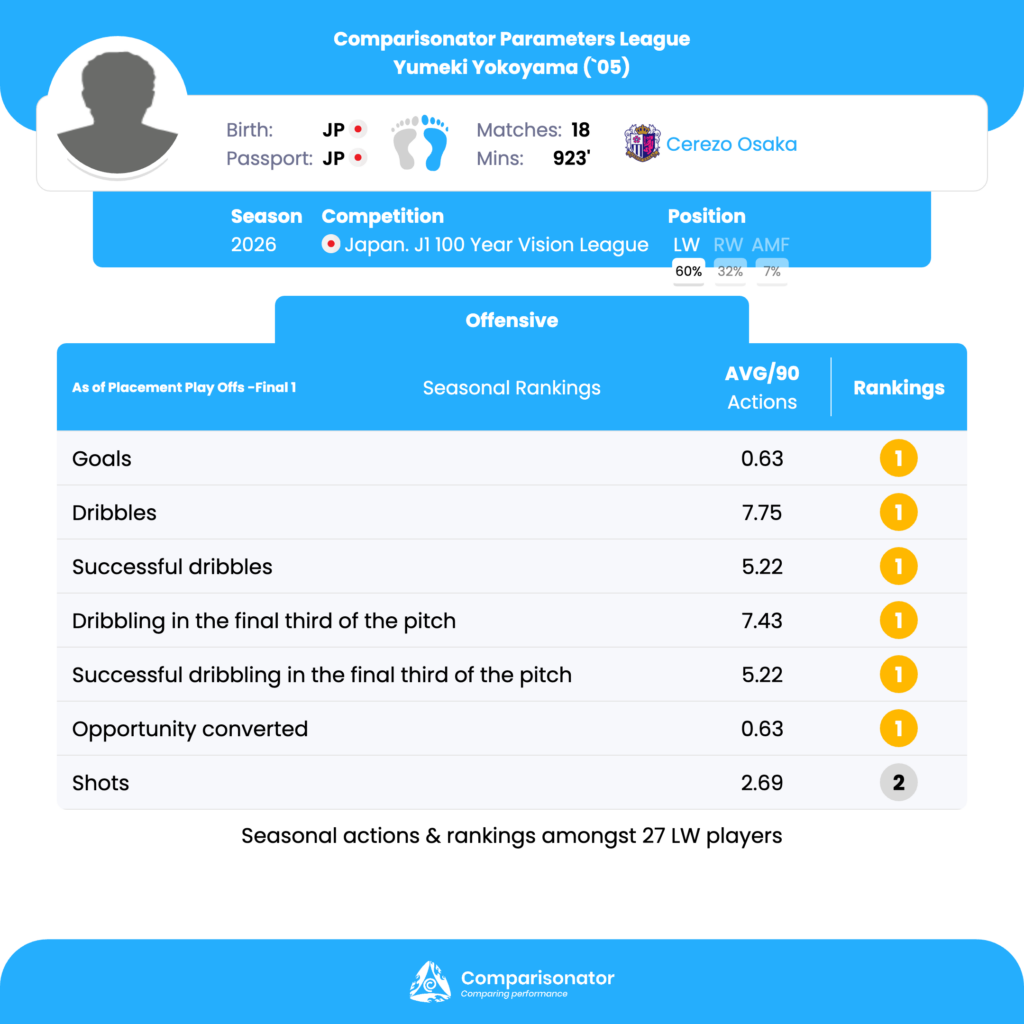
Yumeki Okoyama‘s CompaAI Parameters League Offensive report:
Yokoyama’s clearest strength is direct end product and ball-carrying dominance. He ranks 1st out of 27 for Goals per 90 (0.63), Opportunity converted per 90 (0.63), Dribbles per 90 (7.75), Successful dribbles per 90 (5.22), Dribbling in the final third per 90 (7.43), and Successful dribbling in the final third per 90 (5.22). In every one of these metrics, he is ahead of the closest challengers: for goals and opportunity converted, Ryunosuke Sato is next with 0.44; for dribbles, Mizuki Arai is next with 6.43; for successful dribbles, Arai follows with 3.79; and in final-third dribbling, Arai again trails with 5.93. This profile points to an attacker who can consistently beat opponents and turn those actions into outcomes. Tactically, he can be used as a high-volume isolation winger, especially in systems that encourage 1v1 attacking and final-third penetration.
His shot volume and chance-creation involvement also sit in the upper tier of the position. He ranks 2nd out of 27 for Shots per 90 (2.69), just behind Shion Homma’s 2.85, and 3rd out of 27 for Shots on target per 90 (1.11), behind Ryunosuke Sato’s 1.48 and Ryotaro Meshino’s 1.40. He also ranks 3rd for Progressive runs per 90 (3.8), behind Welton (4.48) and Kanji Okunuki (3.96). This suggests a winger who not only carries the ball aggressively but also finishes moves with regular shot production. He can fit well in transition-heavy attacking structures or as a wide player encouraged to attack the box.
Yumeki Yokoyama (’05) (LW) – Cerezo Osaka
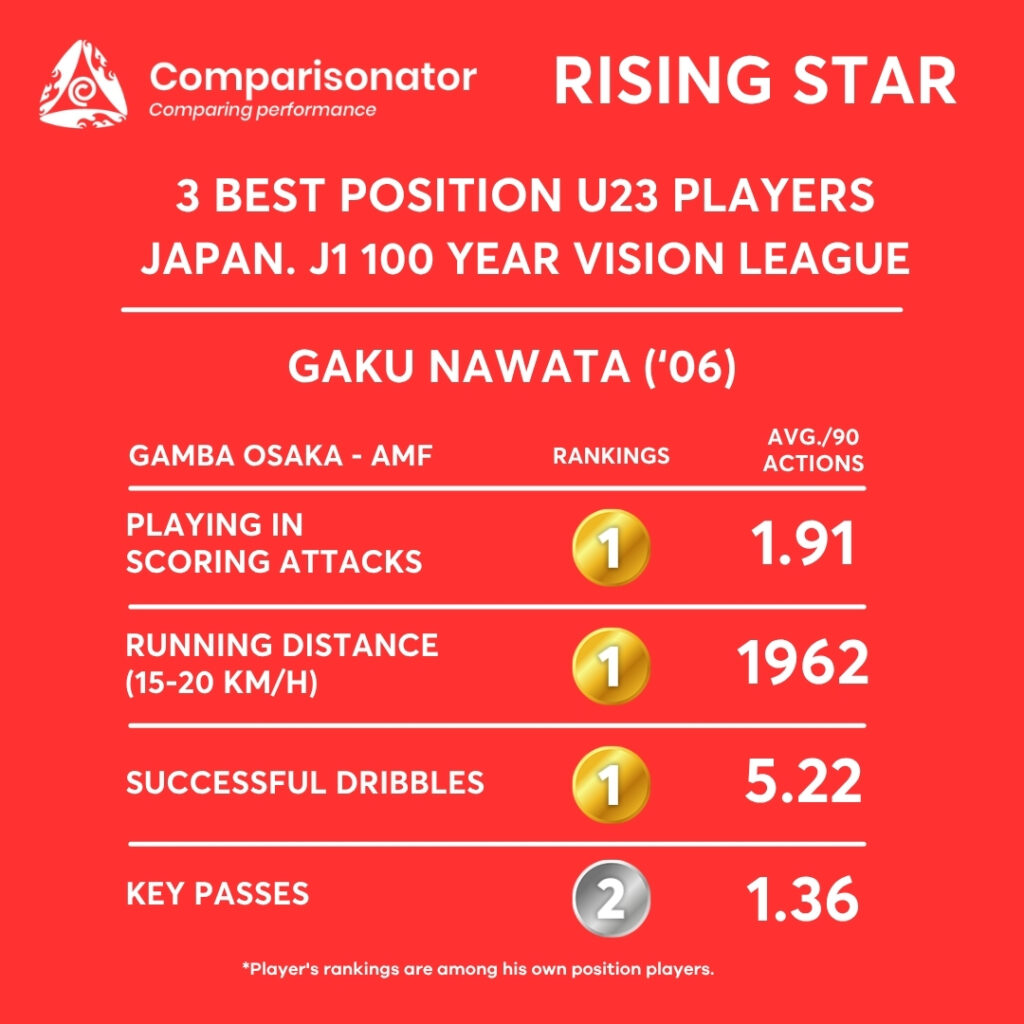
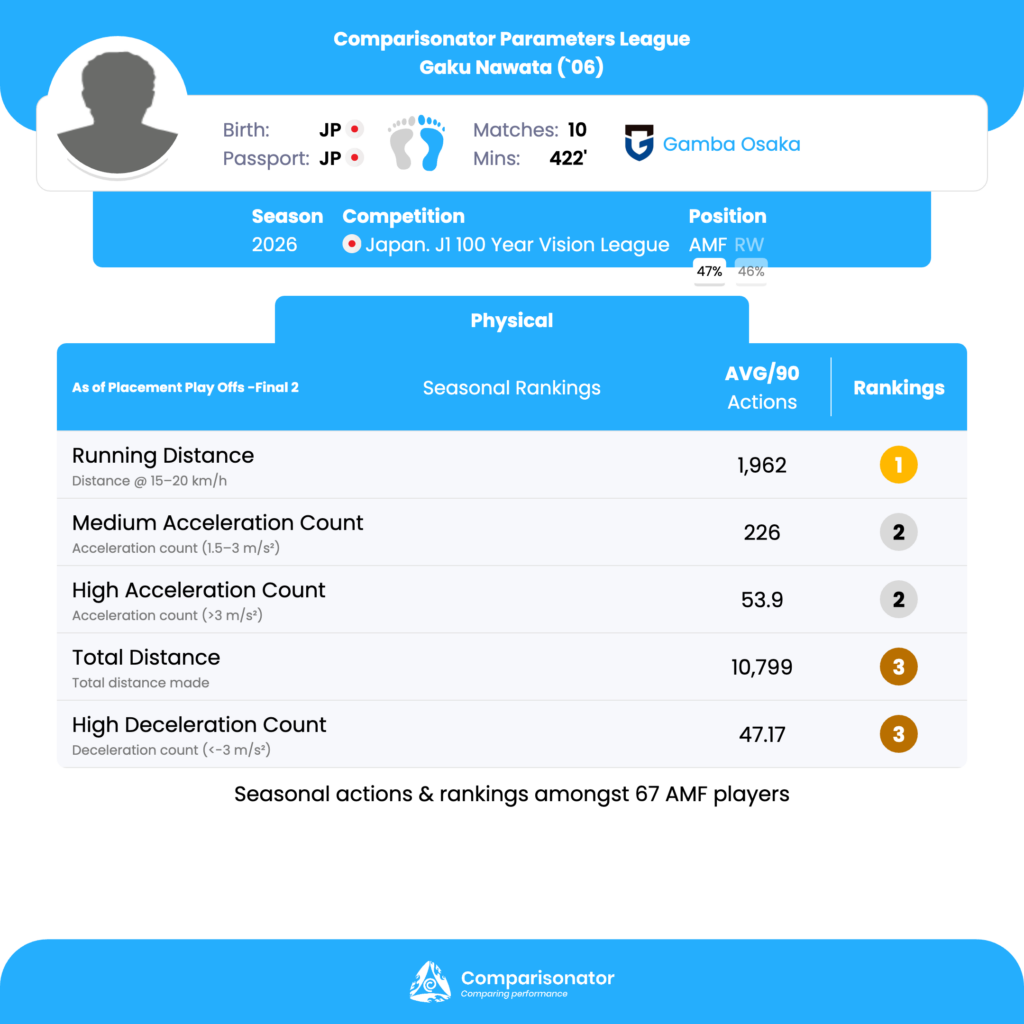
Gaku Nawata (’06) (AMF) – Gamba Osaka
Gaku Nawata‘s CompaAI Parameters League Offensive report:
Nawata’s clearest offensive strength is his direct involvement in decisive attacking moments. He ranks 1st out of 67 in Playing in scoring attacks per 90 (1.91) ahead of Ryotaro Meshino (1.31), 2nd in Opportunity converted per 90 (0.55) behind Kota Kawano (0.86), and 3rd in Goals per 90 (0.55) behind Kawano and Daiya Tono (0.63). This combination points to a player who consistently enters valuable attacking phases and finishes chances at a strong level. Tactically, he is best utilized close to the box as a second-line attacker arriving into scoring zones rather than solely acting as a creator.
He is also highly effective in 1v1 and final-third carry actions, ranking 1st out of 67 in Successful dribbling in the final third, % per 90 (100), 7th in Successful dribbles per 90 (2.18) trailing Futa Tokumura (4.29) and Hinata Yamauchi (3.47), 8th in Successful dribbles, % per 90 (80), and 9th in Successful dribbling in the final third per 90 (1.64). This shows he can carry the ball into dangerous areas and beat opponents efficiently, even if his overall dribble volume isn’t the highest. From a tactical angle, he is valuable in isolated wide-to-inside situations for teams seeking progression through dribbling rather than pure combination play.
Nawata’s broader attacking activity is equally positive, ranking 6th out of 67 in Opportunities per 90 (1.91), 9th in Shots on target per 90 (1.09), and 10th in Successful offensive actions, % per 90 (66.06) behind Shoya Nakajima (74.73) and Shinji Kagawa (72.04). This profile highlights a player regularly present in offensive sequences who can reliably end possessions with shots or useful actions. Tactically, he fits perfectly in systems that reward active off-ball movement, where his willingness to participate in attacking chains can be fully exploited.
While his distribution numbers are more supportive than dominant, they remain relevant as he ranks 15th out of 67 in Assists per 90 (0.27), 16th in Shot assists per 90 (1.36), and 29th in Expected assists per 90 (0.11). This suggests he can comfortably contribute to chance creation, even though it is not his primary standout area compared to his scoring and carrying output. In tactical terms, he functions best as a secondary creator around the box rather than the main chance-creation hub.
Gaku Nawata (’06) (AMF) – Gamba Osaka
Alexandro Pisano (’06) (GK) – Nagoya Grampus
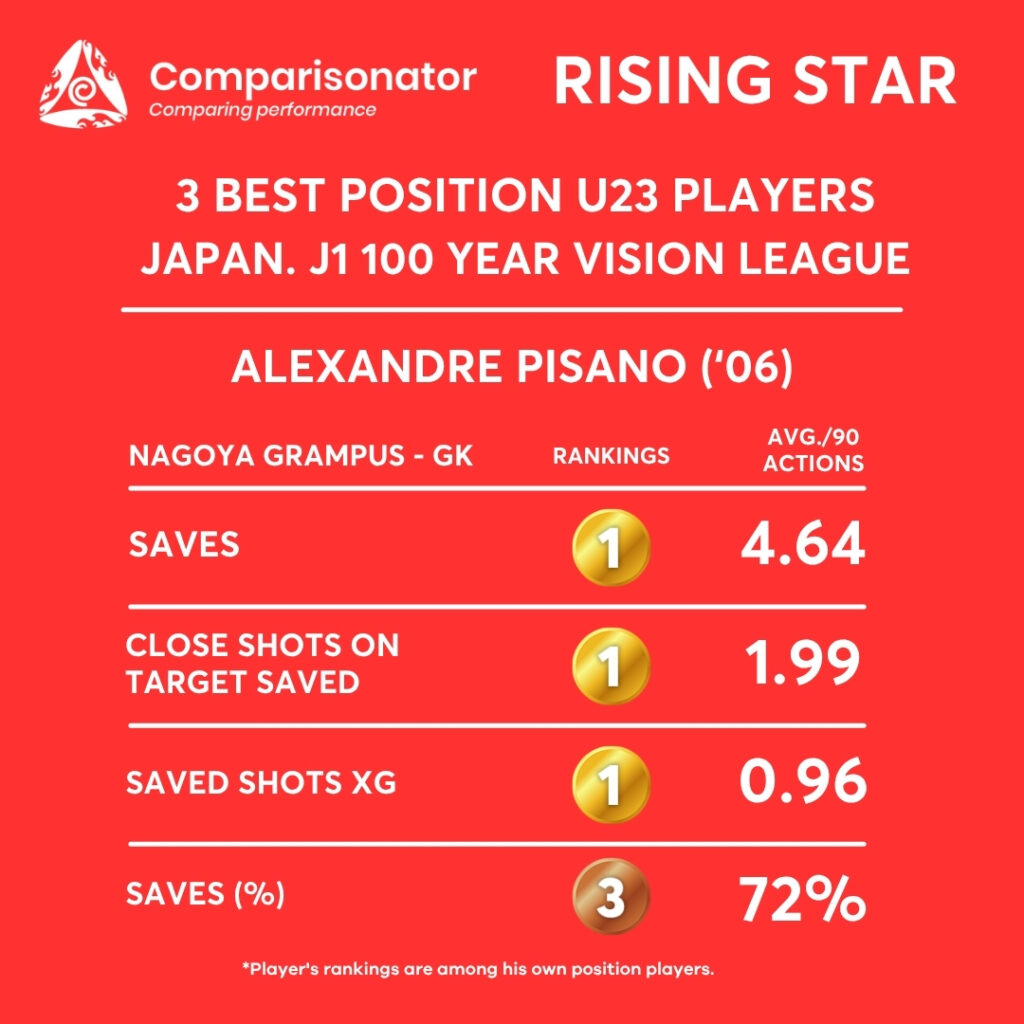
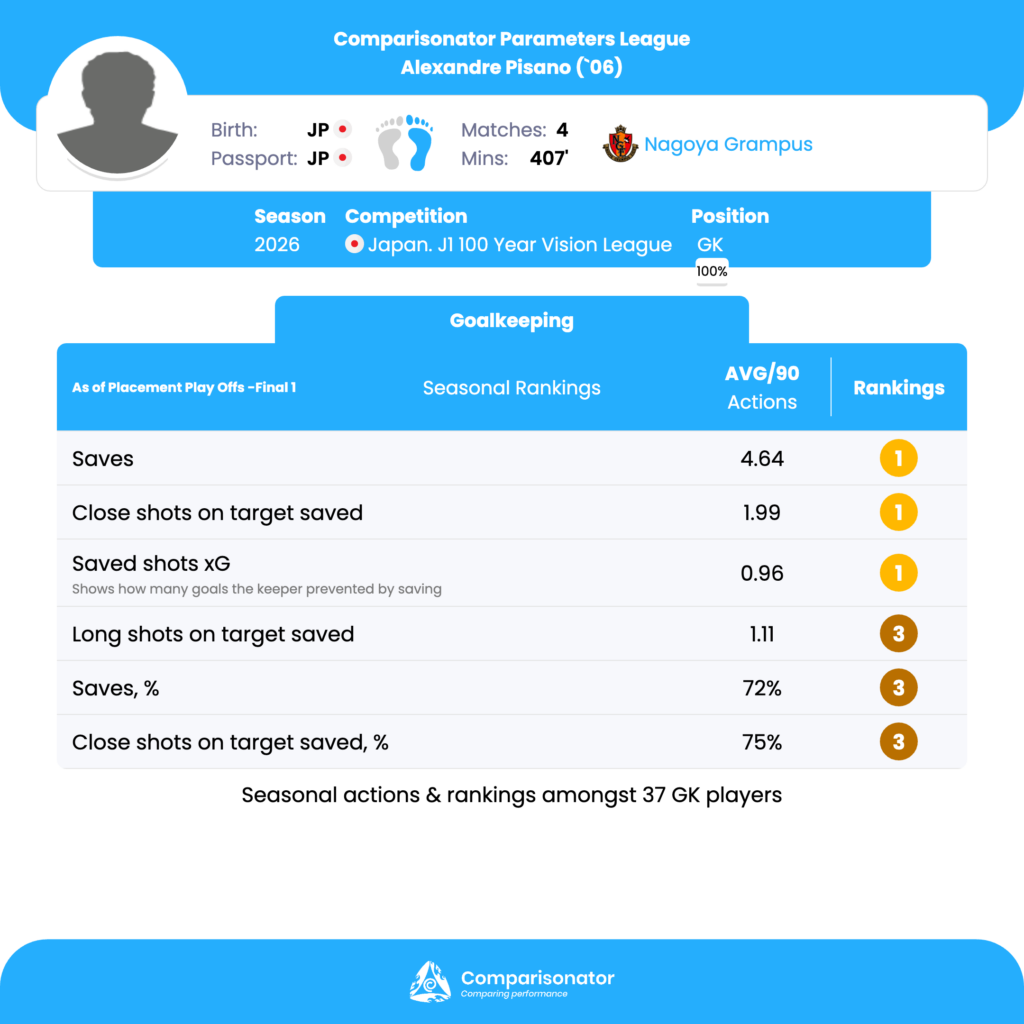
Alexandre Pisano‘s CompaAI Parameters League Goalkeeping report:
Pisano’s strongest seasonal indicator is his 4.64 saves per 90 minutes, where he ranks 1st out of 37 goalkeepers, ahead of Jin-hyeon Kim (4.5). He also leads the category in 1.99 close shots on target saved per 90 minutes, again 1st out of 37, ahead of Shuichi Gonda (1.4). This combination points to a goalkeeper who is heavily involved and highly effective in direct shot-stopping, especially in situations where reactions, positioning, and short-distance blocking matter most. Tactically, this can be valuable for a team that concedes frequent shots inside the box or faces repeated finishing actions in dangerous zones.
A second major strength is his 0.96 saved shots xG per 90 minutes, where he is 1st out of 37 and ahead of Masaaki Goto (0.85). This suggests strong overall shot-stopping impact relative to the quality of shots faced. In practical terms, Pisano is not only making saves, but preventing goals at a level that outperforms his peers in expected shot-stopping value. For a side that may spend time under pressure, this can be a meaningful stabilizing factor because he is converting difficult defensive phases into saved outcomes at an elite rate within this sample.
His output on long shots on target saved per 90 minutes is also strong at 1.11, ranking 3rd out of 37 behind Jin-hyeon Kim (1.5) and Yuji Kajikawa (1.18). Alongside this, his 83.33% long shots on target saved ranks 17th out of 37, which is more mid-range, but the volume-based saving rate still shows good command against distance shooting. This can indicate decent set positioning and handling of shots from outside the box, giving coaches some confidence that he can deal with lower-probability efforts without excessive damage.
Another positive area is his 72.41% saves rate per 90 minutes, ranking 3rd out of 37 behind Go Hatano (85.71) and Hayate Tanaka (73.33). That places him among the more efficient shot-stoppers in the league pool. His 75% close shots on target saved also ranks 3rd out of 37, behind Jin-hyeon Kim (100) and Masaaki Goto (75.86), reinforcing that he performs well in high-pressure, close-range sequences. This profile can suit a team that accepts some volume defensively, because the goalkeeper appears capable of limiting damage when attacks break through.
A further positive detail is his 87.88% successful goal kicks, ranking 6th out of 37, which suggests a respectable level of reliability in starting possession from goal kicks. While not among the very top leaders, it is still a strong signal of technical competence in distribution under this specific action type. For a team aiming to build from the back, this can offer a functional base, especially when combined with his shot-stopping strengths.
Alexandro Pisano (’06) (GK) – Nagoya Grampus
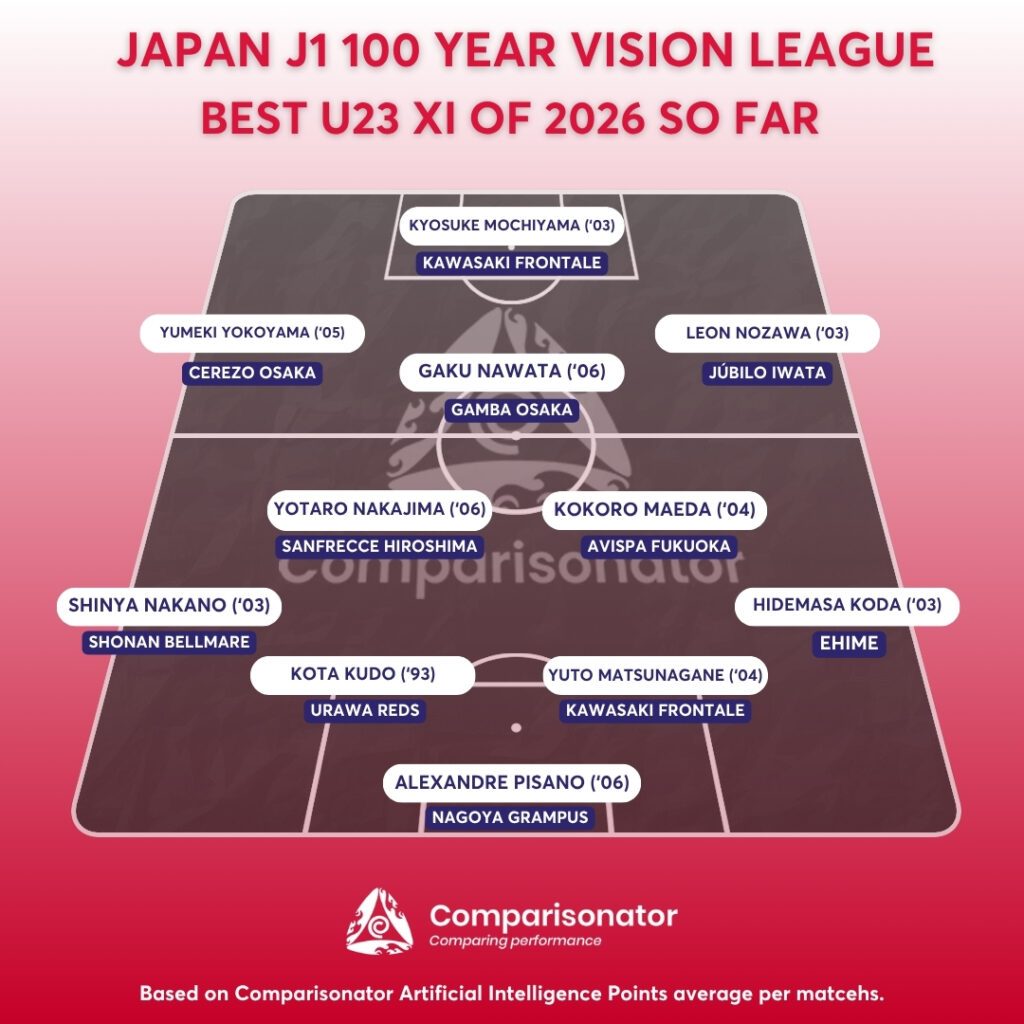
And as the final Best U23 XI of Japan J1 100 Year Vision League 2026 so Far: