
As the Argentina Liga Profesional 2025 season unfolds, a new wave of young talents is making a name for themselves across the league. From commanding defenders to dynamic forwards, these players are proving their worth with standout performances and impressive data-driven contributions. Using advanced performance metrics, we break down their impact, strengths, and potential, giving a data-driven perspective on why these rising stars are ones to watch. Let’s dive into the numbers and uncover what makes them stand out in Argentina Liga Profesional.
Powered by CompaAI, the next-generation AI solution from Comparisonator, this analysis simplifies complex football data into clear, actionable insights. With its cutting-edge features, CompaAI revolutionizes squad analysis, delivering an instant, in-depth assessment of team performance. In just seconds, it pinpoints standout players, uncovers rising young talents, and identifies key areas for enhancement.
Beyond traditional analysis, CompaAI offers strategic intelligence to refine transfer strategies. By detecting high-potential signings, it empowers clubs to strengthen key positions and scout future stars with accuracy. With CompaAI, raw data transforms into valuable, data-driven insights, providing teams with a decisive advantage in the transfer market.
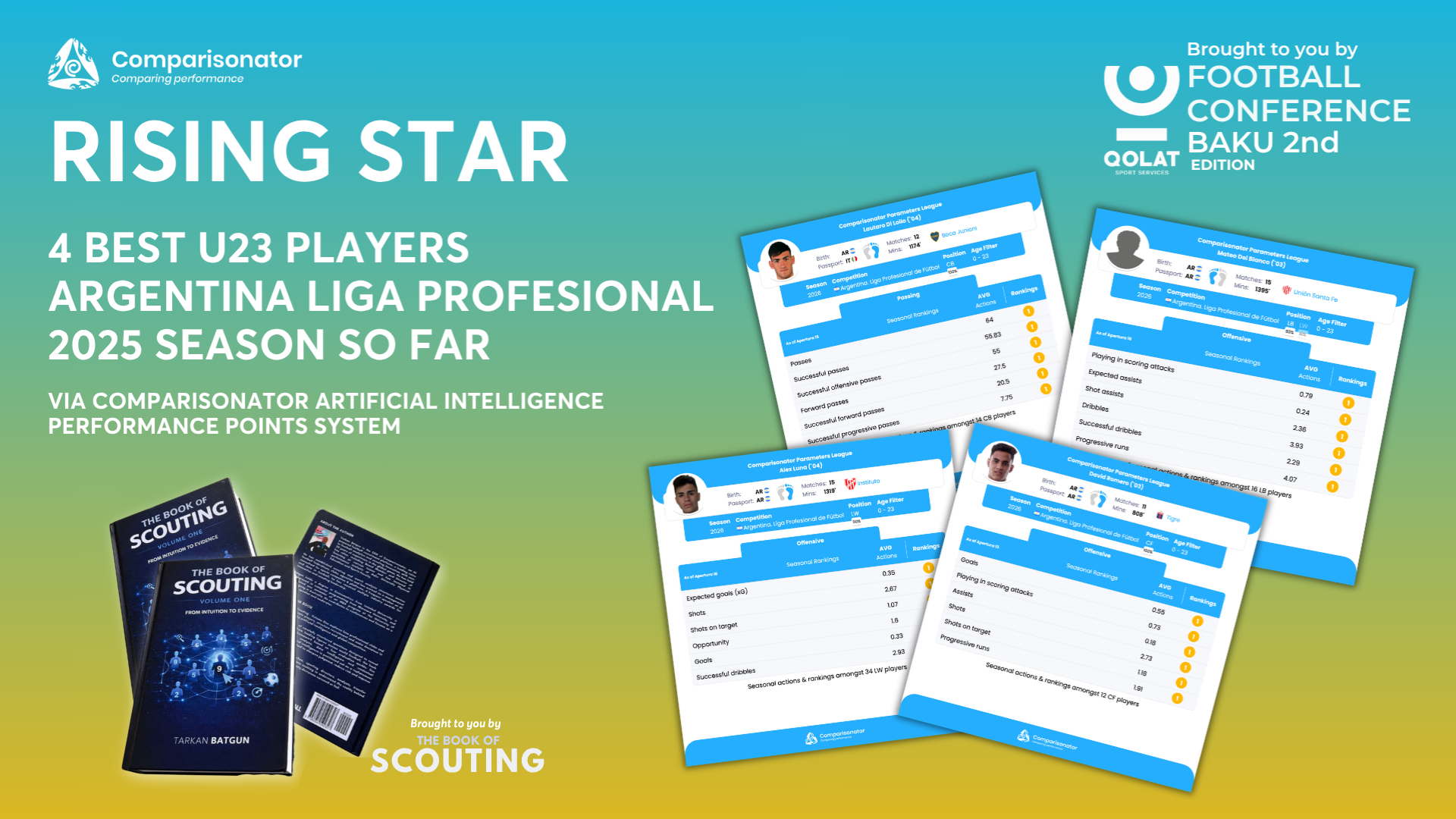
“Rising Star” 4 Best U23 Players Argentina Liga Profesional 2025 Season So Far
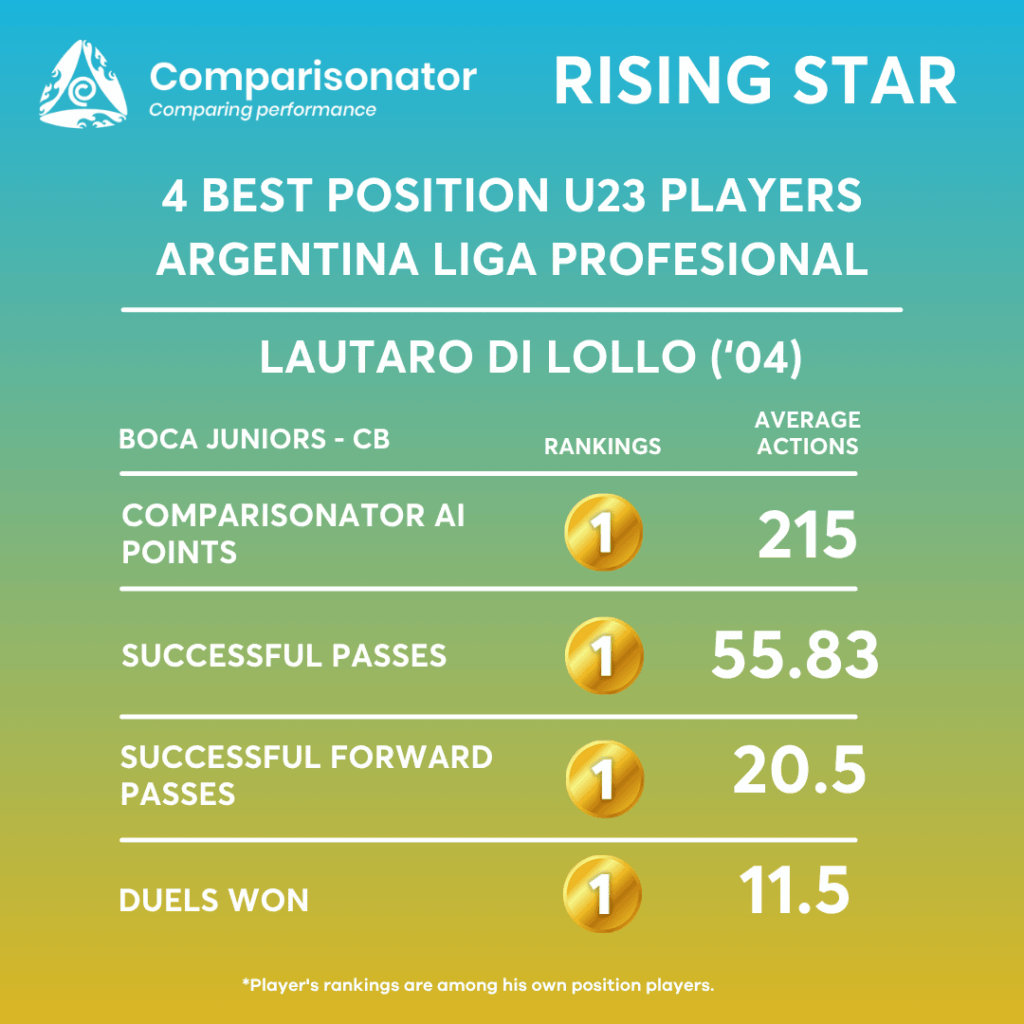
Lautaro Di Lollo (‘04) (CB) – Boca Juniors
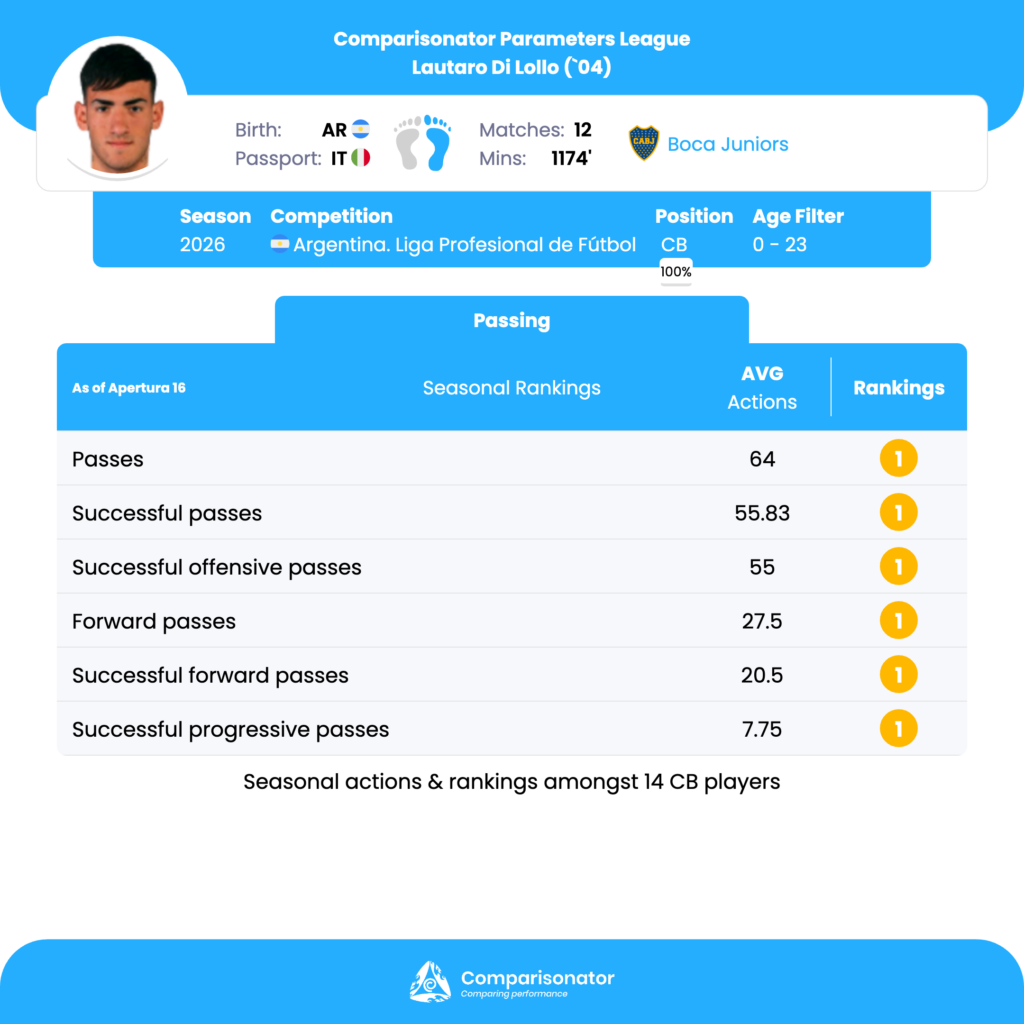
Lautaro Di Lollo‘s CompaAI Parameters League Passing report:
Di Lollo’s strongest seasonal trait is his volume and security in ball circulation. He ranks 1st out of 14 CBs with 64 passes per match, ahead of Lautaro Rivero’s 61.08, and also leads the group in 55.83 successful passes per match versus 54.33 for Rivero. This places him at the top of the position pool for overall distribution volume while maintaining strong completion, which indicates a defender who can be trusted as a regular outlet in buildup and can sustain team possession under normal match rhythm. He is also the clear leader in the more advanced side of his passing profile. Di Lollo ranks 1st with 62.67 offensive passes per match and 55 successful offensive passes per match, both ahead of Rivero’s 59.58 and 53.25. He additionally leads in 27.5 forward passes and 20.5 successful forward passes per match, outperforming Ezequiel Herrera’s 24.5 forward passes and Rivero’s 19.5 successful forward passes. This shows a CB who regularly looks to progress the ball vertically rather than simply recycle it, which can be tactically valuable in teams building from the back and trying to connect defense to midfield quickly. His progression metrics are another major strength. Di Lollo is 1st in 7.75 successful progressive passes per match, ahead of Tomás Palacios’ 6.64, and also leads in 44.58 received passes per match, 36.75 passes into the middle third, and 19.83 passes into the defensive third. He also posts 10.92 progressive passes per match, where only Ezequiel Herrera is slightly ahead with 11. This combination suggests he is heavily involved in structured buildup, receives consistently, and can advance play through intermediate zones.
Di Lollo’s best ranking parameters are his overall passing volume, successful passes, offensive and forward passing output, and progressive passing volume, where he leads or sits near the top of the under-23 CB group. His profile points to a center-back who is highly active in buildup, reliable in possession, and capable of advancing play through structured passing lanes. The main weaknesses are in creative passing, final-third penetration, and especially long-pass efficiency, which can cap his influence when a team needs line-breaking distribution or fast switches under pressure. Tactically, he can be used as a buildup-oriented right or left center-back in possession teams, particularly where the back line needs a secure distributor who can connect into midfield. He may be less suitable as the primary long-range switcher or as a CB expected to provide direct final-third creation.
Lautaro Di Lollo (‘04) (CB) – Boca Juniors