
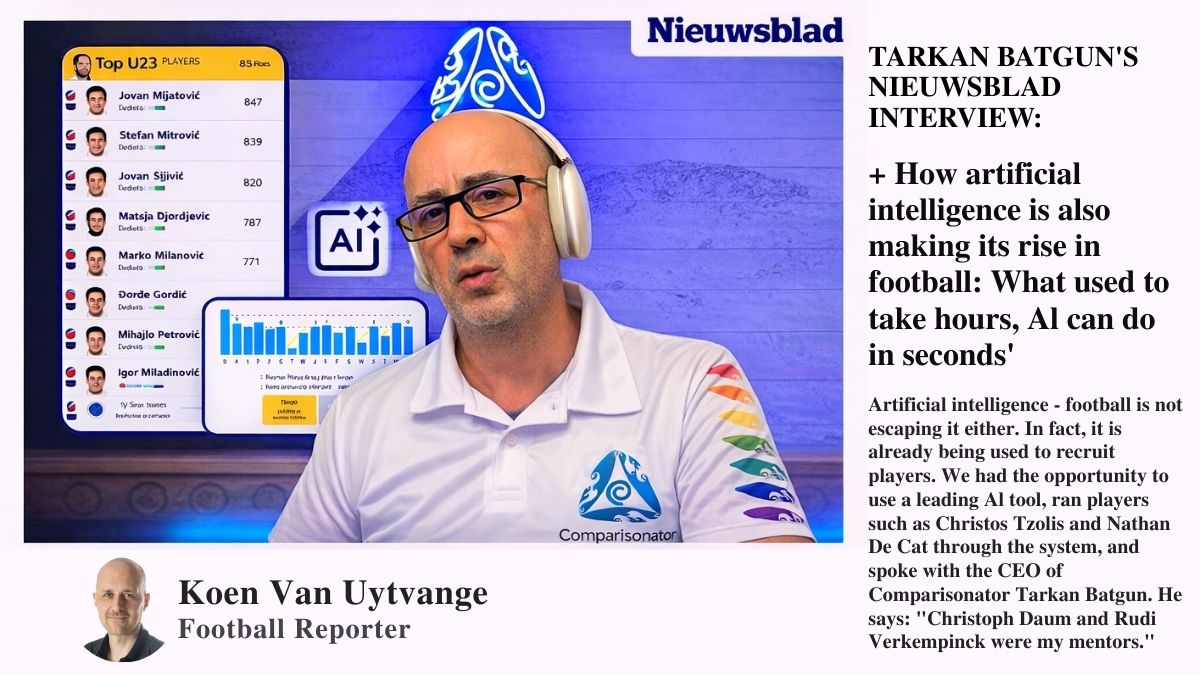
How artificial intelligence is also making its rise in football: “What used to take hours, AI can do in seconds” Artificial intelligence — football is not escaping it either. In fact, it is already being used to recruit players. We had the opportunity to use a leading AI tool, ran players such as Christos Tzolis and Nathan De Cat through the system, and spoke with the CEO of Comparisonator Tarkan Batgun. He says: “Christoph Daum and Rudi Verkempinck were my mentors.”
You will find the answers below, provided by Artificial Intelligence. No, they do not come from ChatGPT. They come from Comparisonator, an AI tool designed for player recruitment. What does Comparisonator do? It pulls in every possible data point, scores players on all those parameters, and creates rankings.
“Every position requires different attributes,” says Tarkan Batgun, CEO of Comparisonator. “A mobile forward runs a lot, so distance covered matters more for him than for a box striker, who needs particular sprinting qualities.”
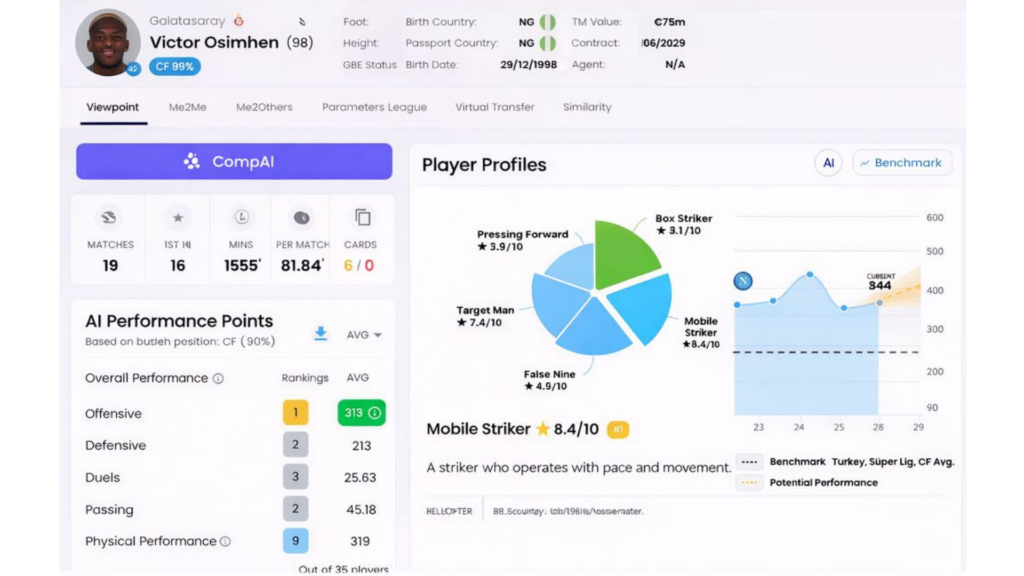
Using data, the system determines each player’s profile. For example, Club Brugge striker Nicolo Tresoldi is classified as a box striker, while Zulte Waregem’s Anosike Ementa clearly emerges from the stats as a target man—actually the best in the league. Christian Burgess is the best libero, but no one ranks higher as a ball‑playing centre-back than Genk’s Matte Smets. In the overall centre-back ranking, however, Smets is only sixteenth in the league.
The best-performing player (with at least half the matches played) in the Jupiler Pro League? KV Mechelen’s Nacho Miras, ahead of Tzolis and Tresoldi.
“Was it the first goal? How difficult was the finish? How good was the pass he received? All those numbers are processed. Each league also has its own weighting. The Belgian league is not on the same level as the English one. And a cup match against a fourth‑tier team is not the same as a game against Club Brugge.”
The inspiration for Tarkan Batgun’s AI model dates back to 2013, when he worked at Bursaspor in Türkiye as Director. The head coach was Christoph Daum, who had just left Club Brugge. “I consider Daum, and his assistant Rudi Verkempinck, as my mentors,” Batgun says. “They wanted every proposed player to be evaluated. So that’s how we started”
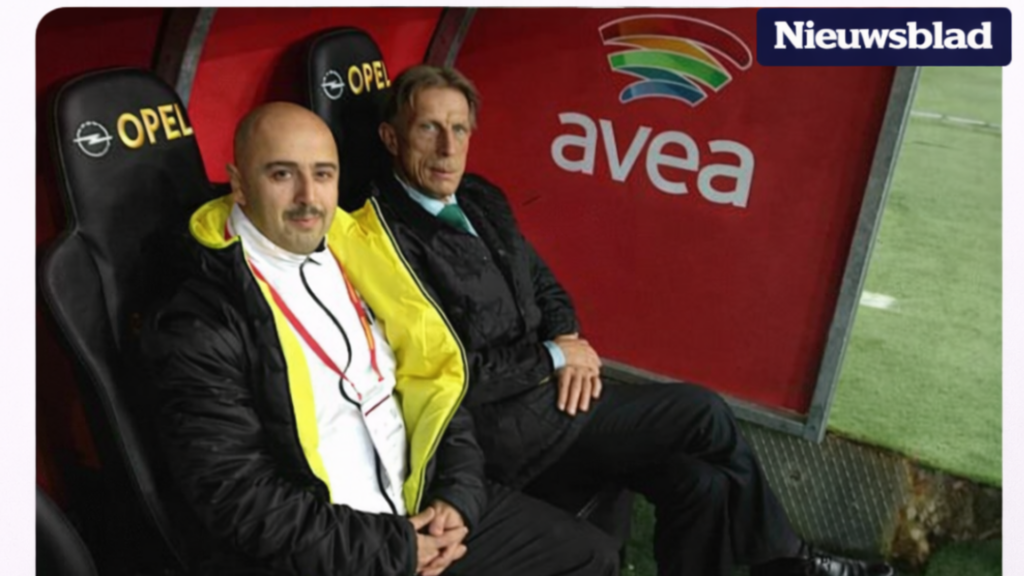
Batgün eventually launched his own company. “In 2021, we began training Artificial Intelligence. We had to teach the AI where it was wrong and which parameters were off. We taught it how to read data and translate it into human language. Now, five years later, one press of a button, and Comparisonator gives you a complete scouting report on any player, in 32 different languages.”
For example, Christos Tzolis ranks as the number‑one left winger because of his top scores in “threat, creation, and physical intensity.” His dribbling against a low block can improve, and he performs better with “freedom around the box” than with “fixed defensive duties on the flank.”
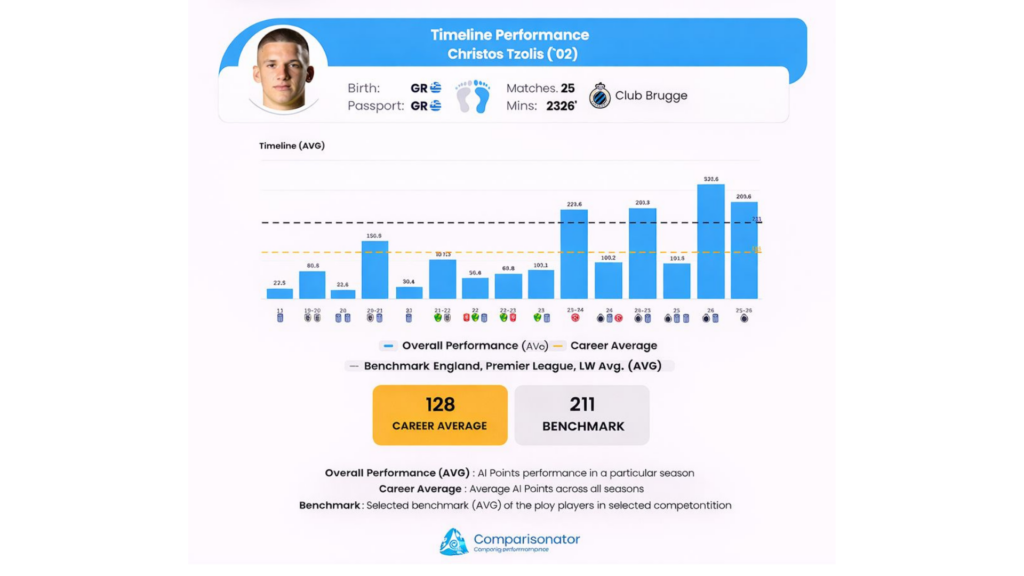
Club Brugge is rumoured to use AI as well, but Batgün calls it “unrealistic” and “too complex” for clubs to fully train AI systems themselves.
Comparisonator screened players on “only” 168 criteria until last week; after the latest update, that number more than doubled to 378 parameters. The company calls this “industry‑leading”—meaning they believe they’re ahead of the competition. “Comparisonator is still evolving. Next year she will really be able to talk with you, in all those languages.”
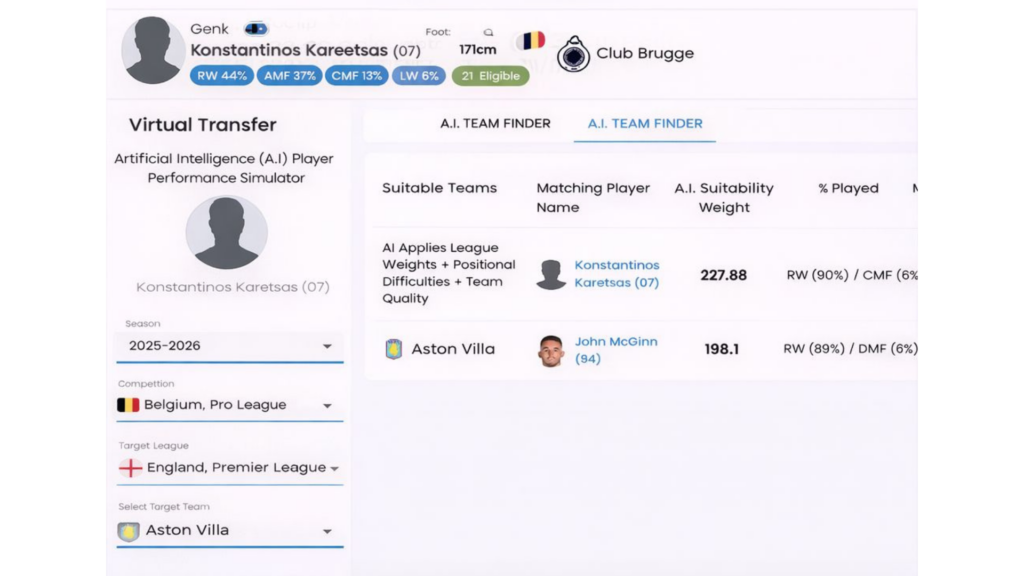
The data pool is enormous and offers a sea of comparison material. But the biggest innovation is the Virtual Transfer: AI estimates how a player would fit within a team based on its current playing style. For example: Kos Karetsas would be most suitable for Aston Villa, replacing John McGinn. He is far below the required level for top teams like Arsenal, mostly because his attacking impact is insufficient. At Manchester United, he might be “a rotation option.”
Christos Tzolis appears to be the ideal replacement for Kevin Schade at Brentford or Harvey Barnes at Newcastle.
At top clubs like Arsenal or Chelsea, he would be at best a second‑choice option behind Gabriel Martinelli or Pedro Neto.
Promise David, Union’s injured title‑driver, would fit best at Wolverhampton, replacing Tolu.
“What used to take hours, AI does in seconds: analysing a player and putting the data into context by recognizing patterns, and turning everything into a clear, readable report showing whether a player fits a system or club.”
Comparisonator already has 178 clients, including KV Mechelen and Westerlo.
The tool also makes predictions. For example, it shows that Anderlecht goalkeeper Colin Coosemans performed worse this season than in 2024–2025 and scores below the league average for goalkeepers—just like Simon Mignolet.
If Anderlecht followed the AI strictly and its downward trend analysis, Coosemans would not get a new contract.
If Club Brugge wanted to find a Belgian replacement for Mignolet, Tobe Leysen from OH Leuven is the closest match in profile.
“AI sees a lot, but not everything. Don’t forget we’re dealing with people. Football is an emotional game. You need to see a player’s face when he’s subbed off in the 55th minute. How does he behave? How does he celebrate his goals? Does the rest of the team join in? Does he push teammates or just follow? The mental aspect is something AI can’t detect yet.”
Take Nathan De Cat. Because the 17‑year‑old only started getting minutes at the top level this season, predictions remain cautious. AI describes him as a regista—a deep‑lying playmaker-passer.
The top three players in that role in our league are Hans Vanaken, Bryan Heynen, and STVV’s Rihito Yamamoto. De Cat ranks only 11th.
Among all players aged 21 or younger (with at least 1200 minutes), he is 16th in the league.
Goore (AA Gent), Karetsas, and Club-back Sabbe form the top three, while Piedfort (Westerlo) and Mbamba (Dender) are also rated slightly higher this season.
According to Comparisonator, De Cat does not yet reach the average performance level for his position in any of the top five leagues. Only smaller clubs focused on development would give him playing time right now.
But the big clubs? According to this AI, that step is still too early.
The impact of AI is hard to predict. Video analysts may soon be “replaced” by much faster AI. Coaches and sporting directors, however, don’t need to worry yet.
“AI will help you find the right players faster. You still check them against data, video, and live matches. All those steps remain important. I’m writing a book about it,” Batgün says. “AI will be a tool for scouting, not a replacement. Everyone will have their own personal AI assistant in the future. And maybe, before long, robots with cameras will attend matches instead of scouts. But fear AI? No. Just learn how to use it.”
AI is here to stay.