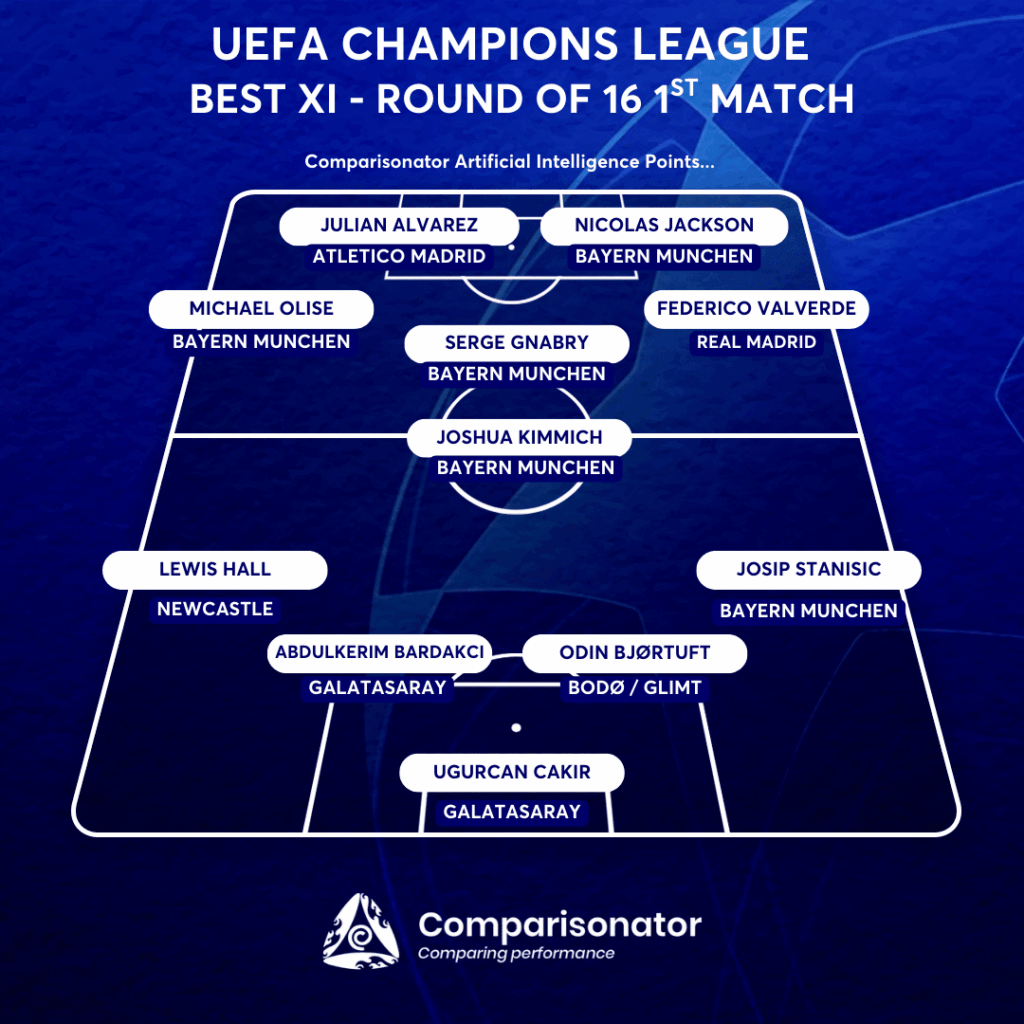

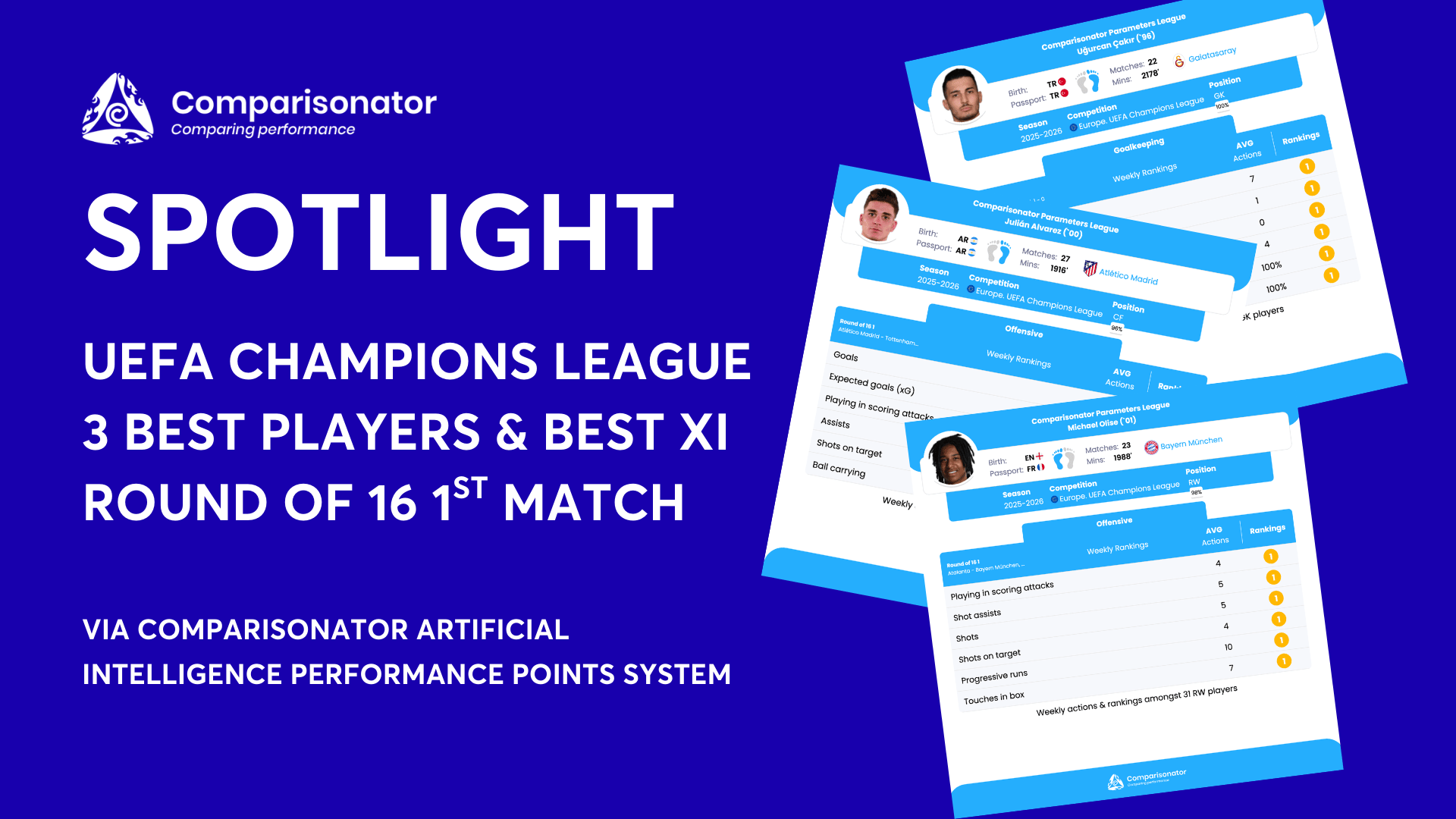
UEFA Champions League has always been a breeding ground for talent, and the 2025/26 season is no exception. With rising stars making their mark, we have identified the top three players who have been standout performers so far. Alongside them, we present the Best XI, showcasing the most promising talents across all positions. These players are not only shaping the present of Europe football but also paving the way for its future. Let’s dive into the best emerging talents of the season!
Powered by CompaAI, the cutting-edge AI tool from Comparisonator, this analysis turns complex football data into clear, actionable insights. With its latest advancements, CompaAI transforms squad analysis, delivering an instant, comprehensive view of team performance. In seconds, it highlights standout players, identifies emerging young talents, and pinpoints key areas for improvement.
More than just analysis, CompaAI provides strategic guidance to optimize transfer strategies. By accurately detecting top potential signings, it enables clubs to reinforce key positions and scout future stars with precision. With CompaAI, raw data becomes powerful, data-driven intelligence, giving teams a competitive edge in the transfer market.
3 Best Players in UEFA Champions League
Ugurcan Cakir (‘96) (GK) – Galatasaray
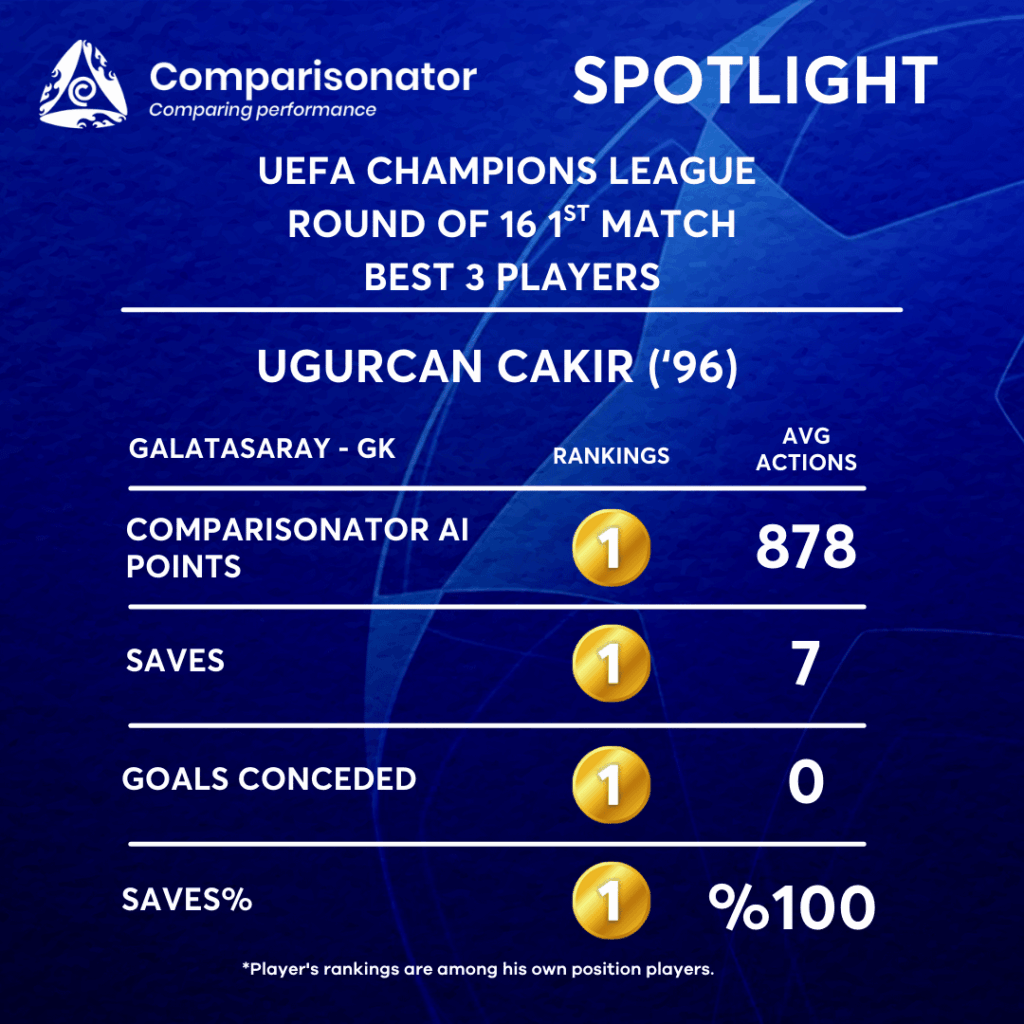
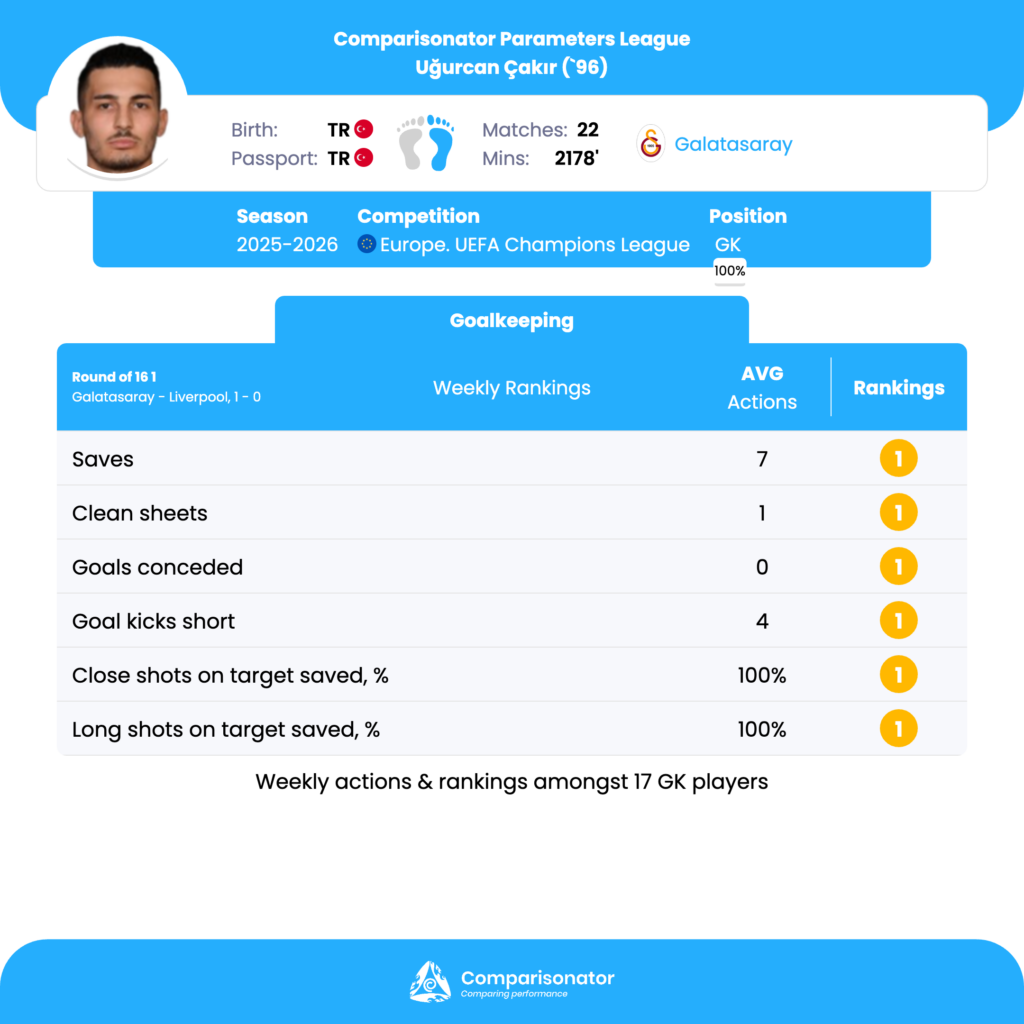
Ugurcan Cakir’s CompaAI Goalkeeping report:
In this selected match period, Uğurcan Çakır’s performance level can be described as elite in pure goal prevention. He ranked 1st out of 17 goalkeepers with 7 saves per match, outperforming the next closest competitor, Marco Carnesecchi (6). This volume of saves, combined with match outcome, highlights a decisive shot-stopping role under sustained pressure. The save count aligns with tactical scenarios where Galatasaray absorbed phases of Liverpool possession, requiring consistent intervention rather than passive control. His effectiveness is reinforced by top rankings in goals conceded (0), conceded goals xG (0), and clean sheets (1), all ranking 1st out of 17. Matching players like Nikita Haikin and Thibaut Courtois in these categories, Çakır converted defensive structure into tangible match control. The zero xG conceded indicates that Liverpool’s shots either came from low-quality areas or were neutralized early, reflecting strong positioning and shot anticipation rather than reliance on high-risk reflex saves.
Across the selected match, Uğurcan Çakır’s strongest contributions came in saves per match, save percentage, goals prevented, clean sheets, and distribution efficiency, all ranked at or near the top among 17 goalkeepers. His profile in this period reflects a goalkeeper in strong form, combining high-volume shot-stopping with maximum efficiency and controlled distribution. From a tactical standpoint, he functioned as both a last-line defender and a stabilizing build-up reference, directly influencing match outcome without introducing defensive volatility.
Michael Olise (‘01) (RW) – Bayern München
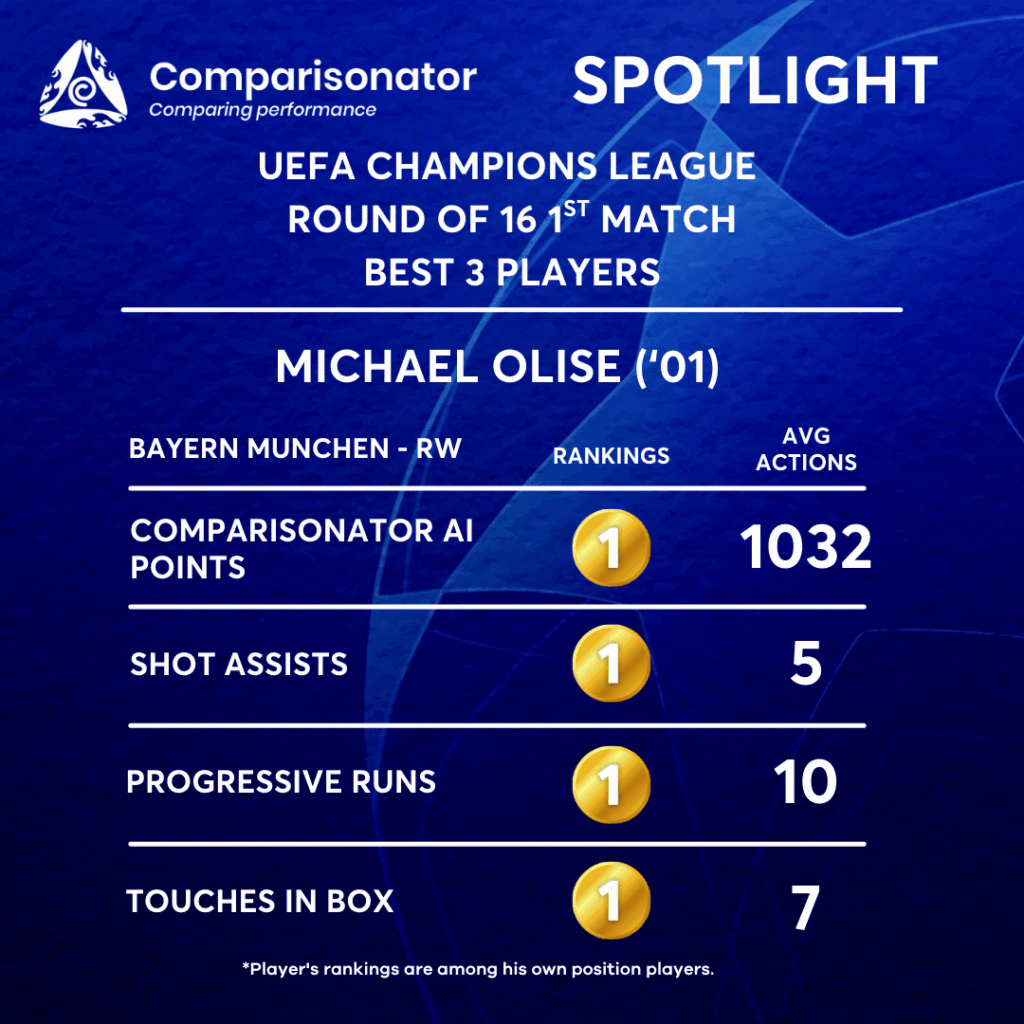
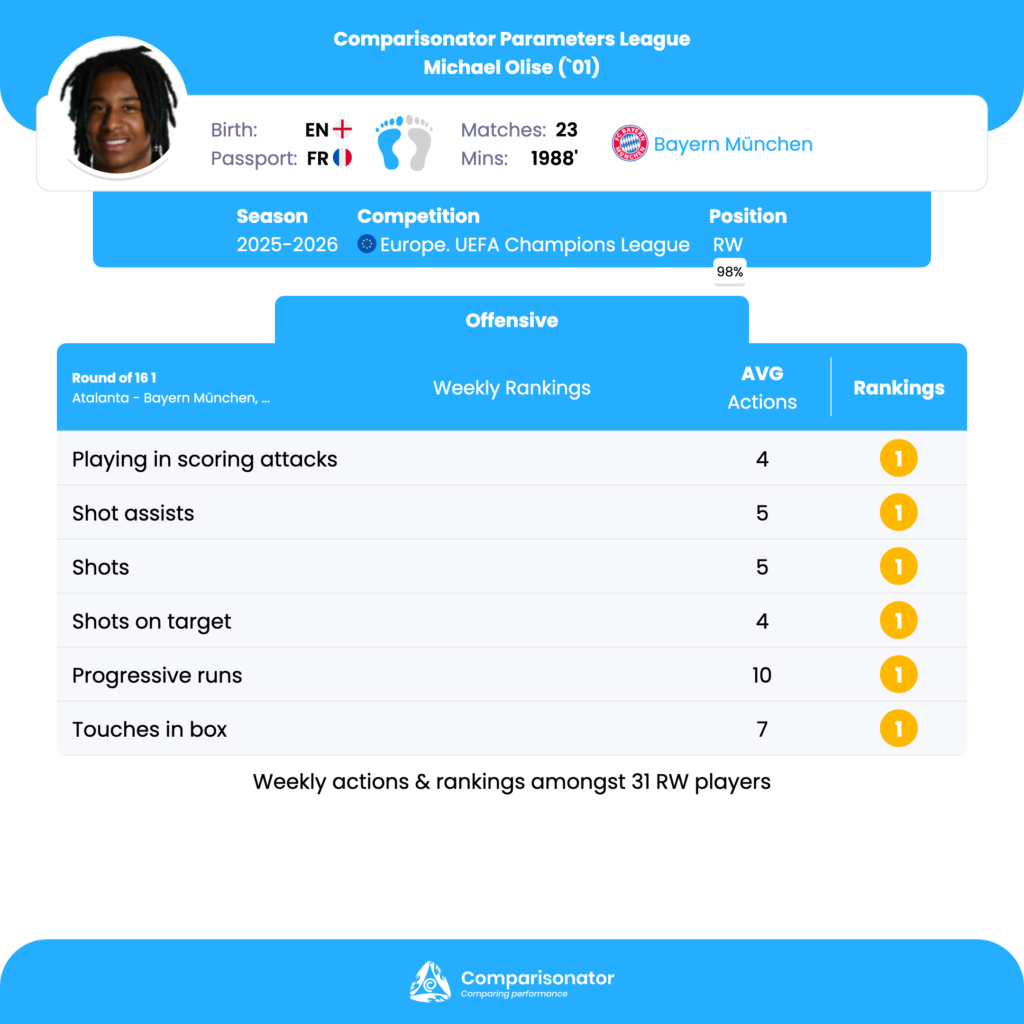
Michael Olise’s CompaAI Offensive report:
A major strength of Olise’s profile is his direct involvement in scoring sequences. He ranked 1st with 4 playing in scoring attacks per match, outperforming peers such as Khvicha Kvaratskhelia (3). This indicates that Bayern’s attacking phases frequently flowed through Olise, underlining his tactical role as a primary catalyst in chance creation rather than a peripheral wide option. His positioning and timing in advanced zones may have allowed Bayern to sustain pressure and repeatedly destabilize defensive structures. Creativity stands out as another defining element of his performance. Olise ranked 1st in assists (1 per match), shot assists (5), and shot-on-target assists (4). Compared to the next-best performers, such as Désiré Doué with 2 shot assists and Jacob Murphy with 1 assist, Olise showed a clear edge in supplying high-quality final actions. This combination suggests not only vision but also precision in execution, pointing toward a winger who can consistently convert possession into immediate scoring threats. Ball progression is another area where Olise separated himself from his positional peers. He ranked 1st with 10 progressive runs per match, doubling the output of the next-best player. This suggests strong ball-carrying intent and verticality, especially valuable against structured defensive blocks. Combined with his 7 touches in the box per match (joint best), Olise demonstrated an ability to advance play from wide areas into decisive zones with consistency.
Across the selected matches, Michael Olise’s strongest parameters were playing in scoring attacks, assists, shot creation, shooting volume, progressive runs, and overall offensive actions, where he consistently ranked 1st among 31 right wingers. These metrics underline a winger in strong current form, combining creativity, direct goal threat, and high involvement in Bayern München’s attacking structure. His performance profile suggests a player capable of driving offensive phases at Champions League level, with tactical value both as a creator and as a finishing presence from the right side.
Julian Alvarez (‘00) (CF) – Atletico Madrid
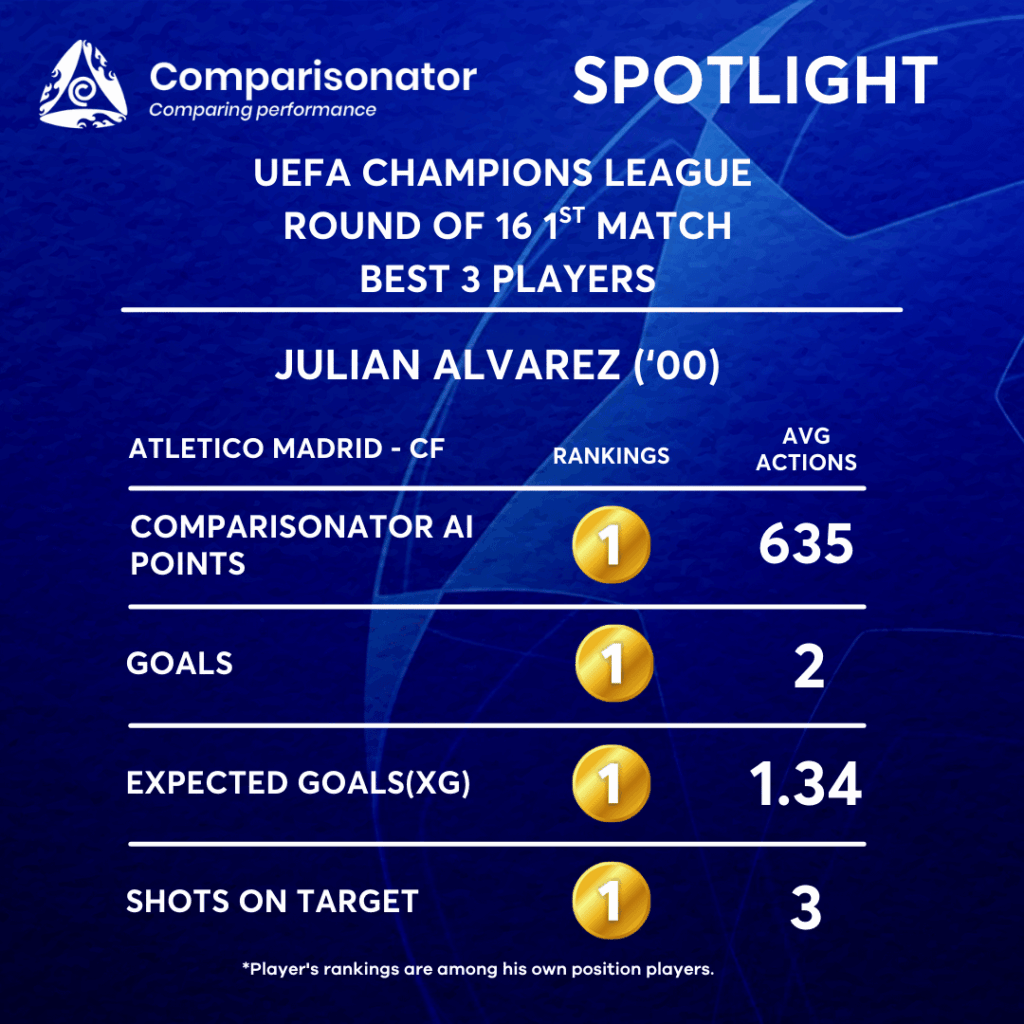
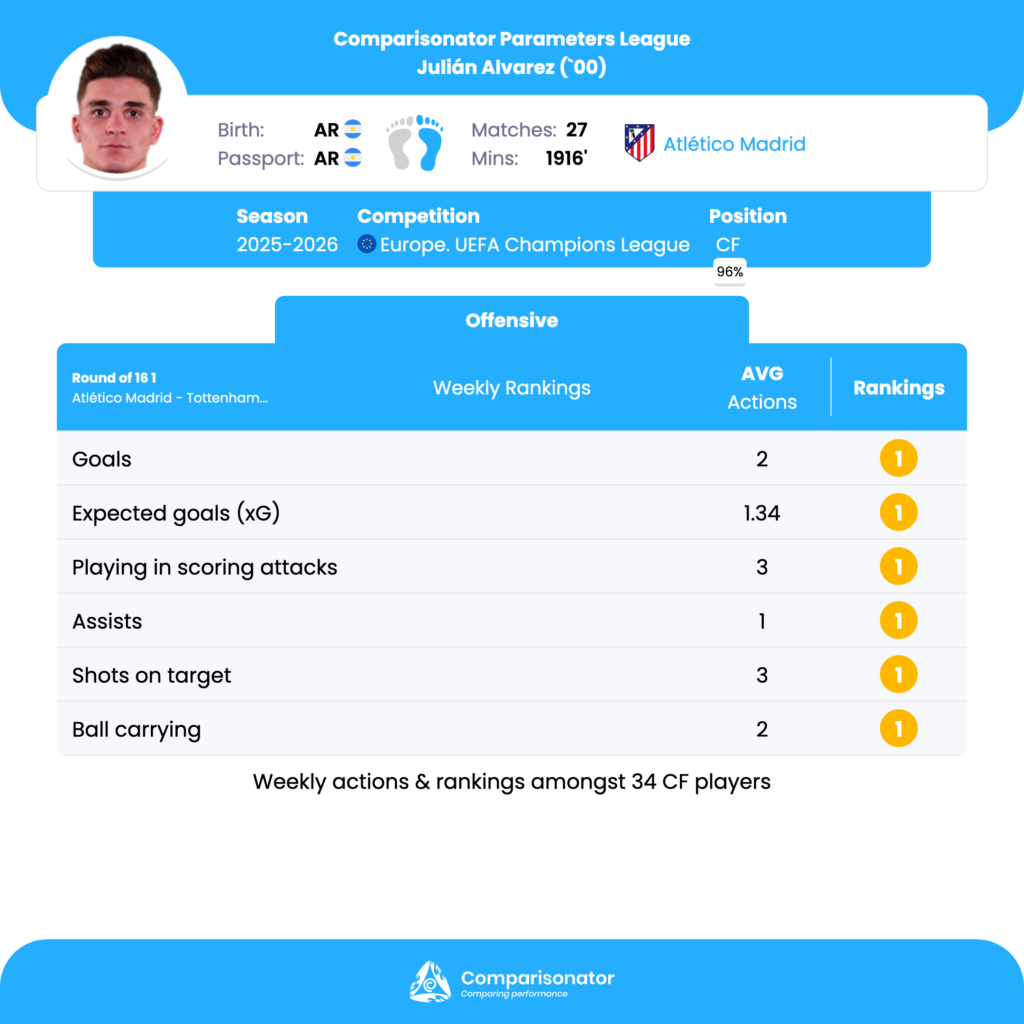
Julian Alvarez’s CompaAI Offensive report:
Julián Álvarez positioned himself at the very top of his positional peer group in several decisive offensive indicators. Most notably, he ranked 1st out of 34 CFs for Goals (2 per match), matching the output of Khvicha Kvaratskhelia. This level of scoring, combined with his 1.34 xG per match, where he also ranked 1st, highlights both elite chance quality and strong positioning inside the box. Compared to the next-best xG performer, Vinicius Junior at 0.8, Álvarez’s shot selection and movement into high-value areas stand out as a defining strength in this period. His involvement in decisive phases of attacking play was equally significant. Álvarez ranked 1st out of 34 for Playing in scoring attacks (3 per match), again alongside Kvaratskhelia. This indicates consistent participation not only in finishing actions but also in the buildup and final connections leading directly to goals. From a tactical perspective, this points to a forward who can operate as a reference point in the box while remaining connected to combination play rather than functioning as a purely static finisher. In terms of shot execution, Álvarez showed elite efficiency. He ranked 1st out of 34 for Shots on target (3 per match) and recorded a 100% shots on target rate, placing him at the top of the positional comparison. This suggests a highly selective shooting profile with strong composure, especially when contrasted with other high-volume shooters who did not reach similar accuracy. His 66.67% conversion of shots on target into goals, ranking 4th, further reinforces the idea of a striker currently in a strong finishing rhythm, even if a small margin separates him from absolute leaders like Kai Havertz in this metric.
In the selected matches, Julián Álvarez’s standout strengths were his Goals, Expected goals (xG), Playing in scoring attacks, Shots on target, Assists, and Ball carrying, all of which placed him 1st among 34 CFs. These top rankings underline a forward in exceptional offensive form, combining elite finishing, intelligent movement, and meaningful creative involvement. Within this specific period, his profile reflects a tactically versatile striker who can finish chances, contribute to buildup, and influence attacking sequences at multiple stages.