
As the demands of modern football continue to rise, physical intensity has become a defining factor in identifying top-level talent. Leveraging the advanced capabilities of the Comparisonator Physical Data Comparison Module, we’ve analyzed Denmark Superliga league to spotlight the top-performing U23 players in three key physical metrics during the 2025/26 season so far. This comprehensive assessment offers clubs, scouts, and analysts valuable insight into emerging players whose physical performance sets them apart.
These findings underscore the increasing significance of physical data in contemporary scouting and recruitment. Extracted from broadcast footage using AI-driven analysis, the metrics provide clubs with accurate, contextualized benchmarks for evaluating talent.
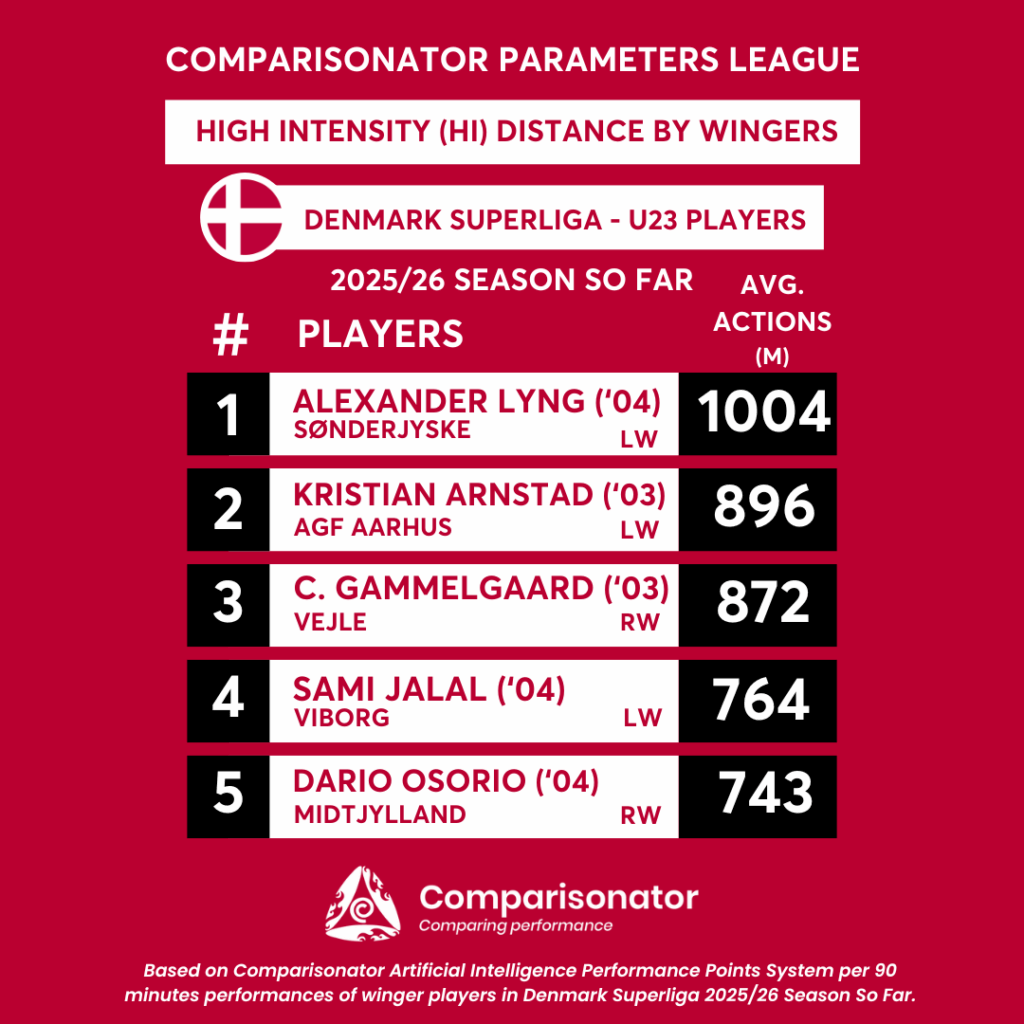
In the High Intensity (HI) Distance category—tracking distance covered at speeds over 20 km/h— Alexander Lyng emerges as the leader, demonstrating sustained pace in high-intensity match scenarios. Juho Lähteenmäki leads in Running Distance, highlighting his exceptional endurance and relentless work rate across full matches. Meanwhile, Caleb Yirenkyi tops the charts in Total Distance a testament to his explosiveness and mobility.
These standout performances not only spotlight Denmark’s next generation of talent but also illustrate how physical analytics can drive smarter, more informed football decisions—from unearthing hidden gems to building dynamic, high-performing squads. Stay tuned as we continue to reveal more data-driven insights throughout the season.
Please note that all numbers are per 90 min data from the 2025/26 Season So Far.
Juho Lähteenmäki’s CompaGPT Physicals report:
Juho averages 1539.42 meters in running distance and 47.79 high-speed runs per match, leading the category. These metrics highlight his endurance and capacity to maintain high activity rates, crucial for roles that demand consistent movement along the flanks. His high-speed runs are particularly useful in breaking defensive lines and supporting quick transitions from defense to attack. Juho Lähteenmäki averages a total distance of 10,491.38 meters per match, ranking 1st among left-backs under 23 in the Denmark Superliga. Compared to Rodrigo Huescas, who follows closely with 10,279.03 meters, Juho demonstrates superior stamina and work rate. This indicates his exceptional ability to maintain high activity levels throughout matches, making him valuable for teams that rely on full-backs for both defensive duties and support in offensive plays. His high distance coverage can be tactically significant for pressing strategies and maintaining width in attacking formations.
Juho Lähteenmäki’s best ranking parameters highlight his endurance, agility, and ability to perform high-speed activities consistently. He excels in total distance, medium accelerations, high-speed running, and sprint counts, which are critical for roles demanding dynamic movement and stamina. Despite his strengths, there is room for improvement in max speed and sprint endurance, which could further enhance his tactical utility in both defensive and offensive scenarios.
Juho Lähteenmäki (‘06) (LB) – Nordsjælland
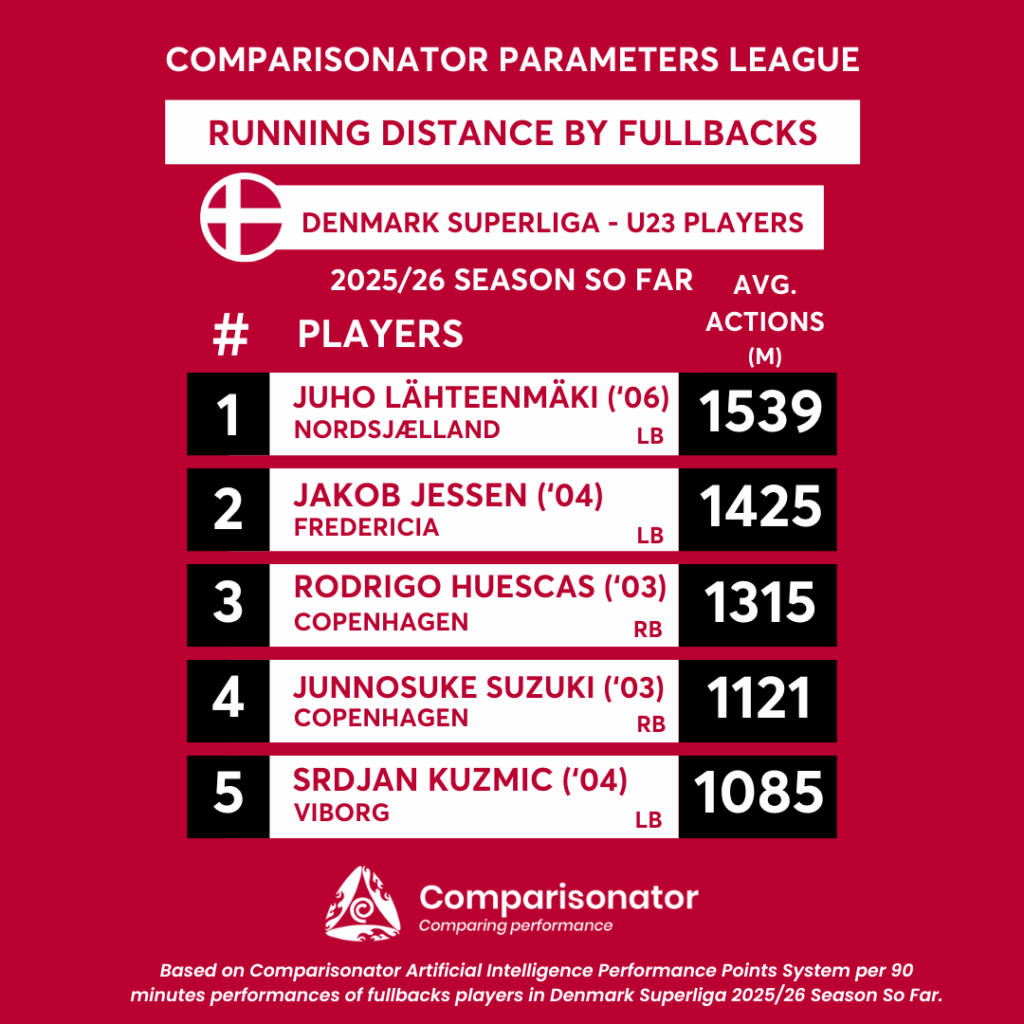
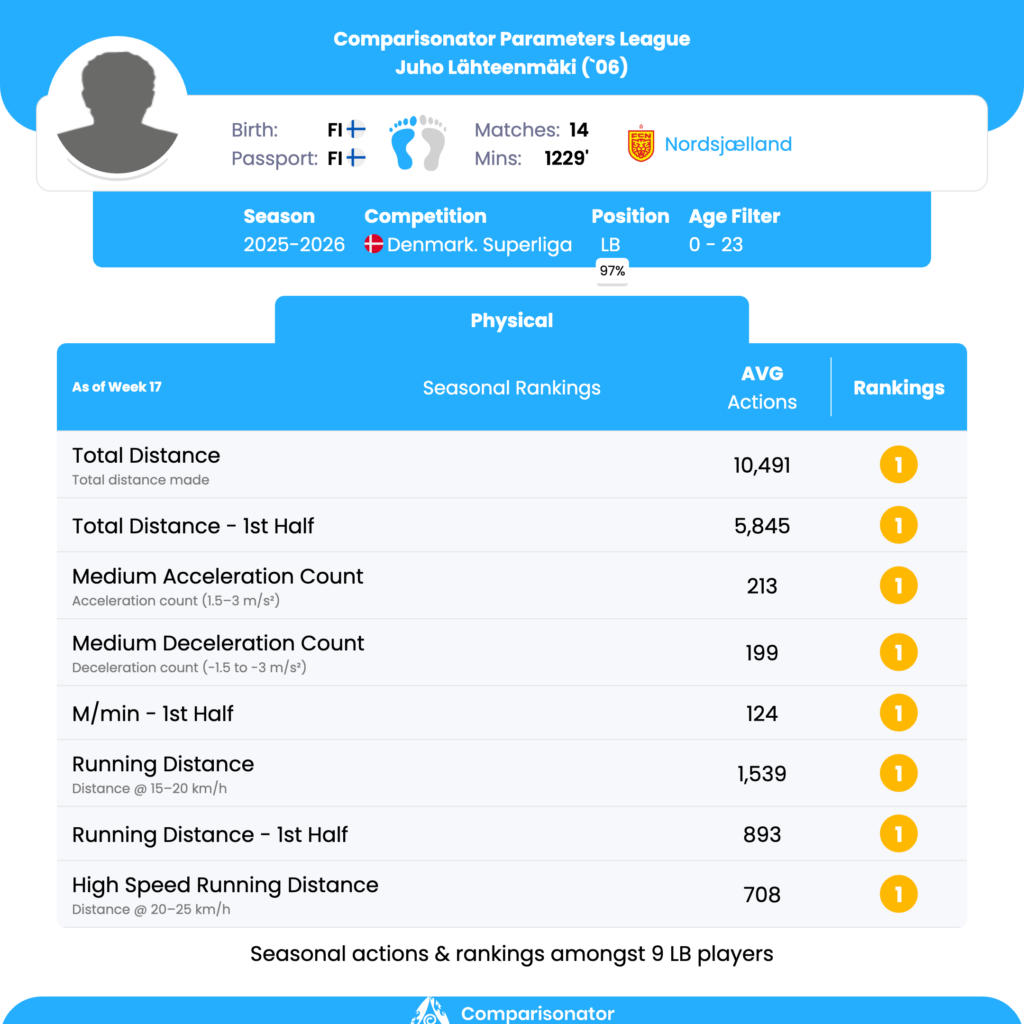
Running Distance
Caleb Yirenkyi’s CompaGPT Physicals report:
Caleb leads the category with an average of 11,383.24 meters per match, outperforming Thomas Jørgensen’s 10,838.17 meters. This indicates Caleb’s exceptional stamina and work rate, allowing him to consistently support both defensive and offensive plays. Tactically, he may be utilized in systems that require extensive midfield coverage and high pressing. With an average of 249.75 per match, Caleb ranks first, ahead of Kristian Arnstad at 227.4. This showcases his ability to frequently accelerate, crucial for quick transitions and closing down opponents. His agility can be leveraged in high-tempo games where rapid changes in speed are necessary. Caleb again tops the rankings with an average of 227.56, compared to Thomas Jørgensen’s 198.81. This suggests his proficiency in controlling his pace effectively, important for maintaining defensive shape and recovering after offensive bursts. It is tactically advantageous in systems that require quick defensive adjustments.
Caleb Yirenkyi’s strengths lie in his exceptional ability to cover long distances, frequently accelerate, and effectively decelerate, making him a valuable asset in midfield roles that demand high physical exertion and adaptability. However, his sprinting capabilities, both in distance and frequency, offer potential areas for improvement to further enhance his overall effectiveness in high-intensity match situations.
Caleb Yirenkyi (‘06) (DMF) – Nordsjælland
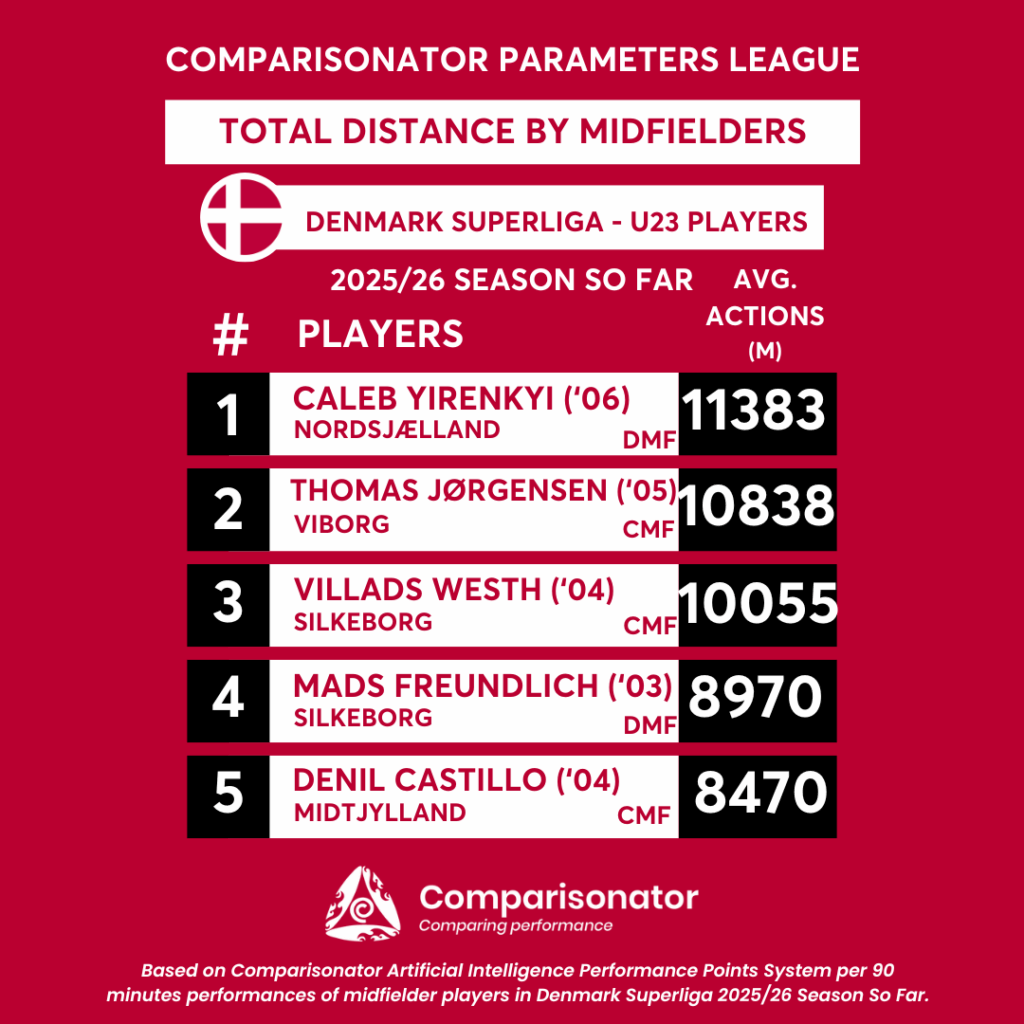
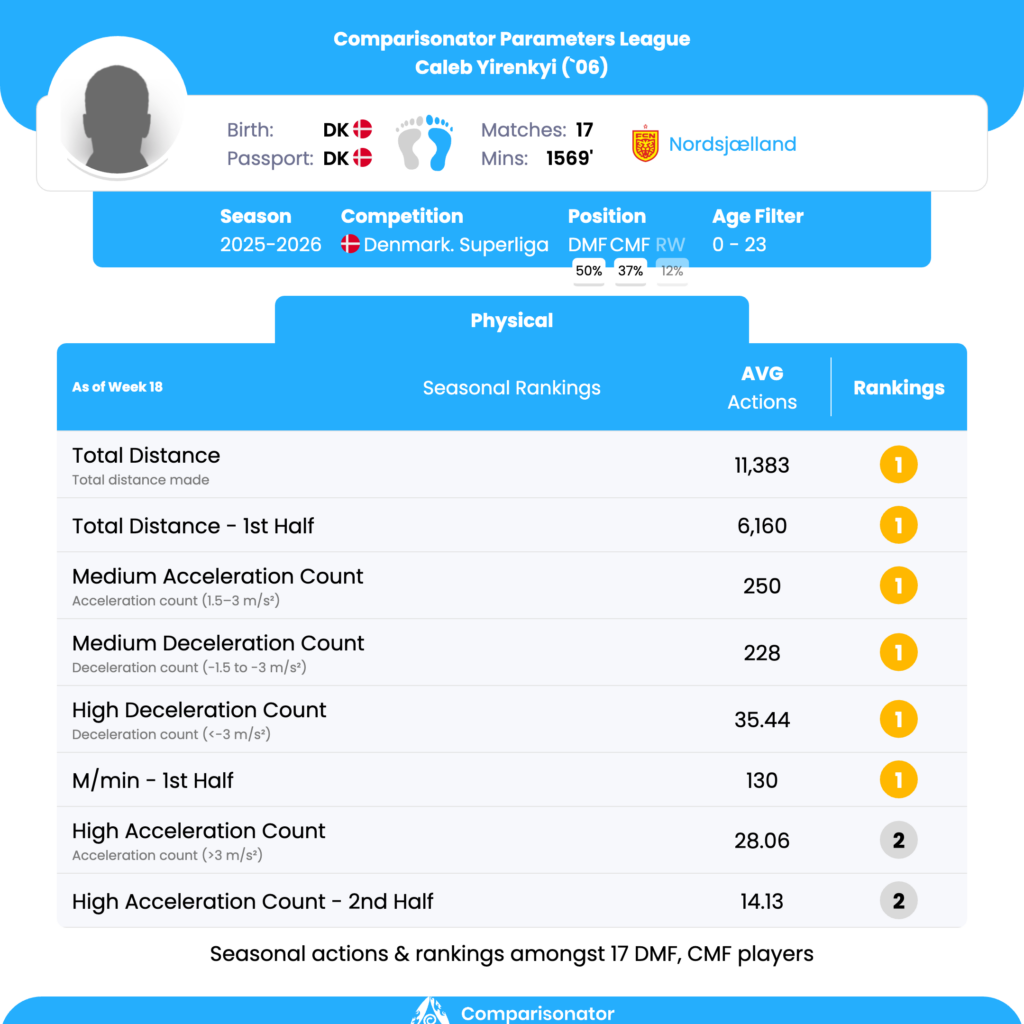
Total Distance
Alexander Lyng’s CompaGPT Physicals report:
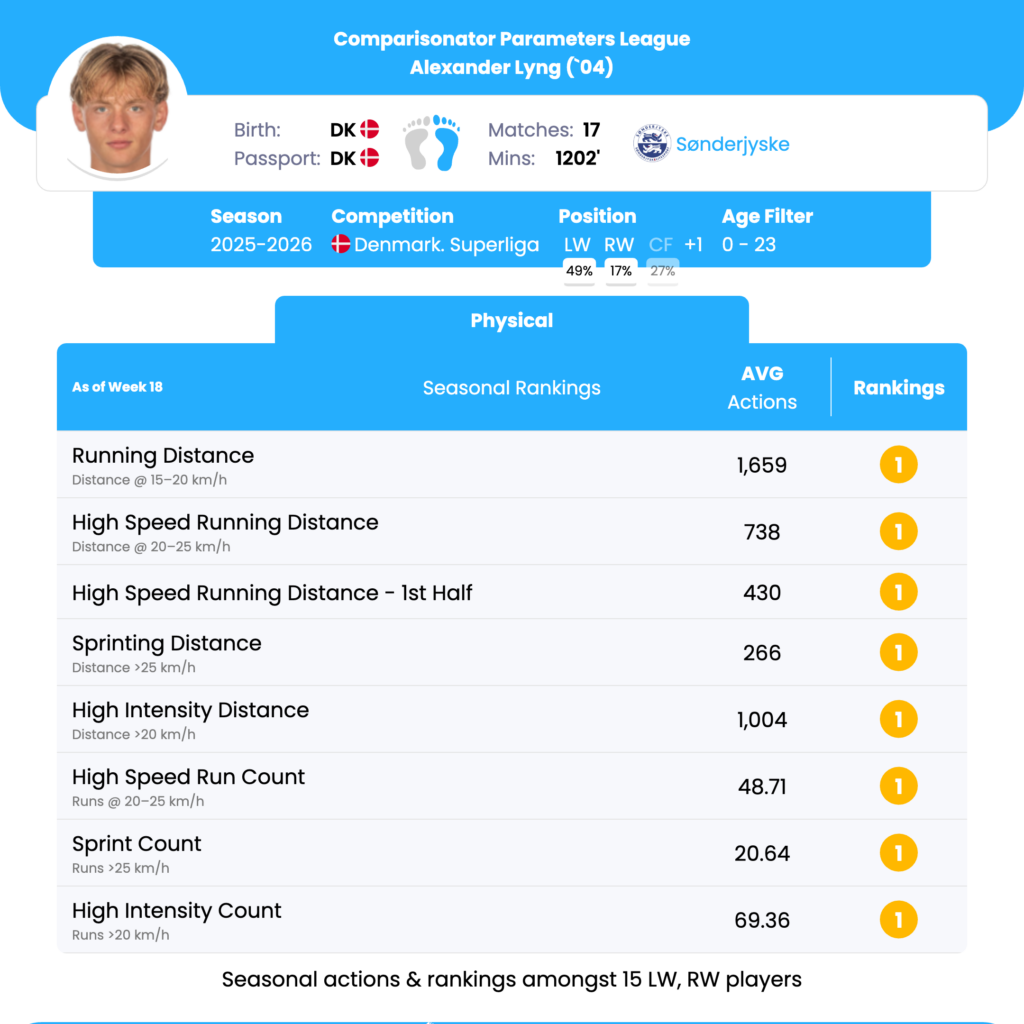
Lyng ranks first in High Intensity Distance, covering 1003.71 meters per match, ahead of Kristian Arnstad’s 896.08 meters. This reflects his capacity for sustained high-energy exertion, benefiting team dynamics in both offensive and defensive phases. Strategically, Lyng could be pivotal in games requiring relentless pressure and dynamic movement across the pitch. Alexander Lyng leads in Running Distance, averaging 1658.53 meters per match, ranking first among his peers. This surpasses the second-best performer, Kristian Arnstad, at 1635.11 meters. Lyng’s ability to cover extensive ground indicates his work rate and endurance, making him a reliable asset in maintaining pressure on opponents and facilitating quick transitions. This strength suggests tactical utilization in roles demanding high mobility and stamina, such as pressing forward or tracking back defensively. Lyng tops the rankings for High Speed Running Distance, averaging 737.7 meters per match. He outpaces Kristian Arnstad, who averages 652.65 meters. This capability highlights Lyng’s explosive pace and ability to sustain high-speed runs, crucial for breaking defensive lines and supporting counter-attacks. Tactically, Lyng might be deployed in situations requiring rapid offensive transitions or when exploiting spaces behind the opposition’s defense.
Alexander Lyng’s strengths lie in his exceptional running and sprinting capabilities, leading multiple categories such as Running Distance, High Speed Running Distance, and Sprinting Distance. These attributes underline his high work rate, pace, and capacity for sustained intensity, making him a valuable asset for roles requiring dynamic movement and aggressive play. However, areas such as Max Speed and second-half acceleration present opportunities for further development to maximize his effectiveness throughout the entirety of a match.
Alexander Lyng (‘04) (LW) – Sønderjyske