

One of Greece’s most widely read and followed sports journalists, Vasilis Sambrakos, interviewed Comparisonator CEO Tarkan Batgün, and the interview was published on Sport24. Here are some of the key headlines:
Vasilis Sambrakos discusses with the founder of scouting platform Comparisonator, Tarkan Batgün, about the revolution that data analytics and AI technology have brought to the way football clubs make transfers.
Tarkan Batgün is a recognizable figure in the field of modern scouting and performance analysis.
With over twenty years of experience on four continents, he has worked as Scouting Director and Head of Performance Analysis in professional clubs, has taught in federations and educational organizations, and is currently the CEO of the Comparisonator platform , one of the most advanced tools worldwide for evaluating and comparing football players through data and AI.
His career has brought him to the center of the international debate about the future of scouting, as he combines football knowledge, technological expertise and a deep understanding of the differences between markets, from Europe and Turkey to Australia and the USA. With this background, he is one of the most authoritative interlocutors on how football is evolving in the era of big data and Artificial Intelligence.
In our discussion, Batgün refers to the young Greek footballers who play outside Greece and stand out today. And he explains how modern scouting is being transformed by digital technology, data-driven decision making and AI-models that are now changing the way teams identify, evaluate and predict talent.
-You have worked in football analytics and scouting on different continents, from Australia to Turkey and Europe. How has this international experience shaped the way you approach data and talent identification today?
“Working in football on four continents has taught me one fundamental truth — data means nothing without cultural context. A player in Australia, Turkey or Belgium may put up the same numbers, but the environment, the pace of the league and the tactical culture completely change the meaning of those numbers.
My time in Australia helped me understand systematization and technology; in Turkey I focused on player development and the human side of scouting; and in Europe I learned how to align these two worlds. That’s why at Comparisonator, our AI doesn’t just do calculations, it adapts to the “language” of football in each country.
This balance between local understanding and international comparison is what makes our technology useful globally and what keeps me passionate about building bridges between football cultures through data.”
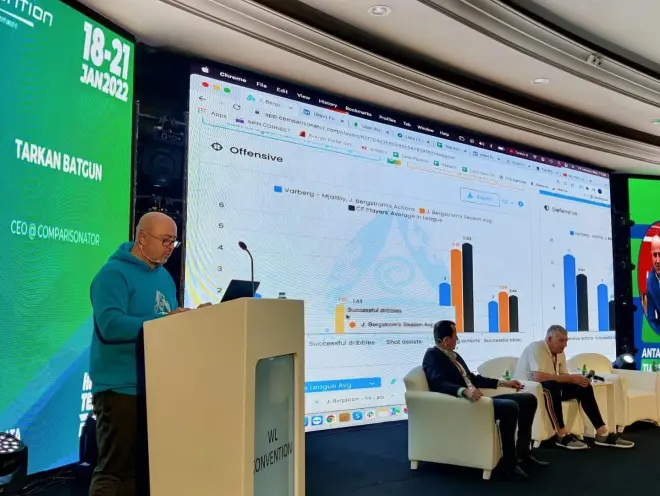
-You have spoken at global events & football forums, coordinated numerous data & AI & scouting panels from Milan, London, Barcelona to Serbia, Australia and Turkey, and advised both clubs and federations. What do you think has brought you this level of international respect and recognition in the football community?
“Respect in football doesn’t come from titles – it comes from consistency and dedication. For over two decades, I have worked to connect three worlds that rarely speak the same language: football, academia and technology.

From creating the first Scouting Laboratory model, to collaborating as a consultant with international data companies such as Wyscout, Sportstec, Hudl, SoccerLab, I have always tried to build systems that can withstand beyond individuals. When I speak at international forums – whether at the Social Football Summit in Rome, or at DealDone Serbia, or at the Hungarian Football Forum – my goal is not to “sell” technology.
It’s about sharing real football knowledge translated into data and AI logic. People in this space appreciate that – because they know it comes from work both on the pitch and behind the screen. At the end of the day, football is a universal language. My mission was to ensure that the data spoke it fluently.”
-Which young Greeks would stand out if someone were looking for young footballers competing in championships far from Greece?
“I use the Comparisonator Recruitment Shop module to identify young players entering U17-U19 or professional leagues anywhere in the world via the AI Player Finder.
Once I enter an age category and the nationality & passport filter – for example, Greece in this case – the system automatically displays a list of players in each position who have a Greek passport, along with selected stats to find the right talent.
I personally follow many of these young Greek players worldwide. Some particularly interesting names are:
- Theofanis Bakoulas (2005) – Rio Ave (Portugal)
- Theodoros Sakoufakis (2007) – Union Berlin U19 (Germany)
- Christos Kostoglou (2009) – Dortmund U17 (Germany)
- Andreas Poulopoulos (2009) – Werder Bremen U17 (Germany)
- Alexandros Zaverdinos (2007) – Sydney FC (Australia)
- Grigoris Politikis (2006) – Torino U20 (Italy)
- Philippos Tsapipis (2008) – Horsens U19 (Denmark)
I also follow several notable U23 players of Greek origin, such as:
- Nektarios Triantis (2003) – Minnesota United (USA)
- Michalis Kosidis (2002) – Zagleby Lubin (Poland)
- Aidy Jaiko (2002) – Cherkasy (Ukraine)”
-From your perspective, what is the biggest change in football scouting in the last five years due to data and AI?
“The biggest change is the shift from judgment to justification. Five years ago, scouting was mostly based on opinions. Now, every observation must be supported by data evidence. AI has made this possible, turning intuition into something measurable and repeatable.
Today, scouts don’t just describe players; they “validate” them with metrics like AI Points, trend consistency, and role fit. It hasn’t replaced human experience, it’s enhanced it, giving structure to what was once instinct.”
-What types of data do you consider to be the most reliable indicators of a player’s future performance?
“The most reliable data is that which explains patterns, not moments. At Comparisonator, we have learned that a player’s consistency trend, decision-making efficiency and physical repeatability are stronger indicators of future performance than individual highlights.
“We also rely heavily on AI Fitness Points to measure how sustainable a player’s performance is over time, not just how good they were once. When this is combined with context-adjusted performance and role suitability, you start to see a player’s true future, not just their past.”
-How can AI help clubs reduce risk when investing in players from lesser-known or undervalued markets?
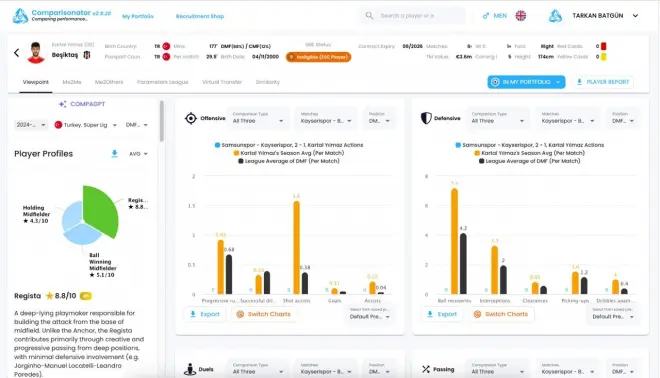
“Artificial Intelligence allows clubs to replace assumptions with evidence. When tracking players from lesser-known or undervalued markets, the biggest risk is data inconsistency — different leagues, different playing styles and gaps in context make comparison almost impossible.
That’s where AI comes in. Through platforms like Comparisonator, AI normalizes and translates each player’s performance into a universal football language, so that a full-back in the USL League can be effectively compared to one in the Belgian Pro League.
AI models evaluate not only statistics, but also contextual difficulty, such as league strength, team quality, and tactical environment. This process turns unknown players into quantifiable profiles. Clubs can see how a player’s metrics would theoretically perform if they were playing in a more demanding environment — this is what I call “Virtual Transfer” technology.
It helps recruitment teams simulate risk before signing, using predictive modeling instead of intuition. In short, AI does not replace human scouting, but it enhances it, allowing scouts to make faster, safer and more informed decisions, especially in markets where traditional scouting is limited or biased.”
-When clubs use Comparisonator, what data points or metrics do they prioritize during scouting?
“Every club uses the data differently, but the main priority is clarity, understanding why a player is performing, not just how much he is performing. When using Comparisonator, coaches and scouts typically start with role-based metrics rather than raw numbers.
For example, instead of simply asking “who has the most tackles”, they ask: “who performs as a Defensive Full-Back?” or “who fits the profile of a Box-to-Box Midfielder?”.
That’s why Comparisonator’s platform converts over 700 statistical parameters into AI Points and role-specific indexes, allowing users to evaluate players based on their functional position within a system.
Clubs prioritize indicators such as:
- AI Points (Overall Performance Index)
- AI Fitness Points (Physical Efficiency Index)
- Positional Role Fit %
- Consistency and trend curves
- League Difficulty & Team Context adjustment
These metrics allow clubs to see how effective a player really is, not just how many passes or tackles they made. The most used areas are the Player vs Player modules and the Virtual Transfer feature.”
-How do you normalize data between leagues of different capacity and how reliable is this normalization in predicting a player’s adaptation?
“This is one of the biggest challenges in football analytics, comparing players from leagues that operate at completely different levels. The Comparisonator platform uses an AI-driven normalization engine that adjusts each player’s performance according to league difficulty, team strength and opposition quality.
Over time, machine learning models learn from thousands of transfers and outcomes, continually improving the weightings. The result is not theoretical, it is predictive.”
-How do you ensure that your AI models avoid biases resulting from league strength, team playing style or data scarcity?
“Bias is the silent enemy of football data. To minimize it, Comparisonator’s AI models are trained on multi-league, multi-season datasets. Everything is normalized through contextual weighting – league strength, team style, possession rate, opposition level.
When there is data scarcity, the model switches to trend-based prediction instead of creating incorrect conclusions.”
-How do you validate AI-driven predictions against actual performance results?
“Validation is where technology meets reality. At Comparisonator, every AI prediction is tested against actual performance after transfers. We track how players actually adapt – by comparing pre-transfer predicted AI Points with their post-transfer results.
This feedback loop allows the model to self-correct, learning which variables really matter for performance adjustment.”
Click here to read the original interview: https://www.sport24.gr/football/aftoi-einai-oi-nearoi-ellines-podosfairistes-pou-xexorizoun/